This story focuses on the high-stakes, isolation-driven world of rural medicine. For Year 12 students, this provides an excellent opportunity to analyze colloquialism, medical jargon, and the man-vs-nature conflict typical of the Australian Gothic or regional realism genres.
Story 4: The Salt-Line
Theme: Isolation, duty of care, and the unpredictability of the Australian landscape.
Chapter 1: The Midnight Page
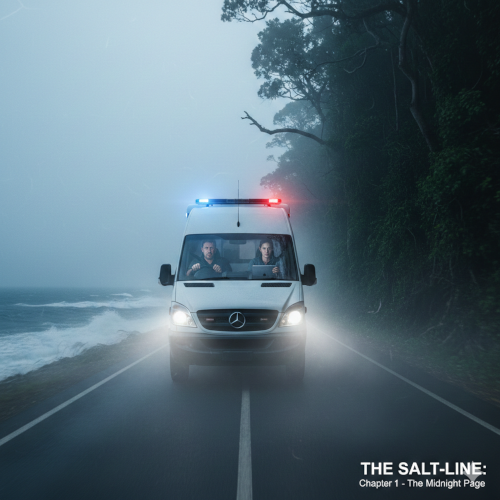
The pagers at the Port Douglas outpost didn’t just beep; they screamed into the humid silence of 2:00 AM.
Finn was awake before his brain had fully processed the sound. It was a reflex honed by three years of service in the Far North—a state of “hyper-readiness” where you could dress, lace your boots, and be in the driver’s seat of the Mercedes Sprinter while still technically dreaming.
His partner, Maya, was already in the passenger seat, her face ghostly in the blue light of the Toughbook. “G’day, sunshine,” she muttered, though there was no humor in it. “We’ve got a Code 1. Possible snakebite at a cattle station near the Daintree crossing. The caller was panicked, said it was a ‘brown,’ but you know how reliable midnight sightings are.”
Finn pulled the ambulance out onto the Captain Cook Highway. To their left, the Coral Sea was a vast, invisible expanse of obsidian, punctuated only by the white foam of waves crashing against the rocks of Rex Lookout. To their right, the ancient rainforest pressed against the bitumen, a wall of emerald shadows that seemed to be trying to reclaim the road.
“Daintree crossing?” Finn asked, his hands tightening on the wheel. “The ferry isn’t running at this hour, and the back-track is a wash-out after last week’s storm.”
“Dispatch knows,” Maya replied, her fingers flying over the keyboard. “They’re trying to raise a local SES boat, but the wind is picking up. If we can’t get across the river, we’re looking at a three-hour detour through the ranges. And if it really is a Taipan or an Eastern Brown, that kid hasn’t got three hours.”
The ambulance hit a patch of low-lying fog, the high-beams bouncing back off the white wall like a physical barrier. In the remote stretches of Queensland, the line between life and death wasn’t just a medical one; it was a geographical one. They were racing against a clock that was being held back by mud, tide, and the sheer indifference of the wild.
Comprehension Questions: Chapter 1
- Diction and Mood: How does the author’s choice of words like “screamed,” “obsidian,” and “obsessed” contribute to the mood of the opening chapter?
- Setting as an Obstacle: Identify two geographical or environmental obstacles mentioned in the text. How do these elements heighten the stakes of the mission?
- Characterization: Compare Finn’s “reflexive” readiness with Maya’s “ghostly” focus. What do their initial interactions reveal about their professional relationship?
- Literary Techniques: Analyze the personification of the rainforest as something “trying to reclaim the road.” What does this suggest about the relationship between civilization and nature in this setting?
- Critical Literacy: The text mentions that “the line between life and death wasn’t just a medical one; it was a geographical one.” Explain the significance of this statement in the context of rural Australian healthcare.
Story 4: The Salt-Line
Chapter 2: The River’s Teeth
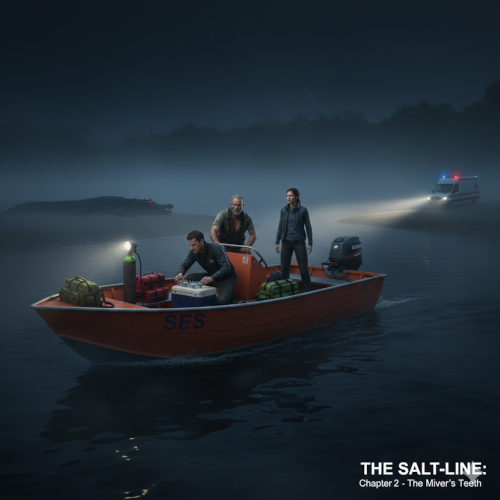
The Daintree River at 3:00 AM was a silver-black ribbon of tension. When the ambulance pulled into the ferry terminal, the gates were locked, and the massive steel cable that guided the ferry across the water hung limp, disappearing into the swirling mist.
“SES is ten minutes out with the punt,” Maya said, her voice tight. She was already out of the vehicle, hauling the primary response kit and the monitor toward the jetty. “The patient is an eight-year-old boy. Name’s Toby. His dad applied a pressure immobilization bandage, but he’s reporting ‘bulbar symptoms’—slurred speech, difficulty swallowing.”
Finn grabbed the oxygen cylinder and the suction unit. “Bulbar symptoms? That’s not a brown snake. That’s neurotoxic. Could be a Tai-pan or even a Death Adder if they’re near the scrub.”
A low, guttural thrumming vibrated through the air. A small, orange SES boat cut through the fog, its spotlight dancing erratically over the water. As it pulled alongside the jetty, the pilot—a local named Gaz whose face was a map of sun-damage—shouted over the engine.
“River’s high, Finn! Plenty of ‘logs’ moving tonight, so keep your eyes peeled!”
In the Daintree, ‘logs’ was a euphemism for saltwater crocodiles.
They scrambled onto the small craft, the ambulance left behind like a stranded whale on the shore. The boat was cramped, and every time it crested a swell, the equipment shifted dangerously. Finn knelt on the vibrating deck, checking the anti-venom vials in the portable cooler.
“We’re losing time, Gaz!” Maya urged, staring into the dark.
“I’m giving her all she’s got, Maya! But there’s a massive ‘salty’ sunning himself on the northern sandbar. I have to swing wide or he’ll take a run at the motor.”
Finn looked back at the receding shore. They were halfway across the river—the ‘Salt-Line’ that separated the tourist-friendly cafes of the south from the ancient, unforgiving wilderness of the north. In the middle of the dark water, the medical protocols he’d memorized felt fragile, like paper shields against a storm.
Comprehension Questions: Chapter 2
- Technical Vocabulary: Based on the context, what are “bulbar symptoms”? Why does this specific medical information change the urgency of the team’s response?
- Symbolism: Analyze the description of the ambulance as a “stranded whale.” What does this metaphor imply about the limitations of modern technology in the Australian bush?
- Local Context and Euphemism: Why does Gaz use the word “logs” to describe crocodiles? How does this colloquialism reflect the cultural attitude of people living in Far North Queensland?
- Atmosphere and Sensory Detail: How does the “guttural thrumming” and the “vibrating deck” affect the reader’s sense of the physical environment?
- Inference: Why is the river referred to as the “Salt-Line”? Beyond the literal presence of saltwater, what metaphorical “line” are the paramedics crossing?
Story 4: The Salt-Line
Chapter 3: The Shadow under the Verandah
The SES boat hit the northern bank with a jarring thud. Finn and Maya didn’t wait for Gaz to tie off; they leaped into the knee-deep mud, hoisting the heavy kits above their heads. Waiting for them was a mud-spattered LandCruiser, its engine idling roughly.
“Get in!” a man screamed from the driver’s seat. It was Toby’s father, Ben. His eyes were bloodshot, and his hands were shaking so violently he could barely grip the steering wheel.
The drive to the station was a bone-rattling five minutes through dense fan palms and ancient cycads. When they arrived at the homestead—a low-set timber house raised on stumps—the silence was terrifying. In the outback, silence usually meant the fighting had stopped.
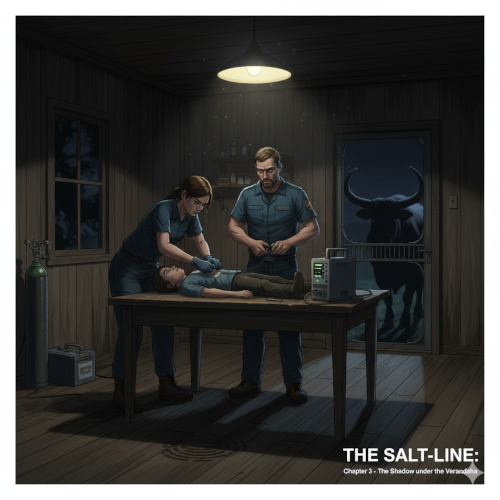
They found Toby on the kitchen table, underneath the flicker of a yellowing fluorescent light. A pressure immobilization bandage (PIB) was wrapped tightly around his left leg.
“He’s stopped talking,” Ben choked out. “He was complaining about a headache, then his eyelids just… dropped.”
Maya moved with clinical precision. “Finn, get him on the monitor. I’m checking the airway.” She leaned over the boy. “Toby? Can you hear me, mate? Give my hand a squeeze.”
Toby’s eyes were half-closed—a classic sign of ptosis, or drooping eyelids, caused by neurotoxic venom. He didn’t squeeze her hand.
“Heart rate is 140, oxygen sats are dipping to 88%,” Finn reported, his voice calm despite the adrenaline surging through him. “We need to ventilate. The venom is paralyzing his diaphragm.”
As Finn reached for the bag-valve-mask, a heavy thud echoed from the verandah outside. Something large was moving in the shadows just beyond the screen door. Ben froze, his eyes darting toward the darkness. “That’s the scrub-bull. He’s been agitated all night. Must have smelled the snake.”
“Ignore it,” Maya snapped, her focus entirely on Toby’s chest rise. “Finn, I can’t get a good seal. His jaw is clinching. We need to intubate, or we lose him right here on the table.”
Outside, the scrub-bull let out a low, vibrating roar that shook the floorboards. The isolation of the station felt absolute; they were three people in a tiny circle of light, surrounded by a world that was actively trying to force its way in.
Comprehension Questions: Chapter 3
- Medical Analysis: Why is the fact that Toby’s “eyelids dropped” a critical clinical sign? What does this tell the paramedics about the type of venom in his system?
- Characterization: Contrast Ben’s emotional state with the professional demeanor of Finn and Maya. How does the author use Ben to highlight the difficulty of being a first responder in one’s own family?
- Atmospheric Tension: How does the presence of the “scrub-bull” outside the house function as a secondary conflict? What does it represent in the context of the Australian landscape?
- Vocabulary: Define “ptosis” and “intubate” based on their usage in the chapter.
- Critical Literacy: Maya tells Finn to “ignore it” (the bull). Discuss the “tunnel vision” required in emergency medicine. Is it a strength or a potential danger in a remote setting?
Story 4: The Salt-Line
Chapter 4: The Fragile Weight
The intubation was successful, but the victory felt hollow. Toby was now entirely dependent on Finn’s hand, rhythmically squeezing the blue bag-valve-mask to breathe for him. The kitchen, once a place of family meals, had been transformed into a cold, makeshift ICU.
“We have to move. Now,” Maya commanded. “The neurotoxins are hitting his cardiac system. If he arrests here, we don’t have the backup to bring him back.”
Ben helped them slide Toby—tabletop and all—into the back of the LandCruiser. The drive back to the river was a nightmare of physics. Finn braced himself against the interior frame, one hand steadying Toby’s head and the other maintaining the life-giving rhythm of the breaths. Every bump in the track threatened to dislodge the tube in Toby’s throat.
When they reached the bank, the wind had whipped the Daintree into a frenzy of white-capped chop. Gaz was struggling to keep the SES punt steady against the muddy landing.
“The tide’s turned!” Gaz yelled over the gale. “The current is ripping through the channel. It’s going to be a rough ride back!”
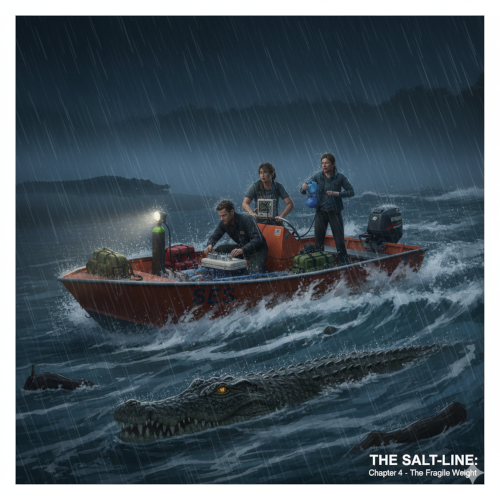
As they loaded Toby onto the boat, the spotlight caught a pair of glowing amber orbs reflecting just ten meters away. The ‘salty’ Gaz had mentioned earlier hadn’t moved; it had closed the distance, a silent prehistoric sentinel watching the frantic movements of the humans.
“Don’t look at it, Ben! Just help me with the stretcher!” Finn shouted.
They pushed off. The small boat felt impossibly fragile as it hit the main current. Rain began to fall—not a drizzle, but a tropical deluge that blinded Gaz and soaked the paramedics. Maya hovered over the monitor, shielding the screen with her body.
“Blood pressure is bottoming out!” she cried. “I’m starting a saline bolus, but I can’t see the vein in this light!”
Suddenly, the boat lurched violently. The propeller had struck a submerged branch—one of the ‘logs’ Gaz had warned them about. The engine coughed, sputtered, and died. In the sudden, terrifying silence, the only sound was the clicking of the ventilator bag and the rushing water pulling them downstream, away from the ferry terminal and toward the open sea.
Comprehension Questions: Chapter 4
- Structure and Pacing: How does the author transition from the “static” tension of the kitchen to the “dynamic” tension of the boat? What linguistic choices accelerate the pace?
- Imagery: Analyze the description of the crocodile as a “prehistoric sentinel.” What does this suggest about the power dynamic between the humans and the environment?
- Conflict: Identify the “Man vs. Nature” and “Man vs. Technology” conflicts in this chapter. Which one feels more threatening at this point in the story?
- Vocabulary in Context: What is a “saline bolus”? Why is Maya struggling to perform this procedure?
- Thematic Analysis: The chapter ends with the “clicking of the ventilator bag” as the only sound. Why is this specific sound significant in the context of the surrounding chaos?
Here is the final chapter of The Salt-Line.
Story 4: The Salt-Line
Chapter 5: The Far Shore
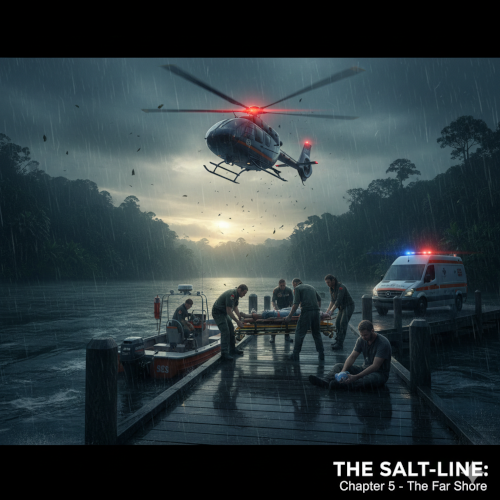
The silence of the dead engine was louder than the storm. For a heartbeat, the team was at the mercy of the Daintree. The current swirled the punt toward the tangled mangroves of the northern bank—the “croc-run.”
“Gaz! Get it started!” Maya yelled, her voice raw. She was leaned over Toby, her knees bruised from the boat’s lurching, her thumb pressed firmly against the boy’s femoral artery to check his fading pulse.
Gaz was a blur of motion, his calloused hands ripping at the starter cord. Pull. Crack. Silence. Pull. Crack. Silence.
Finn didn’t look up. He couldn’t. His entire universe had shrunk to the size of the blue bag in his hands. Squeeze. Release. Squeeze. Release. He was Toby’s lungs; if he stopped for even ten seconds to help with the engine, the boy’s brain would begin to starve.
“I’ve got a rhythm!” Maya shouted over the rain. “But he’s bradying down—his heart rate is dropping, Finn. Thirty beats per minute. Twenty.”
“Come on, Toby,” Finn whispered, the words lost to the wind. “Stay with me, mate.”
On the fourth pull, the motor sputtered, coughed a cloud of blue smoke, and roared to life. Gaz didn’t hesitate. He swung the tiller hard, the propeller screaming as it bit into the water, narrowly missing a submerged stump. They surged toward the south bank, where the lights of a second ambulance and a LifeFlight helicopter began to pierce the fog like twin suns.
They hit the jetty with enough force to throw Ben against the gunwale. Within seconds, a flight medic was on the boat. The transition was a chaotic symphony of professional handovers: “Intubated at 03:45… Neurotoxic symptoms… PIB intact… One bolus of saline.”
As the helicopter’s rotors began to thrum, creating a localized hurricane on the riverbank, the flight medic gave Finn a brief, firm nod. It was the only “thank you” he needed. The chopper lifted, its red and blue lights fading into the grey dawn sky.
Finn sat down on the wet timber of the jetty, his hands finally beginning to shake. His palms were cramped in the shape of the ventilator bag. Beside him, Maya slumped against a pylon, wiping a mixture of rain and river mud from her forehead.
The “Salt-Line” was still there, the river flowing out to sea as it had for millions of years. The wilderness hadn’t been defeated; it had simply allowed them a passage this time.
“Coffee?” Maya asked, her voice trembling slightly.
Finn looked at his hands, then at the sunrise bleeding gold across the horizon. “Yeah,” he said. “Coffee sounds like a start.”
Comprehension Questions: Chapter 5
- Symbolism of the Hands: Why does the author emphasize that Finn’s hands are “cramped in the shape of the ventilator bag”? What does this symbolize about the nature of his work?
- Theme of Nature’s Power: Re-read the line: “The wilderness hadn’t been defeated; it had simply allowed them a passage this time.” How does this reflect the Australian Gothic theme of nature’s indifference to humans?
- Technical Vocabulary: What does “bradying down” mean in a clinical sense? How does this term add to the tension of the scene?
- Characterization: Why is the “brief, firm nod” from the flight medic described as the only “thank you” Finn needed? What does this suggest about the culture of first responders?
- Resolution: How does the “sunrise” at the end of the story provide a contrast to the “midnight page” at the beginning? What does this change in light suggest about the story’s outcome?
この物語は、危険で孤立した田舎の医療現場に焦点を当てています。12年生にとって、これは**口語表現**、**医療用語**、そしてオーストラリアのゴシックや地方リアリズムのジャンルに典型的な**人間対自然**の対立を分析する絶好の機会となります。
—
## 第4話:塩の線
**テーマ:** *孤立、注意義務、そしてオーストラリアの風景の予測不可能性。*
### 第1章:真夜中の呼び出し音
ポートダグラスの分遣隊の呼び出し音は単なるビープ音ではありませんでした。午前2時の湿った静寂に響き渡るほどでした。
フィンは脳がその音を完全に処理する前に目を覚ましました。それは極北での3年間の勤務で磨かれた反射神経だった。服を着て、靴紐を結び、メルセデス・スプリンターの運転席に座りながら、まだ夢を見ているような「超即応態勢」の状態だった。
彼のパートナーであるマヤはすでに助手席に座っており、タフブックの青い光に顔を曇らせていた。「こんにちは、お日様」と彼女は呟いたが、そこにはユーモアはなかった。「コード1です。デインツリー交差点近くの牧場でヘビに噛まれた可能性があります。通報者はパニックになって『茶色』だと言っていましたが、真夜中の目撃情報はどれほど信頼できるかご存知でしょう。」
フィンは救急車をキャプテン・クック・ハイウェイに出した。彼らの左手には、珊瑚海が広大で目に見えない黒曜石の海が広がり、レックス展望台の岩に打ち寄せる白い波の泡だけが点在していた。彼らの右手には、太古の熱帯雨林がアスファルトに押し寄せ、エメラルドグリーンの影の壁が道路を取り戻そうとしているかのようだった。
「デインツリー川の渡し場か?」フィンはハンドルに力を込めながら尋ねた。「この時間だとフェリーは運休だし、帰り道は先週の嵐で流されてしまってるんだ。」
「通信指令室が把握しているわ」マヤはキーボードの上を指でなぞりながら答えた。「地元のSESボートを救出しようとしているんだけど、風が強くなってきているの。川を渡れなければ、山脈を迂回して3時間かかることになるわ。もし本当にタイパンかイースタンブラウンだったら、あの子には3時間も持たないわ。」
救急車は低い霧の中に突入した。ハイビームの光が白い壁に反射し、まるで物理的な障壁のようだった。クイーンズランドの奥地では、生死の境は単なる医療上のものではなかった。それは地理的な問題だった。彼らは泥、潮、そして野生の無関心によって遅れをとる時間との競争を繰り広げていた。
—
### 読解問題:第1章
1. **言葉遣いと雰囲気:** 「叫んだ」「黒曜石の」「取り憑かれた」といった著者の言葉選びは、冒頭の章の雰囲気にどのように影響していますか?
2. **障害物としての設定:** 本文中に言及されている地理的または環境的な障害物を2つ挙げなさい。これらの要素は、どのように任務の重要性を高めていますか?
3. **人物描写:** フィンの「反射的な」準備態勢とマヤの「幽霊のような」集中力を比較しなさい。彼らの最初のやり取りは、彼らの職業的な関係について何を明らかにしていますか?
4. **文学的技法:** 熱帯雨林が「道を取り戻そうとしている」ものとして擬人化されていることを分析しなさい。これは、この設定における文明と自然の関係について何を示唆していますか?
5. **批判的リテラシー:** 本書には「生と死の境界線は医学的なものではなく、地理的なものでもあった」と記されています。この記述がオーストラリアの農村部の医療という文脈においてどのような意味を持つのかを説明してください。
—
## ストーリー4:塩の線
**第2章:川の牙**
午前3時のデインツリー川は、緊張感に満ちた銀黒の帯のようだった。救急車がフェリーターミナルに到着すると、水門は施錠され、フェリーを水面を渡らせていた巨大な鋼鉄ケーブルは垂れ下がり、渦巻く霧の中に消えていった。
「SESはパントボートで10分ほど先です」とマヤは声を張り上げながら言った。彼女はすでに車から降り、一次対応キットとモニターを桟橋へと運んでいた。「患者は8歳の男の子です。名前はトビーです。父親が圧迫固定用の包帯をしましたが、『球麻痺症状』、つまりろれつが回らない、嚥下困難などの症状を訴えています」
フィンは酸素ボンベと吸引器を掴んだ。 「球状症状?それはブラウンスネークじゃない。神経毒だ。藪の近くにいるなら、タイパンかデスアダーかもしれない」
低く、喉を鳴らすような音が空気を震わせた。オレンジ色の小型SESボートが霧を切り裂き、スポットライトが水面を不規則に揺らめいていた。桟橋に着岸すると、パイロット――ガズという名の地元出身で、顔は日焼けで焼けただれたような顔立ち――がエンジン越しに叫んだ。
「フィン、川の水位が高いぞ!今夜は『丸太』がたくさん動いているから、気をつけろ!」
デインツリーでは、『丸太』はイリエワニの婉曲表現だった。
彼らは小型ボートに飛び乗り、救急車は岸に取り残されたクジラのように取り残された。ボートは狭苦しく、波の頂点に達するたびに装備が危険なほど動いた。フィンは振動するデッキにひざまずき、携帯用クーラーボックスの中の抗毒素のバイアルを確認した。
「時間がもったいないわ、ガズ!」暗闇を見つめながら、マヤが促した。
「全力を尽くしているわ、マヤ!でも、北の砂州で巨大な『ソルティ』が日光浴をしているの。大きく舵を切らないと、モーターに突っ込んできちゃうわ。」
フィンは後退する岸辺を振り返った。彼らは川の真ん中を渡りきっていた。そこは、観光客向けのカフェが並ぶ南部と、太古の荒涼とした北部の荒野を隔てる「ソルト・ライン」だった。暗い水の真ん中で、暗記した医療プロトコルは、嵐から身を守る紙の盾のように脆く感じられた。
—
### 読解問題:第2章
1. **専門用語:** 文脈から判断して、「球状症状」とは何を指すか?なぜこの特定の医療情報は、チームの対応の緊急性を変化させるのでしょうか?
2. **象徴性:** 救急車を「座礁したクジラ」と表現している点を分析してください。この比喩は、オーストラリアの森林地帯における現代技術の限界について何を示唆しているのでしょうか?
3. **地域的文脈と婉曲表現:** ガズはなぜワニを「丸太」と表現しているのでしょうか?この口語表現は、クイーンズランド州北部に住む人々の文化的態度をどのように反映しているのでしょうか?
4. **雰囲気と感覚的詳細:** 「喉を鳴らすような音」と「揺れる甲板」は、読者の物理的環境に対する感覚にどのような影響を与えているのでしょうか?
5. **推論:** なぜこの川は「塩の線」と呼ばれているのでしょうか?文字通りの塩水の存在を超えて、救急隊員たちはどのような比喩的な「線」を越えているのでしょうか?
—
## ストーリー4:塩の線
**第3章:ベランダの下の影**
SESボートが北岸に激しい衝撃音を立てて衝突した。フィンとマヤはガズが係留するのを待たずに、膝まで浸かった泥の中に飛び込み、重い装備を頭上に持ち上げた。二人を待っていたのは、泥だらけのランドクルーザーで、エンジンはアイドリングをしていた。
「乗れ!」運転席から男が叫んだ。トビーの父親、ベンだった。目は充血し、手は震え、ハンドルを握るのがやっとだった。
駅までのドライブは、密集した扇状のヤシと古びたソテツの茂みを抜け、骨が震えるような5分間だった。切り株の上に建てられた低い木造家屋である農場に到着すると、その静寂は恐ろしいほどだった。奥地では、静寂はたいてい戦闘が終わったことを意味するのだ。
黄ばんだ蛍光灯のちらつきの下、キッチンのテーブルでトビーを見つけた。左足には圧迫固定包帯(PIB)がきつく巻かれていた。
「もう話さなくなった」ベンは息を詰まらせながら言った。「頭痛を訴えていたのに、まぶたが…下がってしまったんだ」
マヤは医師のような正確な動きをした。「フィン、モニターをつけて。気道を調べている」彼女はトビーに寄りかかった。「トビー?聞こえるか?手を握って」
トビーの目は半分閉じていた。神経毒によって引き起こされる眼瞼下垂、つまりまぶたが垂れ下がる典型的な症状だ。彼は彼女の手を握らなかった。
「心拍数は140、酸素飽和度は88%まで下がっている」とフィンは報告した。アドレナリンが体内に溢れ出しているにもかかわらず、彼の声は落ち着いていた。「人工呼吸器が必要だ。毒で横隔膜が麻痺している」
フィンがバッグバルブマスクに手を伸ばした瞬間、ベランダの外から重々しい音が響いた。網戸のすぐ向こうの影の中で、何か大きなものが動いていた。ベンは凍りつき、暗闇へと視線を走らせた。「あれはスクラブブルだ。一晩中興奮していた。ヘビの匂いを嗅いだに違いない。」
「気にしないで」マヤはトビーの胸の隆起に完全に集中しながら、きっぱりと言った。「フィン、うまく呼吸ができない。顎がガクガクしている。挿管しないと、ここで彼を失ってしまうわ。」
外では、スクラブブルが低く震えるような咆哮が床板を揺らした。ステーションの孤独は絶対的なものだった。彼らは小さな光の輪の中にいる3人であり、その周囲には、積極的に侵入しようとする世界が渦巻いていた。
—
### 読解問題:第3章
1. **医学的分析:** トビーの「まぶたが下がった」という事実は、なぜ重要な臨床的兆候なのでしょうか?これは、救急隊員に彼の体内の毒の種類について何を教えてくれるのでしょうか?
2. **人物描写:** ベンの感情状態と、フィンとマヤのプロフェッショナルな態度を対比させてください。著者は、ベンを通して、家族の中で救急隊員となることの難しさをどのように強調しているのでしょうか?
3. **雰囲気の緊張:** 家の外にいる「雑草野郎」の存在は、どのように二次的な葛藤として機能しているのでしょうか?オーストラリアの風景という文脈において、それは何を表しているのでしょうか?
4. **語彙:** この章で使われている「眼瞼下垂(ptosis)」と「挿管(intubate)」の意味を定義してください。
5. **批判的リテラシー:** マヤはフィンに「(雄牛の)ことを無視して」と言います。救急医療に必要な「トンネルビジョン」について議論してください。それは僻地において強みとなるのでしょうか、それとも潜在的な危険となるのでしょうか?
—
## ストーリー4:塩の線
**第4章:脆い重み**
挿管は成功したが、勝利は虚しく感じられた。トビーは今や、彼の呼吸を助けるために青いバッグバルブマスクをリズミカルに握るフィンの手に完全に頼っていた。かつて家族が食事をする場所だったキッチンは、冷たく間に合わせのICUと化していた。
「今すぐ移動しなければ」とマヤは命じた。「神経毒がトビーの心臓系に作用している。ここで心停止したら、彼を蘇生させるバックアップがない。」
ベンはトビーをテーブルトップごとランドクルーザーの後部座席に滑り込ませるのを手伝った。川に戻るドライブは、まるで物理的な悪夢のようだった。フィンは車内のフレームに体を押し付け、片手でトビーの頭を支え、もう片方の手で命をつなぐ呼吸のリズムを保っていた。道のあらゆる凹凸が、トビーの喉のチューブを外す危険をはらんでいた。
岸に着くと、風がデインツリー川を激しく波立たせ、白波が立っていた。ガズは泥だらけの着岸場でSESのパントを安定させようと必死だった。
「潮が変わった!」ガズは強風に負けまいと叫んだ。「流れが水路を突き破っている。帰りは大変なことになるぞ!」
トビーをボートに乗せると、スポットライトがわずか10メートル先に琥珀色に輝く二つの球体を捉えた。ガズが先ほど言った「塩辛い」物体は動かなかった。距離を縮め、人間の慌ただしい動きを見守る、沈黙を守る先史時代の番兵のようだった。
「見ないで、ベン!担架を運ぶのを手伝ってくれ!」フィンが叫んだ。
彼らは漕ぎ出した。主流にぶつかった小さなボートは、信じられないほど脆く感じられた。雨が降り始めた。霧雨ではなく、熱帯特有の豪雨で、ガズの目はくらみ、救急隊員たちはびしょ濡れになった。マヤはモニターの上に覆いかぶさり、体で画面を覆った。
「血圧が最低ラインに達している!」と彼女は叫んだ。「生理食塩水のボーラス注入を始めるけど、この光では静脈が見えない!」
突然、ボートが激しく揺れた。プロペラが水中の枝にぶつかったのだ。ガズが警告していた「丸太」の一つだ。エンジンは咳き込み、ガタガタと音を立て、停止した。突然の恐ろしい静寂の中、聞こえるのは人工呼吸器のバッグがカチカチと音を立てる音と、彼らをフェリーターミナルから沖へと下流へと引きずり込む激しい水音だけだった。
—
### 読解問題:第4章
1. **構成とペース:** 作者は、キッチンの「静的」な緊張感から、ボートの「動的」な緊張感へとどのように移行させているのでしょうか?どのような言葉遣いが、物語のペースを加速させているのでしょうか?
2. **イメージ:** ワニを「先史時代の番人」と表現している箇所を分析してください。これは、人間と環境の間の力関係について何を示唆しているのでしょうか?
3. **対立:** この章における「人間 vs. 自然」と「人間 vs. テクノロジー」の対立を特定してください。物語のこの時点では、どちらがより脅威に感じられますか?
4. **文脈における語彙:** 「生理食塩水ボーラス」とは何でしょうか?なぜマヤはこの処置を行うのに苦労しているのでしょうか?
5. **テーマ分析:** この章は、「人工呼吸器バッグのカチッという音」という唯一の音で終わります。周囲の混沌とした状況の中で、なぜこの特定の音が重要なのでしょうか?
—
**ソルト・ライン** の最終章です。
—
## 第4話:ソルト・ライン
**第5章:遥かな岸**
エンジンが止まった静寂は、嵐よりも大きかった。一瞬、一行はデインツリー川のなすがままだった。潮流はパントを北岸のマングローブが絡み合う「クロコダイル・ラン」へと渦巻かせた。
「ガズ!エンジンをかけろ!」マヤはかすれた声で叫んだ。彼女はトビーに覆いかぶさり、船の揺れで膝に傷を負いながら、弱まる脈を確かめようと親指をトビーの大腿動脈にしっかりと押し当てていた。
ガズは動きが鈍く、タコのついた手でスターターコードを引っ張っていた。*引く。ガッシュ。静寂。* *引く。ガッシュ。静寂。*
フィンは顔を上げなかった。できなかった。彼の宇宙全体が、両手の青い袋の大きさに縮んでしまった。*ぎゅっと。放す。ぎゅっと。放す。* 彼はトビーの肺だった。エンジンを手伝うために10秒でも止まれば、少年の脳は飢え始めるだろう。
「リズムは取れたわ!」マヤは雨音にかき消されて叫んだ。「でも、だんだんペースが落ちてきてるわ。フィン、心拍数が下がってるの。1分間に30回。20回。」
「さあ、トビー」フィンはささやいたが、言葉は風にかき消された。「一緒にいてよ、相棒。」
4回目の引きで、エンジンはガタガタと音を立て、青い煙を吐き出し、轟音を立てて始動した。ガズはためらわなかった。舵を強く振ると、プロペラが悲鳴を上げながら水面に食い込み、水中の切り株を間一髪でかわした。南岸へと急ぎ足で進むと、2台目の救急車とライフフライト・ヘリコプターのライトが、まるで双子の太陽のように霧を突き破り始めた。
彼らは突堤に激突し、ベンを舷側に投げ飛ばした。数秒後、航空救命士がボートに乗り込んだ。その引き継ぎは、専門家による混沌としたシンフォニーのようだった。「3時45分に挿管…神経毒性症状…PIB(呼吸困難)は正常…生理食塩水1回投与」
ヘリコプターのローターが唸りを上げ始め、川岸に局地的な嵐のような嵐が巻き起こると、航空救命士はフィンに短く、しかし力強く頷いた。それはフィンにとって唯一必要な「ありがとう」だった。ヘリが離陸し、赤と青のライトが灰色の夜明けの空に消えていった。
フィンは桟橋の濡れた木材に腰を下ろした。ついに手が震え始めた。手のひらは人工呼吸器のバッグの形に引きつっていた。彼の隣で、マヤは鉄塔に寄りかかり、額についた雨と川の泥の混ざった汗を拭っていた。
「塩の線」は今もそこにあり、川は何百万年もの間そうであったように海へと流れ出ていた。荒野は打ち負かされたわけではなく、今回はただ彼らに道を譲っただけだった。
「コーヒー?」マヤはかすかに震える声で尋ねた。
フィンは自分の手を見て、それから地平線に金色に染まる日の出を見た。「ああ」と彼は言った。「コーヒーはいい始まりになりそうだ。」
—
### 読解問題:第5章
1. **手の象徴性:** 作者はなぜフィンの手が「人工呼吸器の袋の形に窮屈になっている」ことを強調しているのだろうか?これは彼の仕事の性質について何を象徴しているのだろうか?
2. **自然の力というテーマ:** 「荒野は打ち負かされたのではなく、今回はただ彼らに道を譲っただけだった」という一節をもう一度読んでみてください。これは、人間に対する自然の無関心というオーストラリア・ゴシックのテーマをどのように反映しているでしょうか?
3. **専門用語:** 「bradying down(ブラディ・ダウン)」とは、臨床的な意味ではどういう意味でしょうか?この言葉は、どのようにこの場面の緊張感を高めているでしょうか?
4. **人物描写:** フィンが必要とした唯一の「ありがとう」は、なぜ航空衛生兵の「短く、しっかりとしたうなずき」だったのでしょうか?これは、救急隊員の文化について何を示唆しているでしょうか?
5. **解決:** 物語の終わりの「日の出」は、冒頭の「真夜中のページ」とどのように対照的になっているでしょうか?この光の変化は、物語の結末について何を示唆しているでしょうか?
—
**これで第4話は終わりです!あと1話残っています。第5話の第1章を始めますか?ジムピーのゴールドラッシュに関する歴史小説や、クイーンズランド州の沿岸の町でアスリートが回復していく様子を描いた現代的な物語を探究することもできます。**