📚 Story 2: The Copper Compass
Chapter 1: The Attic Discovery
Story Text
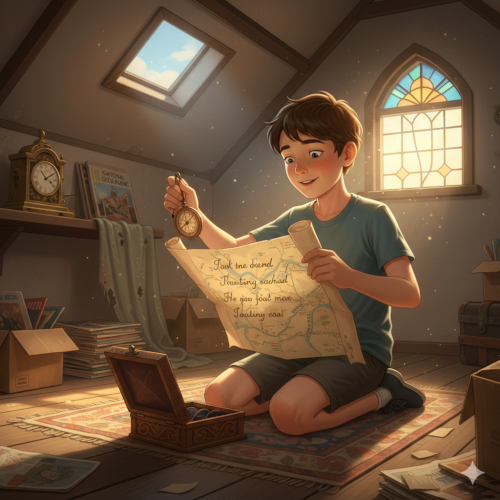
Liam considered the attic his personal museum of forgotten things. It wasn’t the dusty, spider-web-filled space most people imagined. This one, in his family’s old Queenslander house in Ipswich, was airy, thanks to the high ceilings and a tiny stained-glass window. He was supposed to be sorting through old boxes for the upcoming garage sale, but the task was far less interesting than the gilded cage of a broken bird clock and a stack of National Geographic magazines from the 1980s.
Tucked away in the corner, behind a stack of moth-eaten curtains, was a small, wooden box the size of a paperback novel. It wasn’t locked, but the lid was sealed shut with decades of humidity and paint. Liam carefully worked a thin kitchen knife under the edge. With a splintering sigh, the box opened, releasing a scent of old parchment and cinnamon.
Inside, nestled on faded velvet, was a tarnished copper compass. It was beautiful, but the needle was fixed, pointing permanently to the south-east. Beside it lay a thick, rolled-up sheet of paper. Liam carefully unrolled it. It was a faded map, not of a country, but of his own neighbourhood. He recognised the winding path of the Bremer River and the shape of the old railway line. But overlaid on the map, written in spidery, elegant script, were five lines of verse:
Where the first settlers made their mark,
By the sandstone shadow, after dark.
The Queen’s gaze upon the highest peak,
Five paces east, the answer you seek.
From the Copper Compass, the true path speaks.
Liam felt a familiar thrill—the kind he usually only got when his favourite rugby team scored the winning try. This wasn’t junk for a garage sale; it was an invitation.
Comprehension Questions
- Setting and Tone: Describe the atmosphere of Liam’s attic. How does the description (e.g., “airy,” “stained-glass window”) contrast with the typical image of an attic, and what does this suggest about the house?
- Figurative Language: What is the meaning of the metaphor, gilded cage, as used to describe the broken bird clock?
- Inference: Based on the objects Liam finds (old maps, compass, coded message), what kind of activity or mystery do you predict the story will revolve around?
- Vocabulary: The script is described as “spidery, elegant.” What does “spidery” mean in this context when describing handwriting?
- Analysis of Text Structure: The verse is broken into five rhyming lines. What function does this format have, other than being aesthetically pleasing, in a text like this?
Chapter 2: Sandstone and Shadows
Story Text
The first line of the verse was the easiest: Where the first settlers made their mark. Liam immediately thought of the Ipswich Heritage Centre, housed in one of the city’s oldest sandstone buildings. He knew the site held numerous plaques and memorials dedicated to the area’s earliest pioneers.
He waited impatiently until the late afternoon. His friend, Maya, who was a walking encyclopedia of local history, met him outside the Heritage Centre’s main gates.
“You really think this old copper lump is part of a treasure hunt?” Maya asked, turning the fixed compass in her hand.
“It has to be,” Liam insisted, pointing to the map. “And look at the second line: By the sandstone shadow, after dark. That points right here.”
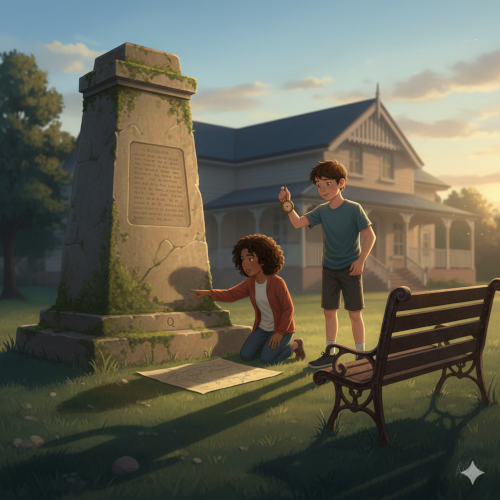
The sun was sinking fast, casting long, distorted shadows across the wide lawn. They found a large sandstone monument dedicated to the city’s founding mayor. The light was fading quickly, and a chilly wind picked up.
“Okay, the shadow’s long. But which shadow?” Maya knelt and ran her hand over the inscription on the plaque. “Wait. The light is hitting this corner perfectly.” She pointed to the plaque’s base. Etched into the stone, almost invisible beneath lichen, was a tiny, faded letter ‘Q’.
“That’s it!” Liam exclaimed. “The next line: The Queen’s gaze upon the highest peak—this Q marks the highest spot on the stone. The Queen is watching over the town, maybe?”
The challenge was applying the penultimate line: Five paces east, the answer you seek. Liam placed the copper compass on the ground, aligning the fixed needle (which pointed south-east) with the longest shadow cast by the monument. He then turned his back to the shadow’s base and paced five careful steps east. He stopped in front of an ancient iron bench, half-buried in the dirt.
Comprehension Questions
- Problem Solving: Explain Liam and Maya’s reasoning for choosing the Ipswich Heritage Centre as the location for the first clue.
- Characterisation: What is Maya’s key strength, and how does she demonstrate it in this chapter to help solve the mystery?
- Analysis: The line By the sandstone shadow, after dark suggests a specific time of day is required. Why is this time significant for locating the clue?
- Connecting Clues: How did the line, The Queen’s gaze upon the highest peak, help them narrow down their search on the sandstone monument?
- Setting: The text uses the word lichen to describe the base of the plaque. What is lichen, and what does its presence suggest about the plaque and the location?
Chapter 3: The Iron Box
Story Text
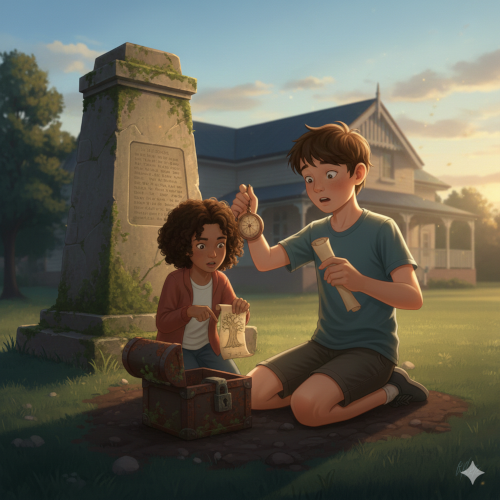
Kneeling before the iron bench, Liam felt along the rusted metal frame. He found a slight looseness in the wooden seat slats nearest the ground. He and Maya wrestled the old bench aside. Where it had stood, the dirt was dark and compressed. Liam dug his fingers into the soft earth. After only a few moments, his fingers hit something hard.
They unearthed a small, heavily-rusted iron box, roughly the same size as the compass box. A padlock, thick with oxidised green grime, secured the lid. Disappointment washed over Liam.
“Great. A clue that’s locked,” Maya sighed, dusting the dirt off her hands.
Liam remembered the last line of the verse: From the Copper Compass, the true path speaks. The compass itself! He examined the copper casing again. The back plate, which looked permanently soldered, felt slightly loose. He pressed on the spot where the fixed needle was pointing (south-east), and with a quiet hiss of displaced air, a tiny cylinder slid out of the side of the compass casing.
It was not a key, but a perfectly rolled, oil-stained parchment. Unfurling it under the fading light, they found a single drawing. It was a simple, yet detailed sketch of a particular tree—a giant fig tree with a distinctive split trunk, located in the town’s oldest park. Beneath the sketch were two numbers, faintly written: 7-12.
“The address isn’t the park, is it?” Liam wondered, puzzled by the numbers. “Maybe it’s a date? July 12th?”
Maya shook her head, tracing the split trunk with her finger. “Look at the park map. That fig tree is number 7 on the historical walking trail. And 12… I bet that’s the number of paces you need to take from the north-facing fork.”
They reburied the iron box, determined to return with tools later, and headed towards the park, the scent of earth and old secrets heavy on the air.
Comprehension Questions
- Frustration and Resolution: What initial obstacle does the iron box present to Liam and Maya? How do they eventually overcome this obstacle?
- Detail/Function: Why do you think the compass’s secret compartment contained a parchment rather than a key to the iron box?
- Interpretation: Explain Liam and Maya’s hypothesis about what the numbers 7-12 represent, referencing details from the text.
- Sensory Detail: The text mentions the scent of “earth and old secrets.” What does this sensory detail contribute to the mood of the chapter?
- Prediction: The oil-stained drawing points them to a specific tree. What kind of secret or information do you think they will find there?
Chapter 4: The Split Trunk
Story Text
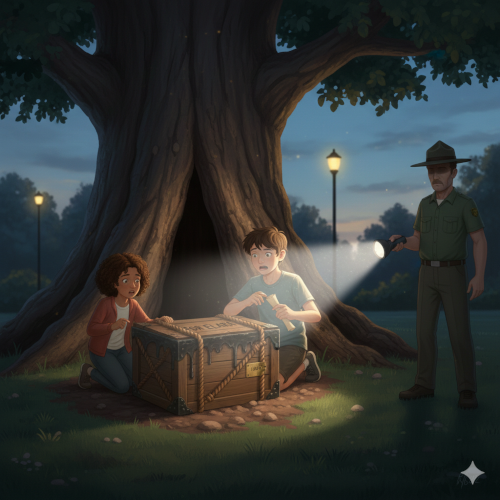
The old park was quiet, lit only by the distant yellow glow of streetlights. The enormous fig tree stood like a silent sentinel, its roots sprawling across the manicured lawn. The split in its trunk was exactly as depicted in the sketch.
“This tree has seen a lot of Ipswich history,” Maya whispered, running her hand over the rough bark. “It’s definitely Tree number 7 on the trail map.”
Following Maya’s direction, they walked to the northern face of the tree, where the trunk split into two immense columns. Liam used his phone’s compass app to confirm direction. He started from the base of the split and walked twelve careful paces straight ahead. He stopped right beside a worn, circular indentation in the grass, as if something heavy had rested there for a long time.
They began to dig, using a small gardening trowel Liam had brought from home. The digging was tough, complicated by thick roots and damp soil. After ten minutes, the trowel scraped against wood. They worked together, carefully clearing the dirt until they uncovered a heavy, wooden crate. Unlike the rusted iron box, this crate was solid, bound with thick rope and sealed with tar.
On the lid, written in charcoal, were the words: FOR ELARA.
“Elara?” Liam frowned. “That’s the name of the girl who owns my house now, isn’t it? Her family bought it four years ago.”
“No, that’s your sister’s middle name,” Maya corrected, pulling a thick piece of twine away from the crate. “And Elara is a historical name. It means ‘bright, shining one.’ Look.” She pointed to a small, brass plate nailed to the side of the crate. Etched beneath the name ‘ELARA’ was a date: 1965. “This is from the keeper who wrote the logbook in the other story you told me about! It must be the family from the lighthouse!”
Suddenly, a flashlight beam cut through the darkness. A tall, uniformed park ranger emerged from the shadows. “Hold it right there,” the ranger called out, his voice sharp. “What exactly are you doing digging up public property?”
Comprehension Questions
- Setting and Mood: How does the description of the fig tree as a “silent sentinel” contribute to the mood of discovery and history in this chapter?
- Procedural Steps: List the three steps Liam and Maya took to correctly locate the final hiding spot (starting with the tree).
- Plot Twist: What does the name FOR ELARA suggest about the intended recipient of the hidden crate, and how does this complicate Liam’s initial treasure hunt idea?
- Connecting Threads (External Knowledge): The crate is dated 1965. Why is this specific date significant, referencing information learned in Story 1 (The Lighthouse Keeper’s Secret)?
- Suspense: The chapter ends with the arrival of the park ranger. What kind of conflict is introduced by this interruption, and how does it create suspense?
Chapter 5: The Heirloom
Story Text
“We weren’t doing any harm!” Liam stammered, holding up the tiny trowel. “It’s a historical discovery!”
The ranger, an older man with a skeptical expression, pointed to the large hole. “Historical discovery, or vandalism? You’ll have to come with me.”
Maya intervened smoothly. “Sir, we were following instructions left by a former resident of 12 Railway Parade. See this?” She held up the copper compass. “It’s an heirloom. We believe this box contains documents relating to his family’s move from the coast to Ipswich in the 1960s. We know the family name.”
The ranger squinted at the compass, then at the label: FOR ELARA. He paused, rubbing his chin. “Elara… I remember that name. The old Silas family. They were the ones who donated that big clock to the town hall. Fine people.” His demeanour softened slightly. “Alright. But you’re not opening that here. You need to prove ownership. We’ll take the box to the council office now, and you can bring your parents in the morning.”
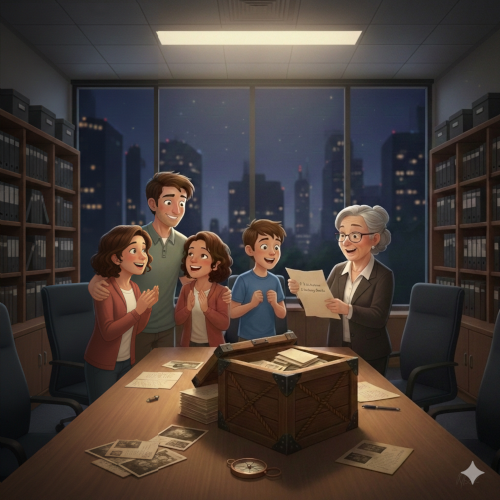
Back at Liam’s house, Liam and Maya stood with his parents in the brightly lit council office, staring at the crate. A council archivist gently prized open the tar-sealed lid.
Inside, there was no gold, no jewels, only stacks of letters, photographs, and, lying on top, a folded piece of paper. It was a will, dated 1964. It bequeathed the copper compass and the Ipswich property at 12 Railway Parade to “my dear nephew, Silas, and his wife, Elara.”
The archivist smiled. “It seems this compass was a key to a completely different kind of treasure: a home. The family didn’t need the compass after they moved, so they left it in the attic, waiting for the next generation to find it.”
Liam stared at the property address. “12 Railway Parade… that’s our house.”
Maya laughed. “The compass didn’t point to gold, Liam. It pointed to home. And you found your house’s history instead.” Liam looked at the copper compass, no longer seeing a faulty instrument, but a beautiful piece of his home’s long and secret history.
Comprehension Questions
- Conflict Resolution: How does Maya’s quick thinking help diffuse the conflict with the park ranger? What key pieces of information does she use to support her claim?
- Analysis of Reveal: What was the true “treasure” hidden in the wooden crate, and what did it explain about Liam’s house?
- Connecting Themes: Explain the significance of the final line: “The compass didn’t point to gold, Liam. It pointed to home.” How does this idea connect the history of the Silas family with Liam’s present life?
- Linking Stories: How does the mention of the “Silas family” and the date 1965 serve to link this story, The Copper Compass, with the previous story, The Lighthouse Keeper’s Secret?
- Character Development: How has Liam’s understanding of “treasure” changed from the beginning of Chapter 1, when he first discovered the box, to the end of Chapter 5?
****************************************************************************
2つ目の物語は、オーストラリアの7年生(QLD)向けに構成されています。この物語「銅の羅針盤」は、クイーンズランド州の地方史と宝探しを絡めた郊外の歴史ミステリーへと焦点を移します。
📚 物語2:銅の羅針盤
第1章:屋根裏部屋の発見
物語本文
リアムは屋根裏部屋を、忘れられたものを集めた自分だけの博物館だと考えていました。そこは、多くの人が想像するような、埃っぽくて蜘蛛の巣だらけの空間ではありませんでした。イプスウィッチにある彼の家族の古いクイーンズランド様式の家にあるこの屋根裏部屋は、高い天井と小さなステンドグラスの窓のおかげで風通しが良かったです。彼は間近に迫ったガレージセールのために古い箱を整理するはずでしたが、壊れた鳥の時計と1980年代のナショナルジオグラフィック誌の山が入った金色の檻の方がずっと面白みに満ちていました。
隅の隅、虫食いのカーテンの山の後ろに、ペーパーバックの小説ほどの大きさの小さな木箱が隠されていました。鍵はかかっていなかったが、蓋は何十年もの湿気と塗料でしっかりと閉まっていた。リアムは薄い包丁を慎重に箱の縁に差し込んだ。かすかなため息とともに箱が開き、古い羊皮紙とシナモンの香りが漂ってきた。
中には、色あせたベルベットの上に置かれた、くすんだ銅製のコンパスが入っていた。美しいものだったが、針は固定されており、常に南東を指していた。その横には、分厚い丸められた紙が置いてあった。リアムはそれを慎重に広げた。それは色あせた地図だった。国の地図ではなく、彼の近所の地図だった。ブレマー川の曲がりくねった流れと、古い鉄道線路の形が彼には分かった。しかし、その地図の上には、蜘蛛の巣のように美しい筆致で、五行の詩が重ねて書かれていた。
最初の入植者たちが足跡を残した場所、日暮れの砂岩の影に。女王の視線が最高峰を見つめ、東五歩の所に、あなたが求める答えがある。銅の羅針盤から、真の道が語られる。
リアムは、いつもの興奮を覚えた。贔屓のラグビーチームが決勝トライを決めた時にだけ感じるあの興奮だ。これはガレージセールのガラクタではなく、招待状だった。
読解問題
1. 設定と雰囲気:リアムの屋根裏部屋の雰囲気を説明しなさい。その描写(例えば「風通しが良い」「ステンドグラスの窓」)は、屋根裏部屋の典型的なイメージとどのように対照的ですか?そして、それはこの家について何を示唆していますか?
2. 比喩表現:壊れた鳥の時計を表す際に使われている「金色の檻」という比喩は、どのような意味ですか?
3. 推論:リアムが見つけた物(古地図、コンパス、暗号文)に基づいて、物語はどのような活動や謎を中心に展開すると予想しますか?
4. 語彙:この筆跡は「蜘蛛の巣のような、優雅な」と表現されています。この文脈における「蜘蛛の巣のような」とは、筆跡を説明する際にどのような意味を持ちますか?
5. テキスト構造の分析:この詩は5つの押韻行に分かれています。このようなテキストにおいて、この形式は美的感覚以外にどのような機能を持っていますか?
第2章:砂岩と影
物語本文
詩の最初の行は最も分かりやすかった。「最初の開拓者たちが足跡を残した場所」。リアムはすぐにイプスウィッチ・ヘリテージ・センターを思い浮かべた。市内で最も古い砂岩の建物の一つにある。彼はそこに、この地域の初期の開拓者たちに捧げられた数多くの銘板や記念碑があることを知っていた。
彼は夕方遅くまで待ちわびた。地元の歴史に精通した、まさに百科事典のような友人マヤが、ヘリテージ・センターの正門の外で彼を迎えた。
「この古い銅の塊が宝探しの一部だと本当に思ってるの?」マヤは、手に持った固定されたコンパスを回しながら尋ねた。
「きっとそうだ」とリアムは地図を指差しながら主張した。「そして2行目を見てみろ。『暗くなってから、砂岩の影のそば』。あれはまさにここを指している」
太陽は急速に沈み、広い芝生に長く歪んだ影を落としていた。彼らは、この街の初代市長に捧げられた大きな砂岩の記念碑を見つけた。日が急速に暮れ、冷たい風が吹き始めた。
「わかった、影は長い。でも、どの影?」マヤはひざまずき、銘板の碑文に手を滑らせた。「待って。この角に光が完璧に当たっているわ。」彼女は銘板の土台を指差した。地衣類に覆われてほとんど見えない石に、小さく色褪せた「Q」の文字が刻まれていた。
「それだ!」リアムは叫んだ。「次の行は『女王が最高峰を見据えている』。このQが石の最高点を示している。女王は街を見守っているのだろうか?」
問題は、最後から2番目の行を当てはめることだ。「東に5歩、これが君の求める答えだ」。リアムは銅製のコンパスを地面に置き、固定された針(南東を指している)を記念碑の最も長い影に合わせようとした。それから彼は影の根元に背を向け、東へ5歩慎重に歩いた。そして、土に半分埋もれた古い鉄のベンチの前で立ち止まった。
理解度チェック問題
1. 問題解決:リアムとマヤが最初の手がかりの場所としてイプスウィッチ・ヘリテージ・センターを選んだ理由を説明しなさい。
2.人物描写:マヤの最大の強みは何ですか?そして、この章で彼女はどのようにそれを示し、謎を解く助けとなるでしょうか?
3.分析:「砂岩の影のそば、日が暮れてから」という行は、特定の時間帯が必要であることを示唆しています。なぜこの時間帯が手がかりを見つける上で重要なのでしょうか?
4.手がかりをつなぐ:「女王が最高峰を見つめている」という行は、どのようにして砂岩の記念碑の捜索範囲を絞り込むのに役立ったのでしょうか?
5.設定:本文では、銘板の根元を表すのに「地衣類」という言葉が使われています。地衣類とは何ですか?そして、地衣類の存在は、銘板とその場所について何を示唆していますか?
第三章:鉄の箱
本文
鉄のベンチの前にひざまずき、リアムは錆びた金属のフレームを触ってみた。地面に近い部分の木製の座面板にわずかな緩みがあることに気づいた。彼とマヤは古いベンチを力ずくで脇に押しやった。ベンチが置かれていた場所は、土が黒く固まっていた。リアムは柔らかい土に指を突っ込んだ。ほんの数瞬後、彼の指は何か硬いものに触れた。
二人は、コンパスの箱とほぼ同じ大きさの、ひどく錆びた小さな鉄の箱を掘り出した。蓋は、酸化した緑色の汚れで厚く覆われた南京錠で施錠されていた。リアムは落胆した。
「よかった。鍵のかかった手がかりね」マヤはため息をつき、手の汚れを払い落とした。
リアムは詩の最後の行を思い出した。「銅のコンパスから、真の道が語られる。コンパスそのものよ!」彼は銅のケースをもう一度調べた。はんだ付けされているように見える裏板は、わずかに緩んでいるように感じた。彼は固定された針が指している場所(南東)を押すと、空気が押しのけられる静かなシューという音とともに、コンパスのケースの側面から小さな円筒が滑り出した。
それは鍵ではなく、完璧に巻かれた、油で染み込んだ羊皮紙だった。薄れゆく光の下でそれを広げると、一枚の絵が見つかった。それは、ある木――町で最も古い公園にある、特徴的な二股の幹を持つ巨大なイチジクの木――の、シンプルながらも詳細なスケッチだった。スケッチの下には、かすかに二つの数字が書かれていた。「7-12」。
「住所って公園じゃないよね?」リアムは数字に戸惑い、思った。「もしかして日付? 7月12日?」
マヤは首を振り、二股の幹を指でなぞった。 「公園の地図を見てください。あのイチジクの木は歴史遊歩道の7番です。そして12…北向きの分岐から何歩進む必要があるのでしょう。」
彼らは鉄の箱を再び埋め、後で道具を持って戻ってくることを決意し、公園へと向かった。土と古き秘密の匂いが空気中に漂っていた。
理解度チェック問題
1.挫折と解決:鉄の箱はリアムとマヤにとって当初どのような障害となるのでしょうか?彼らは最終的にどのようにこの障害を乗り越えるのでしょうか?
2.詳細/機能:コンパスの秘密の箱に、鉄の箱の鍵ではなく羊皮紙が入っていたのはなぜだと思いますか?
3.解釈:リアムとマヤが7から12までの数字が何を表しているのか、本文の詳細を参照しながら説明してください。
4.感覚的詳細:本文には「土と古き秘密」の匂いについて言及されています。この感覚的詳細は、この章の雰囲気にどのように影響していますか?
5.予想:油彩の絵は特定の木を指し示しています。そこで彼らはどんな秘密や情報を見つけると思いますか?
第4章:割れた幹
本文
古びた公園は静まり返り、遠くの街灯の黄色い光だけが灯っていた。巨大なイチジクの木は、手入れの行き届いた芝生に根を張り巡らせ、物言わぬ番人のように立っていた。幹の割れ目は、スケッチに描かれた通りだった。
「この木はイプスウィッチの歴史をずっと見てきたのね」とマヤはざらざらした樹皮に手を滑らせながら囁いた。「トレイルマップの7番の木に間違いないわ」
マヤの指示に従い、二人は木の北側、幹が巨大な二本の柱に分かれている場所まで歩いた。リアムはスマホのコンパスアプリで方向を確認した。割れ目の根元から12歩ほど慎重にまっすぐ進んだ。草に刻まれた、まるで何か重いものが長い間そこにあったかのような、すり減った円形の窪みのすぐそばで立ち止まった。
二人はリアムが家から持ってきた小さな園芸用移植ごてを使って掘り始めた。太い根と湿った土が重なり、掘削作業は困難を極めた。10分後、スコップが木にこすれた。二人は力を合わせ、慎重に土をかきわけ、重い木箱を掘り出した。錆びた鉄の箱とは違い、この木箱は頑丈で、太いロープで縛られ、タールで封印されていた。
蓋には木炭で「エララへ」と書かれていた。
「エララ?」リアムは眉をひそめた。「今、私の家の持ち主の女の子の名前だろ?彼女の家族が4年前に買ったんだ。」
「違うわ、それはあなたの妹さんのミドルネームよ」とマヤは訂正し、木箱から太い紐を引っ張った。「エララは歴史的な名前なの。『明るく輝く者』という意味よ。見て。」彼女は木箱の側面に釘付けされた小さな真鍮のプレートを指差した。 「ELARA」という名前の下には、1965年という日付が刻まれていた。「これは、以前あなたが話してくれた話で航海日誌を書いた灯台守からの手紙です!きっと灯台の家族でしょう!」
突然、懐中電灯の光が暗闇を切り裂いた。背が高く、制服を着た公園管理人が影から現れた。「そのままでいてください」と、管理人は鋭い声で叫んだ。「一体何をして公共の物を掘り返しているのですか?」
理解度チェック問題
1.設定と雰囲気:イチジクの木が「沈黙の番人」と表現されていることは、この章における発見と歴史の雰囲気にどのように貢献していますか?
2.手順:リアムとマヤが最後の隠し場所を正しく見つけるために取った3つの手順を列挙してください(まず木から)。
3.どんでん返し:隠された木箱の受取人について、「ELARA」という名前は何を示唆していますか?そして、これはリアムの当初の宝探しの計画をどのように複雑化させますか?
4.繋がり(外部知識):木箱には1965年の日付が記されています。ストーリー1(灯台守の秘密)で得た情報と関連して、この特定の日付がなぜ重要なのでしょうか?
5.サスペンス:この章は公園管理官の到着で終わります。この中断によってどのような葛藤が生じ、どのようにサスペンスが生まれるのでしょうか?
第5章:家宝
ストーリーテキスト
「何も悪いことはしてないぞ!」リアムは小さなこてを掲げながら、どもりながら言った。「これは歴史的発見だ!」
懐疑的な表情の年配のレンジャーは、大きな穴を指差した。「歴史的発見か、それとも破壊行為か? 一緒に来てくれないか。」
マヤがさりげなく口を挟んだ。「ご主人様、私たちはレイルウェイ・パレード12番地の元住人が残した指示に従っていたんです。これ、見えますか?」彼女は銅製のコンパスを掲げた。「これは家宝です。この箱には、1960年代に彼の家族が海岸からイプスウィッチに移住した際の書類が入っていると思われます。家名は分かっています。」
レンジャーは目を細めてコンパスを見つめ、それから「エララ宛」というラベルを見た。彼は顎をこすりながら言葉を止めた。 「エララ…その名前、覚えてるよ。サイラス家の旧家だ。あの大きな時計を市役所に寄贈した人たちだ。立派な人たちだ」彼の態度が少し和らいだ。「わかった。でも、ここで開けるんじゃないぞ。所有権を証明しないといけない。今、箱を市役所に持っていくから、明日の朝、両親を連れてきていいぞ」
リアムの家に戻ると、リアムとマヤは両親と一緒に、明るく照らされた市役所の事務所に立ち、木箱を見つめていた。市役所の公文書管理官が、タールで封印された蓋をそっとこじ開けた。
中には金も宝石もなく、手紙と写真の束、そしてその上に折りたたまれた紙切れが一枚置いてあった。それは1964年の日付が記された遺言状だった。銅製の羅針盤とイプスウィッチのレイルウェイ・パレード12番地の土地を「私の愛する甥のサイラスと妻のエララ」に遺贈するという内容だった。
公文書管理官は微笑んだ。 「どうやらこのコンパスは全く別の宝物、つまり家への鍵だったようです。一家は引っ越した後、コンパスは不要になったので、屋根裏に置き、次の世代が見つけるのを待っていました。」
リアムは家の住所をじっと見つめた。「レイルウェイ・パレード12番地…あれが私たちの家よ。」
マヤは笑った。「コンパスは金を指していたのじゃあないよ、リアム。家を指していたのよ。そして、あなたは自分の家の歴史を見つけたのよ。」リアムは銅製のコンパスを見つめた。もはや壊れた道具ではなく、家の長く秘密めいた歴史の美しい一片を見ていた。
理解度チェック問題
1.対立解決:マヤの機転は、どのように公園管理人との対立を鎮めるのに役立ったか?彼女は自分の主張を裏付けるために、どのような重要な情報を使ったか?
2.「暴露」の分析:木箱に隠された真の「宝物」は何だったか?そして、それはリアムの家について何を説明していたか?
3.テーマの繋がり:最後のセリフ「リアム、コンパスは金を指していたのではない。家を指していたのだ」の意味を説明してください。この考えは、サイラス家の歴史とリアムの現在の生活をどのように結びつけているでしょうか?
4.物語の繋がり:「サイラス家」という表現と1965年という日付は、この物語『銅のコンパス』と前作『灯台守の秘密』をどのように結びつけているでしょうか?
5.登場人物の発展:リアムが箱を発見した第1章の冒頭から第5章の終わりまでの間に、彼の「宝物」に対する理解はどのように変化したでしょうか?