You’re very welcome! We’ve reached our final destination. This story uses Magical Realism, a genre where supernatural or “magical” elements are treated as a mundane part of a realistic environment. In Year 11 English, this is often used to explore deeper psychological or cultural truths.
Story 5: Liminal Spaces
Chapter 1: The Boundary Fence
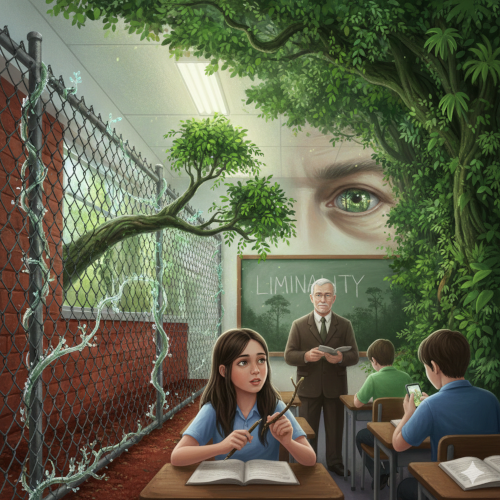
St. Brigid’s High was a cluster of brick buildings perched on the very edge of the Great Dividing Range. To the east lay the town of Maleny—orderly, caffeinated, and mapped. To the west, the land dropped away into a valley of ancient rainforest so dense it seemed to swallow the sunlight.
The boundary was marked by a rusted chain-link fence, but lately, the fence hadn’t been behaving.
“It’s moving again,” Elara whispered, pointing toward the Year 11 locker block.
Her friend, Sam, didn’t look up from his phone. “It’s just the heat haze, El. Fences don’t move.”
But Elara saw it clearly. The silver wire of the fence was vibrating, not from the wind, but with a pulse. Where the metal met the red earth, small, translucent vines—looking like they were woven from glass and moonlight—were beginning to wrap around the posts. They weren’t just growing; they were pulling the school closer to the canopy.
In English class, Mr. Henderson was lecturing on the concept of liminality—the state of being “in-between.”
“A threshold,” he said, tapping the chalkboard. “A place where the rules of one world end and the rules of another begin.”
As he spoke, a stray branch of stinging tree pushed through the classroom window. It didn’t break the glass; it simply filtered through it, as if the window were made of water. The leaves were a vibrant, impossible green, and they hummed with the sound of a thousand cicadas.
The rest of the class didn’t seem to notice. They continued highlighting their textbooks, their faces pale in the fluorescent light. But Elara felt a breeze that smelled of damp moss and eons-old decay. She looked at her desk. Her ballpoint pen was turning into a twig.
“Mr. Henderson?” Elara’s voice was small.
The teacher paused, his hand hovering over the chalk. For a split second, his eyes reflected not the classroom, but a vast, untamed wilderness. “Yes, Elara? Are you finding the boundary… distracting?”
Chapter 1: Comprehension & Analysis Questions
1. Literal: Where is St. Brigid’s High located, and what is the physical boundary between the school and the valley?
2. Inferential: What does the fact that “the rest of the class didn’t seem to notice” suggest about the nature of the magic in this story? Who can see it, and why?
3. Evaluative: How does the author use the setting of Maleny (orderly, caffeinated) vs. the valley (ancient, swallowing sunlight) to establish the two “worlds” of the story?
4. Aesthetic Features: The stinging tree branch filters through the window “as if the window were made of water.” How does this simile reinforce the theme of liminality?
5. Prediction: Mr. Henderson asks if Elara finds the boundary “distracting.” Does he know more about the encroaching rainforest than he is letting on?
Story 5: Liminal Spaces
Chapter 2: The Hallway of Echoes
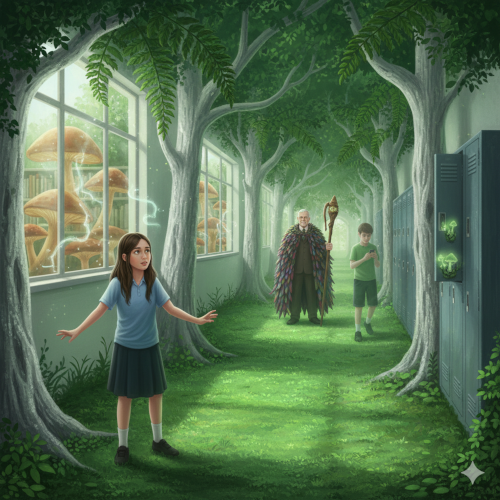
When the bell rang for the end of the period, it didn’t sound like a digital beep. It sounded like the deep, resonant strike of a wooden mallet against a hollow log.
As Elara stepped out into the main corridor, the linoleum floor felt soft, almost spongy, beneath her shoes. Looking down, she saw that the white tiles were being overwritten by a layer of thick, emerald-colored moss. The lockers, once cold and grey, were now covered in a fine, silver bark.
“Sam, look,” Elara said, grabbing his sleeve.
Sam frowned, stumbling slightly. “Whoa, the floor is… uneven. Maintenance really needs to look at these foundations.” He was looking right at the moss, but his brain seemed to be translating it back into “cracked tiles” and “poor construction.”
They passed the library, where the bookshelves were no longer holding paper volumes. Instead, the shelves were filled with glowing fungi that pulsed with a soft, rhythmic light. Each fungus emitted a faint whisper—the collective voices of every story ever told, drifting through the air like spores.
“Do you hear that?” Elara asked, pausing by the library doors.
“Hear what? The air-con?” Sam adjusted his backpack. “Come on, we’re going to be late for Math. Old Man Miller gives detentions if you’re ten seconds over.”
But the way to the Math wing was gone. In its place was a tunnel of interlacing ghost gums, their white trunks smooth and cold as marble. The ceiling of the hallway had vanished, replaced by a canopy of ferns that filtered the sunlight into a hazy, underwater green.
At the end of the tunnel stood Mr. Henderson. He wasn’t wearing his tweed jacket anymore; he was draped in a cloak made of lyrebird feathers. He held a wooden staff that looked suspiciously like Elara’s missing ballpoint pen.
“The curriculum is changing, Elara,” he said, his voice echoing as if they were in a vast cavern. “We’re moving away from the ‘known’ and into the ‘unpredictable.’ Are you coming, or are you staying with the tiles?”
Sam walked right past Mr. Henderson, complaining about a “draft in the hallway,” and disappeared into the green gloom toward a Math room that Elara could no longer see.
Chapter 2: Comprehension & Analysis Questions
1. Literal: What does the school bell sound like in this chapter, and what has happened to the library books?
2. Inferential: Sam interprets the magical changes as “cracked tiles” and “air-con.” What does this tell us about the difference between Sam’s perspective and Elara’s? Why is Sam unable to see the reality of the rainforest?
3. Evaluative: Mr. Henderson says the curriculum is shifting from the “known” to the “unpredictable.” How does this function as a metaphor for the transition from adolescence to adulthood?
4. Aesthetic Features: The author describes the hallway floor as “spongy” and the ceiling as a “canopy of ferns.” How does this sensory shift affect the mood of the story?
5. Prediction: Elara is standing at a literal and figurative crossroads. If she follows Mr. Henderson, what do you think she will have to leave behind?
Story 5: Liminal Spaces
Chapter 3: The Heart of the Canopy
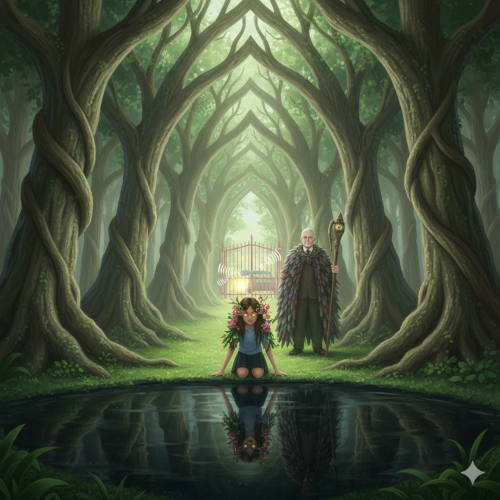
Elara stood at the threshold where the linoleum ended and the mulch began. She looked back at Sam’s retreating figure—he was a ghost of the old world, a flickering image of a boy worried about a math test that no longer existed. Then, she stepped into the tunnel of ghost gums.
The air didn’t just change; it deepened. It felt ancient, heavy with the moisture of a thousand years of rainfall. As she walked, the sounds of the school—the slamming of lockers, the distant chatter—faded into a symphony of clicks, whistles, and the low, tectonic groan of growing timber.
Mr. Henderson led her to what used to be the school assembly hall. Now, it was a cathedral of strangler figs. The massive roots twisted upward like the pillars of a Gothic church, meeting high above in a ceiling of woven leaves.
In the center of the hall, where the Principal usually gave speeches about “Academic Rigor,” sat a pool of black water, perfectly still.
“Every student who comes to the boundary eventually reaches the pool,” Mr. Henderson said, his feathered cloak rustling. “Most turn back. They decide that the math test is safer than the reflection.”
“What’s in the water?” Elara asked, her heart hammering against her ribs.
“The unwritten version of you,” he replied. “The version that doesn’t follow a syllabus. The version that knows that the fence isn’t there to keep the bush out, but to keep you in.”
Elara knelt by the pool. The surface didn’t show her face—at least, not the one she saw in the bathroom mirror every morning. The reflection showed her eyes as bright as fireflies, and her hair as a tangled nest of orchids. She saw herself not as a student, but as a part of the landscape, as vital as the rain or the red soil.
Suddenly, a loud, metallic clack echoed through the hall. It was the sound of a bolt sliding home.
“The Principal is locking the boundary gates,” Henderson whispered. “The sun is setting on the school year. If you stay here past the final bell, the path back to Maleny will vanish. You’ll be a part of the ‘unpredictable’ forever.”
Outside the canopy, Elara could hear the faint, muffled sound of her mother’s car horn in the pickup zone. Honk. Honk. A sound of the “known” world, calling her back to homework, dinner, and a predictable future.
Chapter 3: Comprehension & Analysis Questions
1. Literal: What has the school assembly hall transformed into, and what sits in the center of the room?
2. Inferential: What does Mr. Henderson mean when he says the fence is meant to “keep you in”? How does this change the meaning of the boundary?
3. Evaluative: The pool shows Elara an “unwritten version” of herself. How does this symbolize the fear and excitement of choosing one’s own identity outside of institutional structures?
4. Aesthetic Features: Contrast the auditory imagery of the “car horn” with the “tectonic groan of growing timber.” How do these sounds represent the two different lives Elara is choosing between?
5. Prediction: The “final bell” is about to ring. Do you think Elara will run toward the car horn or dive into the black water of the pool?
Story 5: Liminal Spaces
Chapter 4: The Dissolving Classroom
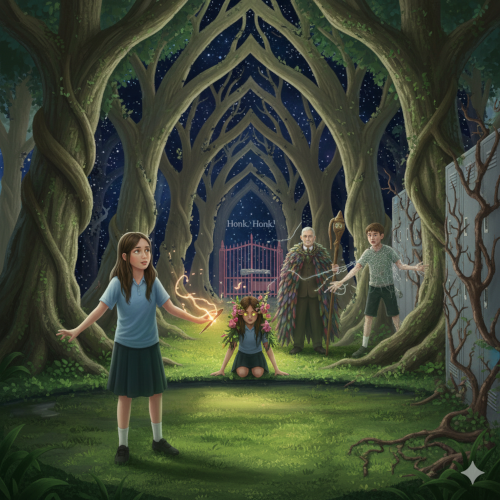
The car horn sounded again, but it was fainter now, as if it were being transmitted from the bottom of a deep well. Elara looked at the pool, then back toward the ghost gum tunnel. The “known” world was blurring. The edges of the hallway were fraying like old fabric, revealing glimpses of a vast, star-filled void where the school’s sports oval used to be.
“Elara! There you are!”
Sam burst through a screen of hanging vines. He looked exhausted and disoriented. To Elara’s eyes, he was covered in cobwebs and leaf litter, but he was frantically brushing at his sleeves as if trying to get rid of invisible dust.
“I’ve been looking everywhere,” Sam panted. “The power went out in the Math wing, and everyone just… disappeared. We have to get to the car park. My dad is waiting, and he’s already annoyed about the traffic.”
He reached out and grabbed Elara’s hand. His grip was a shock—it felt cold, artificial, and strangely thin, like a hand made of paper.
“Sam, look at the hall,” Elara pleaded, pointing to the strangler fig pillars. “Look at Mr. Henderson. He isn’t wearing a jacket, he’s wearing feathers.”
Sam looked directly at Mr. Henderson, but his eyes slid right over him. “There’s no one there, El. Just a bunch of shadows. You’re scaring me. It’s just the storm making the trees look weird. Come on!”
He started pulling her away from the pool, toward the sound of the car horn. As they moved, the rainforest began to retreat. The emerald moss shriveled into dry linoleum; the glowing fungi dimmed into dusty, empty bookshelves. The “predictable” world was reasserting itself, fueled by Sam’s absolute refusal to see anything else.
“Wait!” Elara cried, digging her heels into the floor. She felt the twig-pen in her pocket growing heavy again, pulsing with a warmth that Sam’s hand lacked.
She realized that if she followed Sam now, the boundary would seal forever. She would become like him—someone who saw a “draft” instead of a spirit, and “maintenance issues” instead of magic. She would be safe, but she would be empty.
“I’m not going,” she said, wrenching her hand free.
Sam stumbled back, his face a mask of confusion. “What do you mean? It’s just a school, Elara. It’s just a building. We have to go home!”
“I am home,” Elara whispered, looking at the pool of black water.
Chapter 4: Comprehension & Analysis Questions
1. Literal: How does Sam describe the “power outage” in the Math wing, and what is his primary concern?
2. Inferential: Why does Sam’s hand feel like “paper” to Elara? What does this tactile sensation symbolize about his connection to reality?
3. Evaluative: Sam’s refusal to see the magic actually causes the rainforest to retreat. What does this suggest about the power of “belief” or “perspective” in the world of Magical Realism?
4. Aesthetic Features: The author describes the school hallway “fraying like old fabric.” How does this metaphor describe the fragile nature of Elara’s two realities?
5. Prediction: Sam is heading for the car park, and Elara has stayed behind. What do you think will happen when the “final bell” actually rings?
Story 5: Liminal Spaces
Chapter 5: The Final Bell
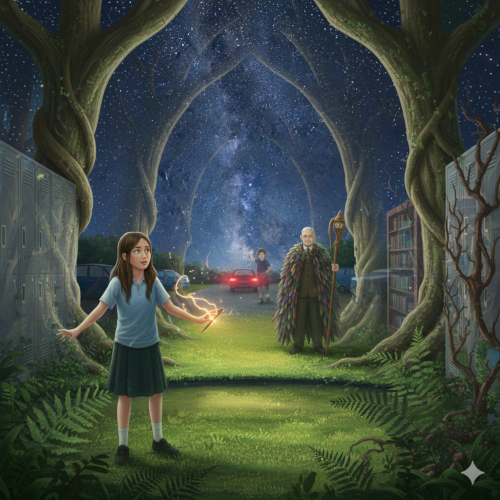
The final bell didn’t just ring; it resonated from the center of the earth. It was a sound that vibrated through Elara’s marrow, shaking the last remnants of the “known” world from her skin.
Sam vanished. Not because he had moved, but because the frequency he occupied—the frequency of math tests, car horns, and starched uniforms—had finally separated from the frequency of the ridge. The school building shuddered one last time and then dissolved like sugar in tea.
Elara stood alone in the heart of the cathedral of figs. The sky above was no longer hidden by a roof; it was a vast, glittering expanse of the Milky Way, unburdened by the glow of town lights.
Mr. Henderson stepped forward, his feather cloak shimmering in the starlight. He held out the wooden staff—her transformed pen. “The boundary is closed, Elara. The school has returned to the town, and the ridge has returned to itself.”
“And me?” Elara asked. Her voice sounded different now—clearer, with a slight melodic hum.
“You are the keeper of the threshold,” he said. “Every generation, the land chooses someone who can see both sides. You will live in Maleny, you will walk those linoleum floors, and you will speak the language of the ‘known.’ But you will carry the pulse of the ‘unpredictable’ in your blood. You will ensure the fence never stays too straight.”
He handed her the staff. As her fingers touched the wood, the rainforest didn’t disappear—it simply became translucent. She could see the ghostly outline of the school lockers superimposed over the ancient ferns. She saw the “real” world and the “magical” world occupying the exact same space, separated only by the thickness of a thought.
Elara walked forward, through the ghost-walls of the library and out onto the gravel of the pickup zone. Her mother’s car was there. Sam was already inside another car, waving at her, his face completely normal, his memory of the “tunnel” already fading into a weird dream he’d have trouble explaining.
Elara climbed into her mother’s car.
“Hard day?” her mother asked, shifting into gear.
“A bit liminal,” Elara said, smiling. She felt the weight of the twig in her pocket—still warm, still pulsing.
As they drove away, Elara looked in the rearview mirror. The school looked perfectly ordinary, a cluster of brick buildings on a hill. But just for a second, she saw the Great Dividing Range lean in and whisper to the wind, and the reflection in the mirror showed a girl with fireflies in her eyes, driving home to a world she would never see the same way again.
Chapter 5: Comprehension & Analysis Questions
1. Literal: What happens to the school building when the final bell rings?
2. Inferential: What does it mean to be a “keeper of the threshold”? Why is it important that Elara returns to the “known” world instead of staying in the forest forever?
3. Evaluative: The story ends with Elara seeing both worlds “occupying the exact same space.” How does this resolve the central conflict of the story?
4. Aesthetic Features: Analyze the metaphor “the school building… dissolved like sugar in tea.” Why is this an effective way to describe the end of Elara’s old reality?
5. Thematic Synthesis: Looking back at all five stories, how does Liminal Spaces tie together the theme of “Identity”? Is our identity defined by the “scripts” we are given, or by the “boundaries” we choose to cross?
Reflection on the Journey
We have finished all five stories! You’ve explored:
- Cyberpunk Brisbane (The Hollow Echo)
- Coming-of-Age Coastal (Salt on the Skin)
- Dystopian Outback Western (Red Earth, Silver Wire)
- 1950s Historical Fiction (The Script of Seasons)
- Modern Magical Realism (Liminal Spaces)
********************************************************************************************************************************************************
最終目的地に到着しました。この物語は**マジカルリアリズム**を用いています。これは、超自然的あるいは「魔法的」な要素が現実的な環境におけるありふれた一部として扱われるジャンルです。11年生の英語では、より深い心理的あるいは文化的真実を探求するために、この技法がよく用いられます。
—
## 物語5:限界空間
### 第1章:境界フェンス
セント・ブリジッド高校は、グレートディバイディング山脈のまさに端にそびえ立つレンガ造りの建物の集落でした。東にはマレニーの町が広がっていました。整然としていて、カフェインが充満し、地図が描かれているような町です。西側には、太陽の光を飲み込むかのように深い古代の熱帯雨林の谷へと、土地が深く落ち込んでいました。
境界は錆びた金網フェンスで区切られていましたが、最近、フェンスがおかしくなっていました。
「また動いているわ」エララは11年生のロッカールームを指さしながらささやきました。
友人のサムは携帯電話から顔を上げなかった。「エル、ただの陽炎だよ。フェンスなんて動かないよ」
しかし、エララにははっきりと見えていた。フェンスの銀色のワイヤーが風ではなく、脈打っていた。金属が赤い土と接する場所では、ガラスと月光で編まれたような、小さな半透明の蔓が柱に巻きつき始めていた。蔓はただ伸びているのではなく、学校を天蓋へと引き寄せているようだった。
英語の授業で、ヘンダーソン先生は*リミナリティ*の概念、つまり「中間」の状態について講義していた。
「境界だ」と先生は黒板を叩きながら言った。「一つの世界のルールが終わり、別の世界のルールが始まる場所だ」
先生が話している間、刺のある木の枝が教室の窓を突き破った。ガラスは割れなかった。まるで窓が水でできているかのように、ただ透過していった。葉は鮮やかで、あり得ないほどの緑色で、無数の蝉の羽音を立てていた。
クラスの他の生徒たちは気づいていないようだった。蛍光灯の光に青ざめた顔で、教科書に線を引き続けていた。しかし、エララは湿った苔と悠久の歳月を経た朽ち果てた物の匂いがするそよ風を感じた。彼女は机に目をやった。ボールペンが小枝に変わっていた。
「ヘンダーソン先生?」エララの声は小さく響いた。
先生はチョークの上に手を置いたまま、言葉を止めた。一瞬、彼の目に映ったのは教室ではなく、広大で手つかずの荒野だった。「はい、エララ?境界線が…邪魔に感じますか?」
—
### 第1章:読解と分析の質問
**1. 文字通り:** セント・ブリジッド高校はどこにありますか?そして、学校と谷間の物理的な境界線は何ですか?
**2.推論:**「クラスの他の生徒は気づかなかったようだ」という事実は、この物語における魔法の本質について何を示唆しているのでしょうか?誰が、そしてなぜそれを見ることができるのでしょうか?
**3. 評価:** 作者は、マレニー(整然としていて、カフェインで満たされている)と谷(古代の、太陽の光を飲み込む)という設定をどのように用いて、物語の二つの「世界」を確立しているのでしょうか?
**4. 美的特徴:** 刺すような木の枝が窓から漏れてくる様子は、「まるで窓が水でできているかのように」見えます。この比喩は、どのように*限界性*というテーマを強調しているのでしょうか?
**5. 予測:** ヘンダーソン先生は、エララが境界線を「邪魔」に感じているかどうか尋ねます。彼は、迫り来る熱帯雨林について、自分が言っている以上に多くのことを知っているのでしょうか?
—-
—-
## 第5話:境界空間
### 第2章:反響の廊下
授業終了のベルが鳴った時、それはデジタルのビープ音とは違っていた。まるで、木槌で中空の丸太を叩くような、深く響き渡る音だった。
エララがメインの廊下に足を踏み入れると、靴の裏でリノリウムの床が柔らかく、まるでスポンジのように柔らかく感じられた。下を見下ろすと、白いタイルがエメラルド色の厚い苔の層に覆われているのが見えた。かつて冷たく灰色だったロッカーは、今や上質な銀色の樹皮で覆われていた。
「サム、見て」エララはサムの袖を掴みながら言った。
サムは眉をひそめ、少しよろめいた。「うわ、床が…凸凹してる。この基礎はメンテナンスの人が見直さなきゃね。」彼は苔をじっと見つめていたが、脳はそれを「割れたタイル」や「粗末な建築」と解釈しているようだった。
彼らは図書館の前を通り過ぎた。書棚にはもはや紙の本はなかった。代わりに、柔らかくリズミカルな光を発する光る菌類が棚を埋め尽くしていた。それぞれの菌類がかすかなささやき声を発していた。それは、これまで語られてきたあらゆる物語の集合的な声であり、胞子のように空気中を漂っていた。
「聞こえる?」エララは図書館の扉の前で立ち止まり、尋ねた。
「何が聞こえるの?エアコン?」サムはバックパックの位置を直した。「さあ、数学の授業に遅れるぞ。ミラー爺さんは10秒でも遅れたら居残りだぞ。」
しかし、数学棟への道は消えていた。代わりに、絡み合うゴーストガムのトンネルが続いていた。白い幹は大理石のように滑らかで冷たかった。廊下の天井は消え去り、シダの天蓋が陽光を霞んだ水中のような緑色に落としていた。
トンネルの突き当たりにヘンダーソン先生が立っていた。ツイードのジャケットはもう着ておらず、コトドリの羽でできたマントを羽織っていた。手に持っていたのは、エララの失くしたボールペンによく似た木の杖だった。
「カリキュラムが変わるんだ、エララ」先生は言った。その声はまるで巨大な洞窟の中にいるかのように響き渡った。「『既知』から『予測不可能』へと移行していくんだ。君も来るか、それともタイルの向こうにいるか?」
サムはヘンダーソン先生の横を通り過ぎ、「廊下の隙間風」に文句を言いながら通り過ぎ、緑色の薄暗い中へと姿を消した。エララにはもう見えなかった数学教室へと。
—
### 第2章:読解と分析の問題
**1.文字通りの意味:** この章で、学校のベルはどのように鳴り、図書館の本はどうなりましたか?
**2. 推論的解釈:** サムは魔法の変化を「ひび割れたタイル」と「エアコン」と解釈しています。これは、サムとエララの視点の違いについて何を示唆しているでしょうか?なぜサムは熱帯雨林の現実を見ることができないのでしょうか?
**3. 評価的解釈:** ヘンダーソン先生は、カリキュラムが「既知」から「予測不可能」へと移行していると述べています。これは、青年期から成人期への移行のメタファーとしてどのように機能しているのでしょうか?
**4. 美的特徴:** 著者は廊下の床を「スポンジ状」、天井を「シダの天蓋」と表現しています。この感覚の変化は、物語の雰囲気にどのような影響を与えているのでしょうか?
**5. 予測的解釈:** エララは文字通りの意味と比喩的な意味での岐路に立っています。もし彼女がヘンダーソン氏に従うなら、何を残していくことになると思いますか?
—
## 第5話:境界空間
### 第3章:天蓋の奥
エララはリノリウムが終わり、マルチが始まる敷居に立っていた。彼女はサムの遠ざかる姿を振り返った――彼は古き世界の亡霊、もはや存在しない数学のテストに悩む少年の、ちらちらと光る影だった。そして、彼女はゴーストガムのトンネルへと足を踏み入れた。
空気はただ変わっただけでなく、深みを増した。千年分の雨の湿気で重く、太古の空気を感じた。彼女が歩いていくと、学校の物音――ロッカーをバタンと閉める音、遠くのおしゃべり――は、カチカチという音、口笛の音、そして成長する木々の低く地殻変動的なうなり声のシンフォニーへと消えていった。
ヘンダーソン先生は彼女をかつて学校の集会所だった場所へと案内した。今、そこは絞め殺しのイチジクの大聖堂と化していた。巨大な根はゴシック様式の教会の柱のように上向きに曲がり、高く伸びた葉を編んだ天井で交わっていた。
校長がいつも「学問の厳しさ」について演説するホールの中央には、黒い水たまりが静まり返っていた。
「境界まで来る生徒は皆、最終的にはこの水たまりに辿り着く」とヘンダーソン先生は羽根飾りのマントを擦りながら言った。「ほとんどの生徒は引き返してしまう。水面に映る水より数学のテストの方が安全だと判断するんだ」
「水の中には何が入っているの?」エララは心臓が肋骨に当たるほど激しく鼓動しながら尋ねた。
「暗黙のあなたの姿だ」と彼は答えた。「シラバスに従わないあなたの姿。柵は茂みを締め出すためではなく、あなた自身を閉じ込めるためにあると知っているあなたの姿だ」
エララは水たまりのそばにひざまずいた。水面に彼女の顔は映っていなかった――少なくとも、毎朝バスルームの鏡に映る彼女の顔は。鏡に映る彼女の瞳は蛍のように輝き、髪は蘭の絡み合った巣のようだった。彼女は自分を生徒としてではなく、雨や赤土のように生命力に満ちた風景の一部だと考えていた。
突然、大きな金属的な「カチッ」という音が廊下に響き渡った。それは、ボルトが締め上げられる音だった。
「校長先生が校門の門を閉めます」とヘンダーソンは囁いた。「学年は終わりに近づいています。終業の鐘が鳴ってもここにいたら、マレニーに戻る道は閉ざされてしまいます。あなたは永遠に『予測不能』な世界の一部になってしまうでしょう。」
天蓋の外では、エララは送迎エリアで母親の車のクラクションがかすかに、くぐもった音で鳴っているのが聞こえた。「クラクション。クラクション。」それは「既知の」世界の音で、宿題、夕食、そして予測可能な未来へと彼女を呼び戻すものだった。
—
### 第3章:理解と分析の質問
**1. 文字通り:** 学校の集会室はどのように変化し、部屋の中央には何がありますか?
**2. 推論:** ヘンダーソン先生がフェンスは「あなたを閉じ込める」ためのものだと言ったのはどういう意味ですか?これは境界線の意味をどのように変えますか?
**3. 評価:** プールはエララに「書かれていない自分」を見せています。これは、制度的な枠組みの外で自分自身のアイデンティティを選択することへの恐怖と興奮をどのように象徴していますか?
**4. 美的特徴:** 「車のクラクション」の聴覚的イメージと「成長する木々の地殻変動的なうめき声」を対比させてください。これらの音は、エララが選択している2つの異なる人生をどのように表していますか?
**5. 予測:** 「最後の鐘」が鳴ろうとしています。エララは車のクラクションに向かって走ると思いますか、それともプールの黒い水に飛び込むと思いますか?
—
## 第5話:境界空間
### 第4章:溶けゆく教室
再びクラクションが鳴ったが、今度はよりかすかで、まるで深い井戸の底から伝わってくるようだった。エララはプールに目をやり、それからゴーストガムのトンネルへと視線を戻した。「既知の」世界がぼやけていく。廊下の端は古布のように擦り切れ、かつて学校の運動場があった場所に、星が輝く広大な空間が垣間見えた。
「エララ!そこにいたのか!」
サムは蔓の隙間から現れた。疲れ果て、方向感覚を失っているように見えた。エララの目には、彼はクモの巣と落ち葉に覆われていたが、まるで目に見えない埃を払い落とそうとするかのように、必死に袖を掻いていた。
「あちこち探していたんだ」サムは息を切らして言った。 「数学棟の停電で、みんな…消えちゃった。駐車場に行かなきゃ。お父さんが待ってるんだけど、もう渋滞でイライラしてる。」
彼は手を伸ばしてエララの手を掴んだ。握った感触は衝撃的だった。冷たく、人工的で、妙に細く、まるで紙でできた手のように感じられた。
「サム、ホールを見て」エララは絞め殺しのイチジクの柱を指差して懇願した。「ヘンダーソン先生を見て。ジャケットを着てないのよ。羽根飾りをつけて。」
サムはヘンダーソン先生をまっすぐ見つめたが、視線は彼を通り過ぎた。「エル、誰もいないよ。影がたくさんあるだけ。怖いなわ。嵐で木々が変に見えてるだけさ。さあ、おいで!」
彼はプールから、クラクションの音の方へ、彼女を引っ張り始めた。二人が動き出すと、熱帯雨林は後退し始めた。エメラルド色の苔は縮んで乾いたリノリウムとなり、光る菌類は薄暗くなり、埃っぽく空っぽの本棚となった。サムが他のものを見ようとしないという断固たる拒絶に支えられ、「予測可能な」世界が再び姿を現した。
「待って!」エララはかかとを床に押し付けながら叫んだ。ポケットの中の小枝のペンが再び重くなり、サムの手にはない温かさで脈打つのを感じた。
今サムについていけば、境界線は永遠に閉ざされてしまうことを彼女は悟った。自分もサムのようになってしまう――精霊ではなく「ドラフト」、魔法ではなく「メンテナンスの問題」を見る者になってしまう。安全ではあるが、空虚になってしまう。
「行かないわ」とエララは言い、手を振りほどいた。
サムはよろめきながら後ずさりし、困惑した表情を浮かべた。「どういう意味?ただの学校だよ、エララ。ただの建物だよ。家に帰らなきゃ!」
「ただいま」エララは黒い水たまりを見ながらささやいた。
—
### 第4章:読解と分析の質問
**1. 文字通り:** サムは数学科の「停電」をどのように表現し、彼の最大の懸念は何ですか?
**2. 推論:** なぜサムの手はエララにとって「紙」のように感じられるのでしょうか? この触覚は、彼と現実との繋がりについて何を象徴しているのでしょうか?
**3. 評価:** サムが魔法を見ようとしないことで、熱帯雨林は後退してしまうのです。これは、マジカルリアリズムの世界における「信念」や「視点」の力について何を示唆しているのでしょうか?
**4. 美的特徴:** 作者は学校の廊下を「古い布のように擦り切れている」と表現しています。この比喩は、エララが抱く二つの現実の脆さをどのように表現しているのでしょうか?
**5.予想:** サムは駐車場へ向かい、エララはそこに残りました。「最後の鐘」が実際に鳴ったら、何が起こると思いますか?
—
## 第5話:境界空間
### 第5章:最後の鐘
最後の鐘はただ鳴っただけではない。地球の中心から響き渡った。エララの骨髄まで響き渡り、彼女の肌から「既知の」世界の最後の残滓を揺り動かすような音だった。
サムは消えた。彼が動いたからではなく、彼が占めていた周波数――数学のテスト、車のクラクション、糊の利いた制服の周波数――が、ついに尾根の周波数から切り離されたからだ。校舎は最後にもう一度震え、そして紅茶の中の砂糖のように溶けていった。
エララはイチジクの大聖堂の中心に一人立っていた。頭上の空はもはや屋根に覆われておらず、街の灯りに邪魔されることなく、広大できらめく天の川の広がりとなっていた。
ヘンダーソン氏が前に進み出た。羽根のマントが星明かりにきらめいていた。彼は木の杖――彼女のペン――を差し出した。「境界は閉じられた、エララ。学校は町に戻り、尾根も元の姿に戻った。」
「私は?」エララは尋ねた。彼女の声は以前と違っていた――より澄み渡り、かすかな旋律的なハミングが加わっていた。
「あなたは境界の守護者だ」と彼は言った。「どの世代にも、大地は両方の側面を見通せる者を選ぶ。あなたはマレニーに住み、あのリノリウムの床を歩き、『既知』の言語を話すだろう。だが、あなたの血には『予測不可能』の脈動が宿っている。柵がまっすぐになりすぎないようにするのだ。」
彼は彼女に杖を手渡した。彼女の指が木に触れても、熱帯雨林は消えなかった――ただ半透明になっただけだった。彼女は、古びたシダの上に学校のロッカーのぼんやりとした輪郭が重なって見えた。彼女は「現実」の世界と「魔法」の世界が、思考の厚さほどの違いで隔てられた、全く同じ空間を占めているのを見た。
エララは図書館の幽霊のような壁を通り抜け、ピックアップエリアの砂利道へと歩みを進めた。母親の車がそこにあった。サムは既に別の車に乗り込み、彼女に手を振っていた。顔は全く普通だったが、「トンネル」の記憶は、彼自身も説明に苦しむような奇妙な夢へと薄れつつあった。
エララは母親の車に乗り込んだ。
「大変な一日だったの?」母親はギアを入れながら尋ねた。
「少し限界だったわ」エララは微笑んで言った。ポケットの中の小枝の重みを感じた。まだ温かく、脈打っていた。
車が走り去る中、エララはバックミラーを見た。学校はごく普通の、丘の上に建つレンガ造りの建物の集まりに見えた。しかし、ほんの一瞬、グレートディバイディング山脈が風にそよぐように傾き、ささやくのが見えた。鏡に映る少女の姿は、蛍を目に宿した少女の姿だった。少女は、二度と同じ目で見ることのない世界へと家路を辿ろうとしていた。
—
### 第5章:読解と分析の質問
**1. 文字通り:** 終業の鐘が鳴ったとき、校舎に何が起こるのか?
**2. 推論:** 「境界の守護者」とはどういう意味か?エララが永遠に森の中に留まるのではなく、「既知の」世界に戻ることが重要なのはなぜか?
**3. 評価:** 物語は、エララが二つの世界が「全く同じ空間を占めている」のを見る場面で終わる。これは物語の中心的な葛藤をどのように解決するだろうか?
**4. 美的特徴:** 「校舎は…紅茶の中の砂糖のように溶けていった」という比喩を分析しなさい。なぜこれがエララの古い現実の終わりを描写するのに効果的な方法なのか?
**5.テーマの統合:** 5つの物語を振り返ってみると、*Liminal Spaces* は「アイデンティティ」というテーマをどのように結びつけているのでしょうか?私たちのアイデンティティは、与えられた「脚本」によって定義されるのでしょうか?それとも、自らが越えることを選択した「境界」によって定義されるのでしょうか?
—
### 旅の振り返り
5つの物語がすべて終わりました!これまでに学んだ作品:
1. **サイバーパンク・ブリスベン** (The Hollow Echo)
2. **沿岸部における成人物語** (Salt on the Skin)
3. **ディストピア・アウトバック・ウェスタン** (Red Earth, Silver Wire)
4. **1950年代歴史小説** (The Script of Seasons)
5. **現代魔術リアリズム** (Liminal Spaces)
**これらの物語を「Year 11(高校2年生)の最終回レビュー」としてまとめ、ジャンルやテーマの面で比較検討してみませんか?それとも、エッセイの練習のために、特定の物語をもっと深く掘り下げてみたいと思いますか?**