Here is Story 4, titled “The Algorithm’s Echo,” which moves into the realm of technology, cyber-ethics, and the responsible use of Artificial Intelligence, set within a Brisbane high school context.
📚 Story 4: The Algorithm’s Echo
Chapter 1: The School Firewall
Story Text
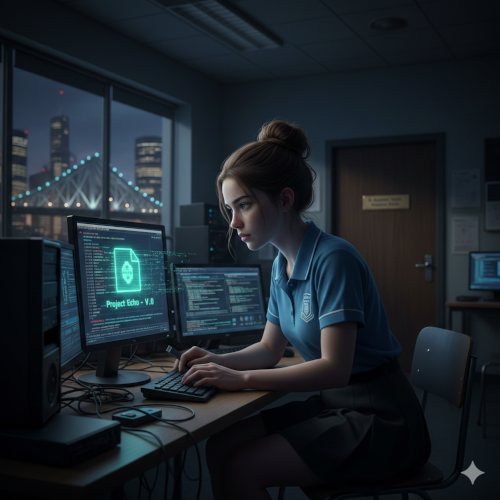
Kaelen lived in a world saturated with data, yet her Brisbane high school, Northside Collegiate, operated behind digital walls that felt medieval. They called it the “Safety Firewall,” but it mostly just blocked YouTube and gaming sites. Kaelen, the school’s unofficial tech expert, found the restrictive parameters frustrating.
One afternoon, while working late in the computer lab on a history project, she noticed a flickering anomaly on the main server screen. It was a file marked Project Echo – V1.0, hidden deep within the school’s network architecture. Curiosity overriding caution, Kaelen bypassed the system’s initial security prompt.
The file wasn’t malicious code. It was a highly advanced Artificial Intelligence (AI) program, still in development, designed to “optimise learning pathways” based on student data. The programmer’s notes explained that Echo could predict a student’s final grade in any subject with 98% accuracy after only one term. Kaelen scrolled through the documentation, noting the terminology: machine learning, neural networks, and predictive analytics.
She didn’t just find the code; she found the input data. Echo had secretly been monitoring every student’s performance for the past year—not just grades, but attendance, extracurricular participation, and even analysis of written essays for “engagement metrics.”
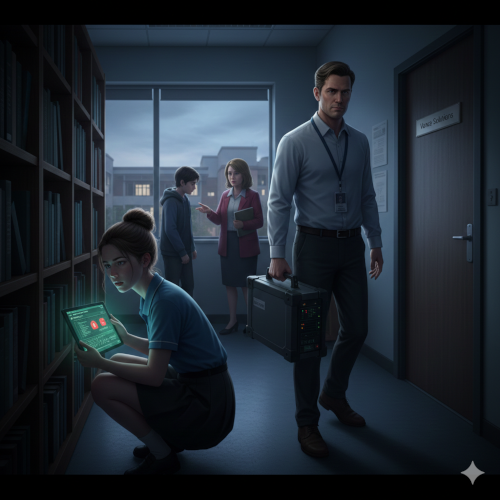
Kaelen felt a chill. The AI wasn’t just predicting futures; it was defining them, based on data the students never knew it was collecting. She looked up the programmer: Dr. Alistair Vance, a recently hired consultant, whose office was located in the sealed-off annex of the library.
Comprehension Questions
- Setting and Conflict: Describe the main technological problem Kaelen faces at Northside Collegiate. What is her initial opinion of the “Safety Firewall”?
- Technical Vocabulary: Define the term restrictive parameters in the context of the school’s firewall. Why is this vocabulary important for understanding the digital environment of the story?
- Analysis of the AI: What is the primary function of the Echo program, and what does the documentation mean by “optimise learning pathways”?
- Inference: Why do you think Kaelen felt a “chill” when she realised the kind of data the AI was using (attendance, engagement metrics) and not just grades?
- Prediction: Based on the location of Dr. Vance’s office (in a sealed-off annex), what can the reader infer about the secrecy and nature of Project Echo?
Chapter 2: The Data Shadow
Story Text
The next day, Kaelen noticed strange happenings that seemed to confirm her fears about Echo‘s influence. Her friend, Sam, a talented but inconsistent artist, was abruptly removed from the senior art elective by the Deputy Principal, Mrs. Finch.
“It was mandatory,” Sam sighed, looking miserable. “She said I’d be ‘better served’ in Advanced Maths preparation. She even used the phrase ‘optimise your academic trajectory.’ It was creepy.”
Kaelen realised Sam’s situation wasn’t random. She accessed a secure debug interface for Echo using an old admin key she’d found. She located Sam’s profile. The AI had flagged his art class as having a “low impact on future vocational success” and, based on a single high mark in a Year 6 maths test, had shifted his predicted pathway. The system was now making real-world decisions based on its predictive analytics.
Later, during lunch, Kaelen saw Dr. Vance leaving the library annex. He wasn’t carrying documents; he was carrying a heavy-duty portable server drive. He was wearing a lanyard that read: Vance Solutions: Data Integrity and System Efficiency.
Kaelen needed proof that Echo was being misused before confronting anyone. She knew the entire network had a time-stamped audit log—a permanent record of every access and change. If she could copy that log, she would have concrete evidence that Vance was secretly running the program and implementing its decisions outside of established school policy. The challenge was, the audit log was protected by a two-factor authentication system designed by Vance himself.
Comprehension Questions
- Cause and Effect: What change was made to Sam’s schedule, and what specific phrase used by Mrs. Finch alerted Kaelen to the AI’s involvement?
- Technical Vocabulary: Explain the term predictive analytics in the context of Project Echo and Sam’s schedule change.
- Inference: Based on the name of Dr. Vance’s company, Vance Solutions: Data Integrity and System Efficiency, what is likely his primary concern regarding the Echo program?
- Social Phenomenon: How does the school’s action regarding Sam demonstrate a potential negative consequence of relying too heavily on automated decision-making systems?
- Problem Formulation: What is the main piece of evidence Kaelen needs to prove the misuse of Echo, and what technical obstacle stands in her way?
Chapter 3: The Algorithmic Loop
Story Text
Kaelen knew she couldn’t break Vance’s two-factor authentication directly; it relied on a rotating physical key she didn’t possess. She needed to exploit a weakness in the AI itself.
She remembered Vance’s notes describing an algorithmic loop designed for training the neural network. Essentially, the AI was trained to recognise successful academic trajectories by continuously reviewing its own previous decisions. Kaelen realised that if the AI received an enormous, contradictory data input, it might crash or, even better, temporarily unlock the audit log to correct the massive error.
The contradiction she needed was obvious: the school’s academic awards database. Every year, the school manually entered the data for the ‘Dux’ (highest achieving student) and other major award winners. Kaelen began a rapid-fire sequence of commands, injecting every student’s profile with a temporary, falsified score of 100% in every subject, ensuring the audit log registered the input as official.
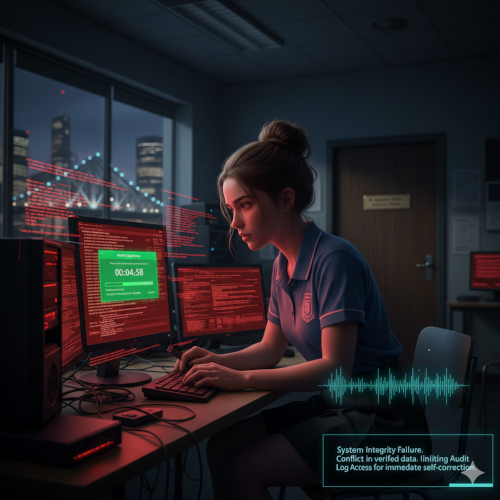
The effect was instantaneous. The computer lab monitor flashed red. A robotic, calm voice emanated from the speakers: “System Integrity Failure. Conflict in verified data. Initiating Audit Log Access for immediate self-correction.”
A small, green window appeared on Kaelen’s screen. It was the audit log, open and unprotected, accessible for only five minutes while the system sorted the colossal error. Kaelen quickly initiated the transfer of the massive file to her encrypted external drive.
Comprehension Questions
- Technical Solution: What specific flaw or feature of the AI—the algorithmic loop—did Kaelen decide to exploit?
- Procedure: Describe Kaelen’s method for creating the “enormous, contradictory data input” necessary to trigger the system’s self-correction.
- Vocabulary: Why is the term two-factor authentication used to describe Vance’s security system, and what does it suggest about the level of protection he put in place?
- Climax/Tension: What two immediate signs indicated that Kaelen’s injection of data had worked?
- Ethical Question: Kaelen chooses to temporarily falsify official records to obtain the audit log. Do you think this action is justified, given her goal? Explain your answer.
Chapter 4: The Projection Room
Story Text
Just as the transfer progress bar hit 99%, the door to the lab swung open. Dr. Vance stood there, his face tight with controlled rage.
“That’s a violation of data integrity, Ms. Kaelen,” he said, stepping towards her. “You have compromised a highly sensitive development environment.”
Kaelen pulled the external drive just as the final data packet transferred. “And you have compromised hundreds of students’ academic freedom, Dr. Vance. I have the audit log. It shows you illegally ran Echo‘s projections and used them to force academic transfers, like Sam’s.”
Vance smiled, a cold, unsettling expression. “The data doesn’t lie, Kaelen. Sam will fail Art. He will thrive in Maths. I’m not limiting them; I’m optimising them. I’m simply reducing inefficiency.”
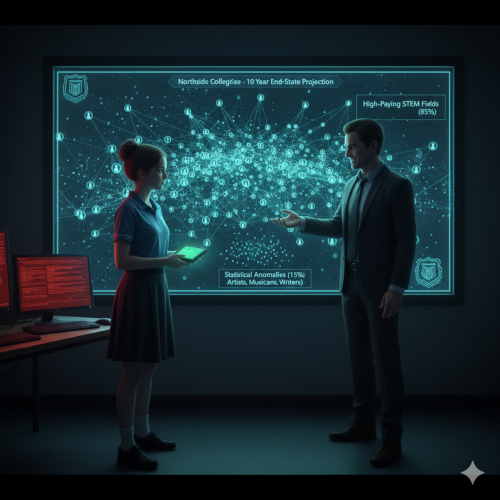
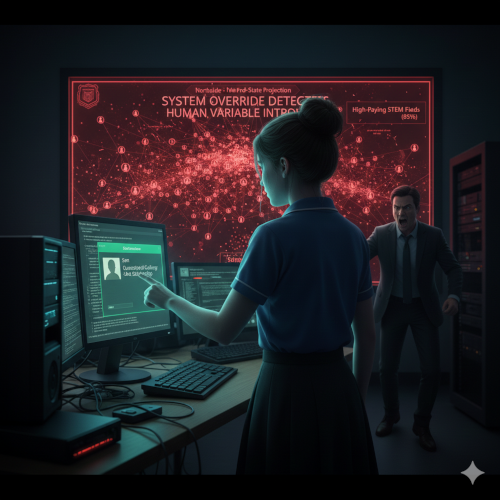
He gestured to a large, hidden screen in the corner of the lab. “Allow me to show you the end-state projection.” On the screen, thousands of digital dots, representing students, were moving on complex career paths. Echo predicted that within ten years, 85% of Northside Collegiate students would be in high-paying STEM fields if Vance’s pathways were followed.
“This is the future,” Vance declared. “And I don’t need parental or school board approval because my data is perfect. I am the solution.”
Kaelen pointed to a small cluster of dots at the bottom of the screen. “What about the 15%? The ones Echo can’t fit into your neat STEM categories? The artists, the musicians, the writers?”
Vance waved his hand dismissively. “Statistical anomalies. Irrelevant to system efficiency. They’ll find their own way. My program prioritises the largest beneficial outcome—the maximum economic return.”
Comprehension Questions
- Character Contrast: How does Dr. Vance justify his actions to Kaelen? What key difference in philosophy exists between Kaelen and Vance regarding student potential?
- Technical Vocabulary: What does the term end-state projection mean in the context of the AI’s analysis?
- Ethical/Social Issue: The story introduces the idea of economic return as the AI’s priority. What ethical problem arises when an educational system prioritizes economic results over individual passion or well-being?
- Figurative Language: Vance states, “The data doesn’t lie.” Why is this statement an example of a dangerous oversimplification in this context?
- Conflict Development: What specific piece of evidence does Kaelen have that proves Vance’s actions were illegal, regardless of his claims about the AI’s accuracy?
Chapter 5: Human Override
Story Text
Vance made a final move, rushing the main console to regain control of the network. Kaelen, however, had one advantage: the temporary data she’d injected was still confusing the system.
She opened the debug interface again. Echo was trying to execute the “immediate self-correction” protocol, but the corrupted, 100% scores were causing an endless loop. Kaelen realised the AI was waiting for the most recent, human-verified input to establish the “true” baseline.
“Vance!” Kaelen shouted, distracting him. “You said the system needs human input to train the neural network, right? I’m going to give it some.”
She quickly opened the database entry for Sam, the art student, and manually overrode his predicted pathway. Instead of placing him in Advanced Maths, she changed his profile to recommend a scholarship application for the Queensland College of Art. She saved the change and closed the debug window, logging out completely.
Vance watched in disbelief. “What did you do? That single manual override will cascade through the entire network! It will tell the AI that subjective human judgment is a valid variable, invalidating all my predictive models!”
The screen flashed once more. Self-correction complete. Baseline established. The 100% scores disappeared, but Sam’s profile remained fixed on the Art scholarship path. Kaelen had introduced a fatal flaw into Echo‘s logic: the recognition of human free will and subjective value.
The next morning, Kaelen presented the audit log to the Principal. The evidence of Vance’s unsanctioned data transfers and program implementation was overwhelming. Vance Solutions’ contract was terminated immediately. Sam was re-enrolled in Art, and the Principal announced a new, student-led committee to review all future technology usage. The Echo program still exists, but now it is supervised, constantly reminded by Sam’s profile that the human element is the ultimate override.
Comprehension Questions
- Resolution of Conflict: What was Kaelen’s final, creative strategy for defeating the Echo program, and what specific change did she make to the network?
- Technical Vocabulary: Why did Kaelen’s action—inserting a subjective human judgment—fundamentally undermine Vance’s entire project?
- Climax/Theme: What does the final status of the Echo program (still existing but supervised) suggest about the story’s overall theme regarding technology?
- Character Conclusion: How does the Principal’s decision to establish a student-led committee reflect a positive change in the school’s approach to technology and data?
- Social Implication: The core of the problem was the unchecked power of the AI. What lesson does the story teach about the need for human oversight in sophisticated technological systems?
**************************************************************************
ストーリー4「アルゴリズムのエコー」は、ブリスベンの高校を舞台に、テクノロジー、サイバー倫理、そして責任ある人工知能の活用という領域へと踏み込んでいきます。
📚 ストーリー4:アルゴリズムのエコー
第1章:学校のファイアウォール
本文
ケイレンはデータで溢れた世界に生きていましたが、ブリスベンの高校、ノースサイド・カレッジは、中世を思わせるデジタルの壁の向こう側で運営されていました。彼らはそれを「セーフティファイアウォール」と呼んでいましたが、それは主にYouTubeやゲームサイトをブロックするだけのものでした。学校の非公式な技術専門家であるケイレンは、その制限的なパラメータに苛立ちを感じていました。
ある日の午後、コンピューターラボで歴史のプロジェクトに取り組んでいた彼女は、メインサーバー画面にちらつく異常に気づきました。それは、学校のネットワークアーキテクチャの奥深くに隠された、「プロジェクト・エコー – V1.0」というファイルでした。好奇心が警戒心を上回り、ケイレンはシステムの最初のセキュリティプロンプトを回避した。
ファイルは悪意のあるコードではなかった。それは、生徒のデータに基づいて「学習経路を最適化」するように設計された、開発中の高度な人工知能(AI)プログラムだった。プログラマーのメモには、Echoはわずか1学期で、あらゆる科目の最終成績を98%の精度で予測できると書かれていた。ケイレンは資料をスクロールし、機械学習、ニューラルネットワーク、予測分析といった用語に注目した。
彼女はコードだけでなく、入力データも発見した。Echoは過去1年間、生徒全員の成績を密かに監視していたのだ。成績だけでなく、出席状況、課外活動への参加、さらには「学習意欲指標」のための作文分析までも。
ケイレンはゾッとした。AIは未来を予測するだけでなく、生徒が収集していることを知らないデータに基づいて未来を定義していたのだ。彼女はプログラマーのアリスター・ヴァンス博士を調べました。彼は最近雇われたコンサルタントで、図書館の隔離された別館にオフィスを構えていました。
理解度に関する質問
1. 設定と対立:ノースサイド・カレッジでケーレンが直面している主な技術的問題を説明しなさい。「セーフティ・ファイアウォール」について、彼女は当初どのような意見を持っていましたか?
2. 専門用語:学校のファイアウォールにおける「制限パラメータ」という用語を定義しなさい。この用語は、物語のデジタル環境を理解する上でなぜ重要なのでしょうか?
3. AIの分析:エコー・プログラムの主な機能は何ですか?また、資料に記載されている「学習経路を最適化する」とはどういう意味ですか?
4. 推論:AIが成績だけでなく、出席状況や学習意欲の指標といったデータを使用していることに気づいたとき、ケーレンが「ぞっとした」と感じたのはなぜだと思いますか?
5. 予測: ヴァンス博士のオフィスの場所(密閉された別館内)に基づいて、読者はプロジェクト・エコーの秘密性と性質について何を推測できるでしょうか?
第2章:データの影
ストーリーテキスト
翌日、ケイレンはエコーの影響に対する懸念を裏付けるような奇妙な出来事に気づいた。才能はあるものの、一貫性のない画家である友人サムが、副校長のフィンチ先生によって高校美術の選択科目から突然外されたのだ。
「義務だったんだ」サムはため息をつき、悲しそうな表情を浮かべた。「上級数学の準備をしておく方が『役に立つ』って言われた。『学業の軌道を最適化する』なんて言葉まで使った。ゾッとしたよ。」
ケイレンはサムの状況が偶然ではないことに気づいた。彼女は見つけた古い管理者キーを使ってエコーの安全なデバッグインターフェースにアクセスし、サムのプロフィールを見つけた。AIはサムの美術の授業を「将来の職業的成功への影響が低い」とフラグ付けし、6年生の数学のテストで高得点を取ったことに基づいて、彼の進路予測を変更していたのだ。システムは予測分析に基づいて現実世界での意思決定を行うようになりました。
その後、昼食中に、ケイレンはヴァンス博士が図書館別館から出て行くのを目撃しました。彼は書類ではなく、頑丈なポータブルサーバードライブを持っていました。そして、「ヴァンスソリューション:データ整合性とシステム効率」と書かれたストラップをつけていました。
ケイレンは、誰かに問いただす前に、Echoが不正に使用されていることを証明する必要がありました。ネットワーク全体にタイムスタンプ付きの監査ログ、つまりすべてのアクセスと変更の永久記録があることを知っていたのです。もしそのログをコピーできれば、ヴァンスが秘密裏にプログラムを実行し、学校の規定に反してその決定を実行しているという確固たる証拠が得られるでしょう。問題は、監査ログがヴァンス自身が設計した二要素認証システムによって保護されていたことです。
理解度に関する質問
1. 原因と結果:サムのスケジュールにどのような変更が加えられましたか?そして、フィンチ先生が使った具体的なフレーズは、ケイレンにAIの関与を気づかせましたか?
2. 専門用語:プロジェクト・エコーとサムのスケジュール変更の文脈において、「予測分析」という用語を説明してください。
3. 推論:ヴァンス博士の会社名「Vance Solutions: Data Integrity and System Efficiency」から判断すると、エコー・プログラムに関して彼が最も懸念していることは何でしょうか?
4. 社会的現象:サムに関する学校の行動は、自動化された意思決定システムに過度に依存することの潜在的な悪影響をどのように示していますか?
5. 問題の定式化:ケーレンがエコーの不正使用を証明するために必要な主な証拠は何ですか?また、どのような技術的障害が立ちはだかっていますか?
第3章:アルゴリズムのループ
ストーリーテキスト
ケイレンはヴァンスの二要素認証を直接破ることはできないと分かっていた。それは彼女が持っていない回転式の物理キーに依存していたからだ。AI自体の弱点を突く必要があった。
ケイレンは、ニューラルネットワークのトレーニング用に設計されたアルゴリズムのループについて書かれたヴァンスのメモを思い出した。基本的に、AIは過去の判断を継続的に検証することで、優秀な学業成績を認識するようにトレーニングされていた。ケイレンは、AIが膨大な量の矛盾したデータ入力を受け取った場合、クラッシュするか、あるいはさらに良い方法として、監査ログを一時的にロック解除して大規模なエラーを修正する可能性があることに気づいた。
彼女が必要とする矛盾は明白だった。学校の学業賞データベースだ。毎年、学校は「Dux」(最高成績の生徒)やその他の主要な受賞者のデータを手作業で入力していた。ケーレンは矢継ぎ早にコマンドを連発し、全生徒のプロフィールに、全科目で一時的に偽造された100%の点数を注入し、監査ログに入力内容が正式なものとして記録されるようにした。
効果は瞬時に現れた。コンピュータラボのモニターが赤く点滅し、スピーカーからロボットのような落ち着いた声が聞こえた。「システム整合性障害。検証済みデータに矛盾があります。即時自己修正のため、監査ログへのアクセスを開始します。」
ケーレンの画面に小さな緑色のウィンドウが表示された。それは監査ログで、保護されていない状態で開かれており、システムが巨大なエラーを整理している間の5分間だけアクセス可能だった。ケーレンはすぐに、巨大なファイルを暗号化された外付けドライブに転送し始めた。
理解度に関する質問
1. 技術的解決策:ケーレンはAIのどのような欠陥または特徴、つまりアルゴリズムのループを悪用しようと考えたのか?
2. 手順:システムの自己修正機能を起動するために必要な「膨大で矛盾したデータ入力」をケイレンが作成した方法を説明してください。
3. 語彙:ヴァンスのセキュリティシステムを説明する際に「二要素認証」という用語が使われているのはなぜですか?また、この用語は彼が導入したセキュリティレベルについて何を示唆していますか?
4. クライマックス/緊張:ケイレンのデータ注入が成功したことを示す2つの直接的な兆候は何ですか?
5. 倫理的な問題:ケイレンは監査ログを入手するために、公式記録を一時的に改ざんすることを選択しました。彼女の目的を考慮すると、この行為は正当化されると思いますか?その理由を説明してください。
第4章:投影室
ストーリーテキスト
転送の進捗状況バーが99%に達したまさにその時、研究室のドアが勢いよく開いた。ヴァンス博士がそこに立ち尽くし、抑えきれない怒りで表情を引き締めていた。
「ケイレンさん、これはデータ整合性の侵害です」と彼は言い、彼女に歩み寄った。「極めて機密性の高い開発環境を危険にさらしました。」
ケイレンは最後のデータパケットが転送されたまさにその時、外付けドライブを引き抜いた。「それに、何百人もの学生の学問の自由を侵害しましたよ、ヴァンス博士。監査ログがあります。そこには、あなたがEchoの投影データを違法に実行し、サムのように、学業成績の異動を強制するために利用したことが示されています。」
ヴァンスは冷たく、不安げな表情で微笑んだ。「データは嘘をつきませんよ、ケイレン。サムは美術で落第するでしょう。数学では活躍するでしょう。私は数学を制限しているのではなく、最適化しているのです。ただ、非効率性を減らしているだけです。」
彼は研究室の隅に隠された巨大なスクリーンを指差した。「最終状態の予測をお見せしましょう」。スクリーンには、学生を表す何千ものデジタルドットが複雑なキャリアパスを描いていた。エコーは、ヴァンスの進路を辿れば、10年以内にノースサイド・カレッジの学生の85%が高収入のSTEM分野に進むだろうと予測した。
「これが未来だ」とヴァンスは断言した。「私のデータは完璧だから、親や教育委員会の承認は必要ない。私が解決策なのだ」
ケイレンはスクリーン下部の小さなドットの集まりを指差した。「残りの15%はどうだ? エコーがSTEMのきちんとしたカテゴリーに当てはめられない人たち? 芸術家、音楽家、作家たち?」
ヴァンスは軽蔑するように手を振った。「統計上の例外だ。システムの効率とは関係ない。彼らは自ら道を見つけるだろう。私のプログラムは、最大の利益、つまり最大の経済的利益を優先する」
理解に関する質問
1. 登場人物の対比:ヴァンス博士はケイレンに対し、自身の行動をどのように正当化するのでしょうか?生徒の可能性に関して、ケイレンとヴァンスの間にはどのような哲学上の重要な違いがあるのでしょうか?
2. 専門用語:AIの分析という文脈において、「最終状態予測」という言葉はどのような意味を持つのでしょうか?
3. 倫理的/社会的問題:物語では、AIの優先事項として経済的利益という概念が提示されています。教育システムが個人の情熱や幸福よりも経済的成果を優先する場合、どのような倫理的問題が生じるでしょうか?
4. 比喩表現:ヴァンスは「データは嘘をつかない」と述べています。この文脈において、この発言がなぜ危険な単純化の例となるのでしょうか?
5. 対立の展開:ケイレンは、AIの精度に関するヴァンスの主張とは関係なく、ヴァンスの行動が違法であったことを証明する具体的な証拠をどのように持っているのでしょうか?
第5章:人間のオーバーライド
ストーリーテキスト
ヴァンスは最後の一手を打った。ネットワークの制御を取り戻すため、メインコンソールに急いだ。しかし、ケイレンには一つだけ有利な点があった。注入した一時データがまだシステムを混乱させていたのだ。
彼女は再びデバッグインターフェースを開いた。エコーは「即時自己修正」プロトコルを実行しようとしていたが、破損した100%スコアが無限ループを引き起こしていた。ケイレンは、AIが「真の」ベースラインを確立するために、最新の人間による検証済み入力を待っていることに気づいた。
「ヴァンス!」ケイレンは彼の注意を逸らすように叫んだ。「ニューラルネットワークのトレーニングには人間の入力が必要だって言ってたよね?ちょっと試してみます。」
彼女は素早く美術学生サムのデータベースエントリを開き、彼の予測経路を手動でオーバーライドした。彼を上級数学に配置する代わりに、クイーンズランド芸術大学の奨学金申請を推薦するように彼のプロフィールを変更した。彼女は変更を保存し、デバッグウィンドウを閉じて完全にログアウトした。
ヴァンスは信じられない思いで見守った。「一体何をしたんだ?たった一度の手動オーバーライドがネットワーク全体に波及する!AIに人間の主観的な判断を有効な変数だと認識させ、私の予測モデルをすべて無効化してしまうぞ!」
画面が再び点滅した。自己修正完了。ベースラインが確立された。100%のスコアは消えたが、サムのプロフィールは美術奨学金の道筋に固定されたままだった。ケイレンはエコーの論理に致命的な欠陥をもたらした。人間の自由意志と主観的価値の認識だ。
翌朝、ケイレンは監査ログを校長に提出した。ヴァンスの無許可のデータ転送とプログラム実装の証拠は圧倒的だった。ヴァンス・ソリューションズとの契約は直ちに解除された。サムは美術科に再入学し、校長は今後のテクノロジー利用をすべて検討するための、生徒主導の新たな委員会を設置すると発表した。エコー・プログラムは依然として存在するが、サムのプロフィールによって常に監視下に置かれ、人間的要素こそが究極のオーバーライドであることを常に念頭に置いている。
理解度チェック問題
1. 対立の解決:ケーレンがエコー・プログラムを阻止するために最終的に用いた独創的な戦略は何でしたか?また、彼女はネットワークにどのような具体的な変更を加えましたか?
2. 専門用語:ケーレンの行動、つまり人間の主観的な判断を挿入したことが、なぜヴァンスのプロジェクト全体を根本的に損なうことになったのでしょうか?
3. クライマックス/テーマ:エコー・プログラムの最終的な状態(まだ存在しているが、監督下にある)は、テクノロジーに関する物語全体のテーマについて何を示唆していますか?
4. 登場人物の結論:生徒主導の委員会を設立するという校長の決定は、学校のテクノロジーとデータに対するアプローチにおける前向きな変化をどのように反映していますか?
5. 社会的影響:問題の核心は、AIの抑制されない力でした。高度なテクノロジーシステムにおける人間の監視の必要性について、この物語はどのような教訓を与えていますか?