🦈 Story 2: The Silent Coast
This new story is set further north, along the remote beaches and estuaries north of Cooktown, focusing on a different type of environmental threat related to historical actions and local Indigenous knowledge.
🏝️ Chapter 1: The Tide Reveals
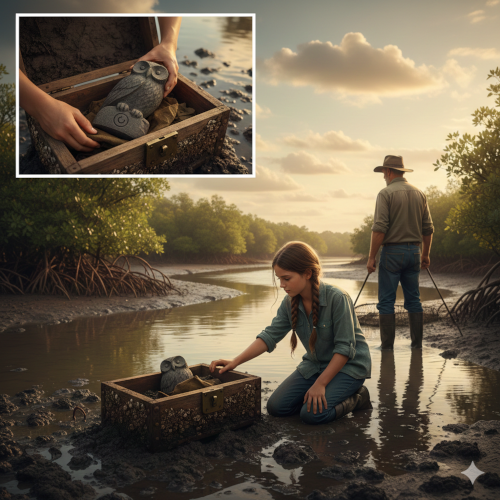
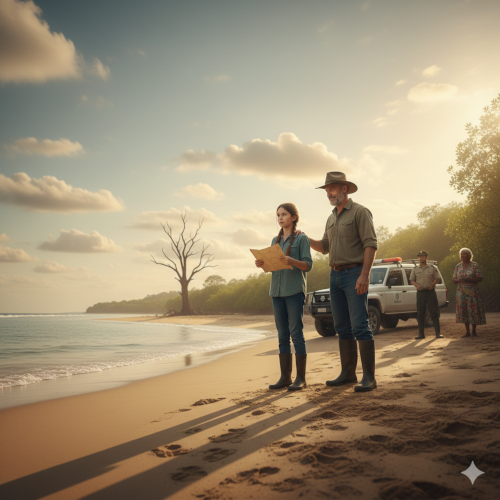
Amelia, a 13-year-old spending the school holidays with her uncle, a remote community park ranger, found the coast north of Cooktown both beautiful and unsettling. The beaches were pristine, but the vast mangroves felt like a maze of secrets.
Her uncle, Rhys, was working on a project to monitor the local estuarine crocodile population. One afternoon, while checking a trap line along the tidal flats, Amelia spotted something that didn’t belong: a small, sturdy wooden box, half-buried in the silt. The wood was blackened and waterlogged, but a heavy brass latch held it shut.
“Probably old fishing gear,” Rhys said, dismissing it. “The tides bring all sorts of junk in.”
Amelia, however, felt a pull toward it. Back at their cabin, she managed to pry the latch open. Inside, cushioned by ancient, dry mud, was a single, heavy object: a block of dark grey stone, about the size of a fist, carved into the shape of a seated owl. The stone was ice-cold to the touch, and carved into its base was a strange symbol—a circle enclosing a crescent moon and three dots.
Wrapped around the owl was a thick, oilskin packet. Inside the packet was a single, folded chart. It wasn’t a standard naval map; it was a rough, hand-drawn sketch of the local coastline, with specific, cryptic labels written in faded pencil:
- Where the river mourns
- The old sentinel’s blind eye
- The place of the long silence
Rhys, examining the chart, suddenly turned serious. “That owl… I recognize the symbol. It belonged to the North Coast Mining Company. They operated up here in the 1960s, doing secretive mineral surveys before they were shut down by the government. They were notorious for hiding things.” He tapped the third label. “The ‘long silence’ is a forbidden area. Old Man Koopa always warned me about the land there. Said it was poisoned.”
Amelia looked at the stone owl. This wasn’t junk; it was a piece of a forgotten, possibly dangerous, history.
Comprehension Check: Chapter 1
- Setting and Character Background: Where is Amelia spending her school holidays, and what is her uncle’s occupation?
- Key Artifact: What object did Amelia find half-buried in the silt, and what item was inside it (besides the stone owl)?
- Physical Clue: Describe the appearance of the key object found inside the box.
- Historical Connection: Who did the carved owl symbol belong to, and what was this company known for?
- New Conflict: What does the label ‘The place of the long silence’ refer to, according to Rhys’s local knowledge?
🗺️ Chapter 2: The Old Sentinel
The next morning, Rhys contacted an old acquaintance, Shirley, an elder from the local community, who knew the history of the region. He showed her the owl carving and the cryptic chart.
Shirley’s face clouded. “The North Coast Mining Company tried to hide their contamination. They used that owl as their secret marker. That stone owl carving isn’t just a symbol, it’s a locator. The three dots are supposed to align with three places to show the path to what they called the ‘Last Cache.’“
Rhys pointed at the first location on the chart: “Where the river mourns.”
“That’s the old logging weir,” Shirley explained. “They stopped the natural flow of the water there years ago. The river has been sick ever since—it’s mourning its natural path.”
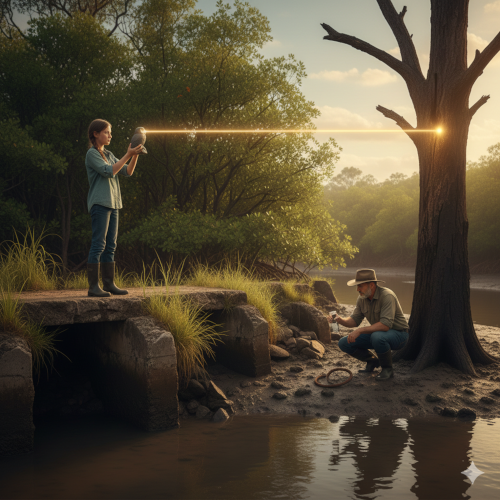
Rhys and Amelia drove upriver. The weir was a crumbling wall of concrete and rock, overgrown with vines. The water on the river side was stagnant and brown. Amelia climbed onto the weir and looked down at the stagnant water. She held the stone owl, trying to figure out how a stone could be a “locator.” She noticed the crescent moon symbol on its base was a slightly different colour stone, almost like a piece of inlay.
As she held it up to the afternoon sun, the stone crescent moon piece suddenly glowed faintly. A concentrated beam of light, as thin as a laser pointer, shot from the owl’s head, landing exactly on a large, dead paperbark tree on the opposite bank.
The paperbark tree was blackened, appearing to have been burned years ago. This must be the ‘old sentinel’s blind eye’ from the map.
They quickly crossed the river. At the base of the dead tree, they found a small, rusted metal ring set into the earth. Attached to the ring was another object: a small, thick glass vial. Inside the vial was not liquid, but a dense, crystalline dust that glittered ominously.
Rhys quickly sealed the vial in a safety bag. “This looks like processed mineral residue—highly toxic. If the mining company was hiding something, it was probably pollution. We have to find the ‘Last Cache’ before this stuff leaks into the water table.”
Comprehension Check: Chapter 2
- Consulting the Expert: Who did Rhys contact, and what key function did this person reveal about the stone owl carving?
- Cipher Solving: What specific part of the stone owl carving was used to reveal the second location?
- Location 2 Identified: What specific feature of the paperbark tree led them to believe it was the ‘old sentinel’s blind eye’?
- New Artifact: What object was found at the base of the dead paperbark tree, and what did Rhys identify the contents as?
- Motivation/Urgency: What is the new danger that Rhys identifies at the end of the chapter, driving the need to find the ‘Last Cache’?
📍 Chapter 3: Aligning the Dots
Rhys reported the finding of the toxic vial to the park authority, but they were too remote to send an immediate clean-up team. It was up to Amelia and Rhys to find the ‘Last Cache’ before the next high tide could potentially wash more pollutants into the river.
They returned to Shirley, who was studying the chart and the owl. “The three dots on the owl are positions,” she repeated. “You’ve found the first two locations, but you need a third point to triangulate the Last Cache. That third point is the highest part of the landscape around here. They always used the highest point.”
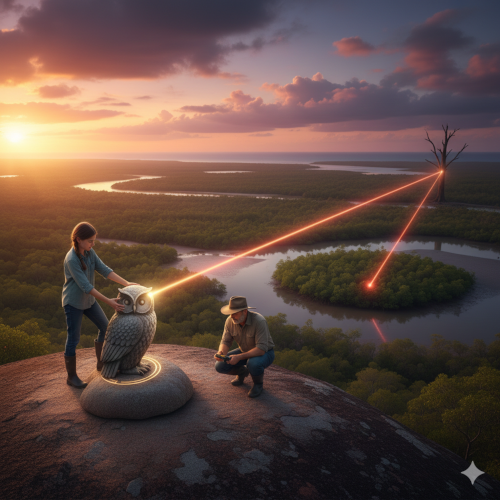
They drove inland, climbing a rocky track to the summit of the only decent-sized hill nearby, a place known as Bald Rock. From there, they had a perfect view of the entire coastal plain, the river, and the ocean.
Amelia held the stone owl tightly. She knew the three dots on the owl’s base represented the three major locations: The Mourning River (Weir), The Blind Eye (Paperbark), and the final spot, the Last Cache.
She positioned the owl on a flat boulder at the summit. She carefully aimed the two known positions—the crescent moon light beam and the base of the owl—at the Weir and the Paperbark tree, respectively. The stone owl was now aligned, like a viewfinder sighting two distant points.
Suddenly, the whole owl stone thrummed with a deep, vibrating energy. A third, stronger beam of light, this one a shimmering coppery red, shot out of the stone’s base. It didn’t point at the river or the tree, but at a distinct, hidden section of mangroves deep in the tidal flats—the area marked on the map as “The place of the long silence.”
Rhys quickly took a GPS reading of the point where the red beam landed. “That’s it. It’s a full kilometer into the densest part of the mangroves. The light only points there when the owl is perfectly aligned with the other two spots.” The last part of the chase required a boat, and they had to hurry; the tide was already starting to turn.
Comprehension Check: Chapter 3
- Setting the Third Point: What location did Shirley advise was the key to finding the third position to triangulate the final cache?
- Action/Mechanism: How did Amelia use the stone owl at the summit to determine the location of the ‘Last Cache’?
- Clue Interpretation: What was the name of the location where the final light beam landed, and what type of landscape was it in?
- Key Observation: What specific physical phenomenon (energy) did the stone owl exhibit when it was correctly positioned?
- New Physical Clue: What was the colour of the final, decisive beam of light that located the cache?
🚤 Chapter 4: The Long Silence
Rhys and Amelia took their small tinny boat deep into the mangrove maze. The ‘long silence’ was an unnerving place. The air was thick and humid, and the mangrove roots formed a dense, confusing latticework that blocked the light. It was quiet, save for the occasional splash of a fish.
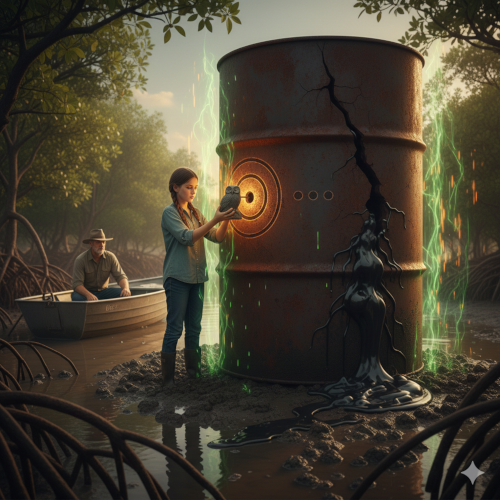
Using the GPS coordinates obtained from Bald Rock, Rhys eventually navigated the boat to a small, enclosed clearing in the mangroves. There, rising out of the mud, was a massive, rusted, cylindrical steel drum—clearly the ‘Last Cache’ left by the mining company.
The drum was old and had been anchored deep, but the tidal surge over decades had exposed the top. There was a large, ominous crack running vertically down the side, seeping a thick, dark, syrupy liquid into the surrounding mud.
“That’s worse than I thought,” Rhys muttered. “That’s heavy metal sludge. The next high tide will flood this whole clearing and spread it far and wide.”
They had to seal the crack now. They had no materials. They had only the stone owl and the chart.
Amelia noticed that the rusted steel drum had a series of markings near the top. They were precisely the same markings found on the original oilskin chart: the circle-crescent-three-dots symbol. Just below the symbol was a small, round opening—a keyhole, perfectly sized and shaped for the base of the stone owl.
“Rhys, I think the owl isn’t just a locator,” Amelia whispered. “It’s the stopper.”
Carefully, Amelia approached the cracked drum. The toxic sludge was slick and smelled foul. She inverted the stone owl, using the smooth, heavy base (the one with the symbols) like a plug. She pushed it hard into the circular opening on the drum’s surface.
The stone owl clicked into place, plugging the hole completely. The toxic seepage immediately stopped. The moment the owl locked into the drum, the entire drum vibrated violently. The crack in the side seemed to heal, covered by a black, resilient polymer that squeezed out from inside the drum itself, effectively sealing the pollutants away. The mining company hadn’t just used the owl to locate the cache; they had used it to activate its self-sealing mechanism.
Comprehension Check: Chapter 4
- Setting and Condition: Describe the appearance and atmosphere of ‘The place of the long silence’ (the mangroves).
- The Cache: What specific object did they find in the mangrove clearing, and what was its condition?
- Conflict: What immediate, time-sensitive danger did the cracked drum present?
- Role of the Artifact: What new function did Amelia realize the stone owl carving served besides being a “locator”?
- Climax: What happened to the steel drum immediately after Amelia secured the stone owl in the opening?
🌟 Chapter 5: The Seal and the Sentinel
The massive steel drum, now stabilized and sealed by the strange black polymer, was safe from the tide. Rhys sighed with relief. “You didn’t just find a clue, Amelia; you found the whole operation. This drum likely holds the worst of the toxic waste, and the owl was the failsafe.”
They made their way out of the mangroves. Rhys called the authorities again, reporting the sealed drum and its coordinates, assuring them the immediate danger was contained.
Back at the cabin, Rhys sat with Amelia, looking at the original chart. “The mining company’s symbol was a secret, but the real wisdom came from Old Man Koopa and Shirley. They knew the land was poisoned—they just didn’t know the precise location or the mechanism.”
Amelia looked out at the ocean, the sun setting over the clean, quiet horizon. She realized the ‘Last Cache’ wasn’t just a physical container of waste; it was a record of history that someone had tried to erase.
The authorities arrived the next morning, confirming the drum’s stability and arranging for a specialized recovery team. The park ranger who arrived was impressed by Amelia’s quick thinking.
“You saved this whole river system,” the ranger told her. “That sludge would have done irreparable damage.”
Amelia picked up the original oilskin chart, the only remaining artifact from the wooden box, and folded it carefully. The adventure had changed her perspective. She no longer saw the quiet coastline as merely a place for crocodile surveys. She saw it as a fragile ecosystem with its own deep, complex history—a history that needed not only monitoring but active protection.
She had found the silence, unsealed the poison, and then resealed it again, becoming the coast’s temporary guardian, a role far more interesting than any assignment her history teacher could devise.
Comprehension Check: Chapter 5
- Resolution: What key action allowed the toxic seepage to be completely stopped, and what specific material sealed the crack in the drum?
- Source of Wisdom: Who does Rhys acknowledge as possessing the “real wisdom” about the poisoned land?
- Post-Climax Action: What did Rhys do immediately after the drum was sealed, and why was this important?
- Character Development: How has Amelia’s perspective of the “quiet coastline” changed by the end of the story?
- Final Artifact: What was the only remaining artifact from the wooden box that Amelia decided to keep at the end of the story?
This revised story, “The Silent Coast,” is now consistent, with the clues and artifacts (the stone owl, the chart, the vial) maintaining their function throughout the narrative, culminating in the sealing of the pollution.
Would you like me to create Story 4, Chapter 1 now?
**********************************************************************************
🦈 ストーリー2:静かな海岸
この新しい物語は、クックタウン北部のさらに北、人里離れたビーチや河口沿いを舞台に、歴史的な出来事や地元の先住民の知識に関連した、異なるタイプの環境的脅威に焦点を当てています。
________________________________________
🏝️ 第1章:潮の満ち引き
13歳のアメリアは、辺鄙な地域の公園管理人である叔父と学校の休暇を過ごし、クックタウン北部の海岸の美しさと同時に不安な気持ちも感じました。ビーチは手つかずのままでしたが、広大なマングローブ林はまるで秘密の迷路のようでした。
叔父のリースは、地元の河口域に生息するワニの個体数を監視するプロジェクトに取り組んでいました。ある日の午後、干潟沿いの罠のラインを確認していたアメリアは、そこにあるものとは違うものを見つけた。小さくて頑丈な木箱が、泥に半分埋もれていた。木は黒ずんで水浸しになっていたが、重々しい真鍮の掛け金で閉じられていた。
「たぶん古い漁具だろう」とリースは言い、それを無視した。「潮がいろんなゴミを運んでくるからね」
しかし、アメリアは何かに引き寄せられるのを感じた。小屋に戻り、なんとか掛け金をこじ開けた。中には、古く乾いた泥に覆われた、重い物体が一つ入っていた。拳ほどの大きさの、暗い灰色の石の塊で、座ったフクロウの形に彫られていた。石は触ると氷のように冷たく、底には奇妙なシンボルが彫られていた。円の中に三日月と三つの点が描かれていた。
フクロウの周りには、分厚いオイルスキンの包みが巻かれていた。包みの中には、一枚の折りたたまれた海図が入っていた。それは一般的な海軍の地図ではなく、地元の海岸線を大まかに手描きしたスケッチで、色褪せた鉛筆で謎めいた具体的なラベルが書かれていた。
1. 川が嘆き悲しむ場所
2. 老哨兵の盲目の場所
3. 長い沈黙の場所
海図をじっくりと眺めていたリースは、急に真剣な表情になった。「あのフクロウ…シンボルに見覚えがある。ノースコースト鉱業会社のものだ。1960年代、この辺りで操業し、政府に閉鎖されるまで秘密裏に鉱物調査を行っていた。隠蔽工作で悪名高かったんだ。」彼は3つ目のラベルを軽く叩いた。「『長い沈黙』は禁断の地だ。クッパ爺さんはいつもあそこの土地について警告していた。毒が撒かれているって。」
アメリアは石のフクロウを見た。これはガラクタではない。忘れ去られた、もしかしたら危険な歴史の一部だった。
_____________________________________________________
理解度チェック:第1章
1. 設定と登場人物の背景:アメリアは学校の休暇をどこで過ごしていますか?そして、彼女の叔父の職業は何ですか?
2. 重要な遺物:アメリアは泥の中に半分埋もれた状態で何を見つけましたか?そして、その中には(石のフクロウ以外に)何が入っていましたか?
3. 物理的な手がかり:箱の中にあった重要な遺物の外観を説明してください。
4. 歴史的つながり:彫刻されたフクロウのシンボルは誰のものでしたか?そして、この会社はどのようなことで知られていましたか?
5. 新たな対立:リースの地元の知識によると、「長い沈黙の場所」というラベルは何を指していますか?
🗺️ 第2章:古き歩哨
翌朝、リースは旧知のシャーリーに連絡を取った。シャーリーは地元の長老で、この地域の歴史に詳しい。彼は彼女にフクロウの彫刻と謎めいた海図を見せた。
シャーリーの表情が曇った。「ノースコースト鉱山会社は汚染を隠そうとした。あのフクロウを秘密の目印として使っていたんだ。あの石のフクロウの彫刻は単なるシンボルではなく、位置を示すものなんだ。3つの点は3つの地点と一直線になり、彼らが『最後の貯蔵庫』と呼んでいた場所への道を示すはずなんだ。」
リースは海図の最初の場所を指差した。「川が嘆き悲しむ場所だ。」
「あれは昔の伐採堰よ」とシャーリーは説明した。「何年も前に、あそこで水の自然な流れを止めてしまったの。それ以来、川は病んでいる。本来の道を嘆いているのよ。」
リースとアメリアは車で川を上っていった。堰堤はコンクリートと岩でできた崩れかけた壁で、蔦が生い茂っていた。川岸の水は淀んで茶色く濁っていた。アメリアは堰堤に登り、淀んだ水面を見下ろした。彼女は石のフクロウを手に持ち、石がどのようにして「位置特定器」になるのか考えてみた。台座の三日月型のシンボルが、まるで象嵌細工のように、わずかに異なる色の石であることに気づいた。
午後の太陽にかざすと、三日月型の石が突然かすかに光り始めた。フクロウの頭からレーザーポインターのように細い光線が放たれ、対岸の大きな枯れたペーパーバークの木に正確に命中した。
ペーパーバークの木は黒く変色し、何年も前に焼けたように見えた。これは地図に記されていた「老番兵の盲目」に違いない。
彼らは急いで川を渡った。枯れ木の根元で、彼らは地面に埋め込まれた小さな錆びた金属の輪を発見した。その輪には、もう一つの物体、小さくて厚いガラスの小瓶が取り付けられていた。小瓶の中身は液体ではなく、不吉に輝く濃厚な結晶の粉塵だった。
リースは素早く小瓶を安全袋に封をした。「これは加工された鉱物の残留物みたいだ。非常に有毒だ。鉱山会社が何かを隠しているとしたら、それはおそらく汚染物質だろう。この物質が地下水に漏れる前に、『最後の隠し場所』を見つけなければならない。」
理解度チェック:第2章
専門家への相談:リースは誰に連絡を取り、その人物は石のフクロウの彫刻についてどのような重要な役割を明らかにしたか?
暗号解読:2番目の場所を特定するために、石のフクロウの彫刻のどの部分が使われたか?
場所2の特定:ペーパーバークの木のどのような特徴から、彼らはそれが「老番兵の盲目」だと確信したか?
新たな遺物:枯れたペーパーバークの木の根元で見つかった物体は何ですか?そして、リースはその中身を何だと特定しましたか?
動機/緊急性:この章の最後でリースが特定し、「最後の隠し場所」を見つける必要性を駆り立てる新たな危険とは何ですか?
第3章:点と点を繋ぐ
リースは毒物容器の発見を公園管理局に報告したが、管理局はあまりにも遠く離れていたため、すぐに清掃隊を派遣することはできなかった。次の満潮で川に汚染物質が流れ込む前に、「最後の貯蔵庫」を見つけ出すのは、アメリアとリースの責任だった。
二人は地図とフクロウを調べていたシャーリーのところに戻った。「フクロウの上の3つの点は位置を表すのよ」とシャーリーは繰り返した。「最初の2つの場所はわかったわね。でも、最後の貯蔵庫を三角測量するには3つ目の点が必要なの。その3つ目の点は、この辺りの地形で最も高いところなの。彼らはいつも一番高いところを使っていたのよ。」
二人は内陸へと車を走らせ、岩だらけの道を登り、近くにある唯一のまともな丘、ボールドロックと呼ばれる丘の頂上を目指した。そこからは、海岸平野全体、川、そして海が一望できた。
アメリアは石のフクロウをしっかりと抱きしめた。フクロウの台座にある3つの点は、三つの主要な場所、すなわちモーニング川(堰)、ブラインドアイ(ペーパーバーク)、そして最後の場所であるラストキャッシュを表していることを彼女は知っていた。
彼女はフクロウを山頂の平らな岩の上に置いた。そして、既知の二つの位置――三日月の光とフクロウの台座――を、それぞれ堰とペーパーバークの木に注意深く向けた。石のフクロウは、まるでファインダーで二つの遠くの地点を捉えるように、一直線に並んだ。
突然、フクロウの石全体が深く振動するエネルギーで震えた。三つ目の、より強い光線――今度は赤銅色の揺らめく光線――が石の台座から放たれた。それは川でも木でもなく、干潟の奥深く、マングローブ林の、はっきりと隠れた一角――地図に「長い沈黙の場所」と記された場所を指し示していた。
リースはすぐにGPSで赤い光線が着地した地点を測定した。 「そこだ。マングローブの最も密集した場所まで1キロメートルほど入ったところだ。光がそこを指し示すのは、フクロウが他の2つの地点と完全に一直線になった時だけだ。」追跡の最後の部分にはボートが必要だったが、彼らは急がなければならなかった。潮がすでに変わり始めていたからだ。
理解度チェック:第3章
3番目の地点の設定:シャーリーは、最後のキャッシュを三角測量するための3番目の地点を見つける鍵となる場所を、どの場所だとアドバイスしたか?
行動/メカニズム:アメリアはどのようにして山頂の石のフクロウを使って「最後のキャッシュ」の位置を特定したか?
ヒントの解釈:最後の光線が着地した場所の名前は何で、どのような地形だったか?
重要な観察:石のフクロウは正しい位置にいたとき、どのような物理現象(エネルギー)を示したか?
新たな物理的ヒント:キャッシュの位置を特定した最後の決定的な光線の色は何だったか?
第四章:長い沈黙
リースとアメリアは小さなボートでマングローブの迷路の奥深くへと進んでいった。「長い沈黙」は、不安を掻き立てる場所だった。空気は重く湿っぽく、マングローブの根は密集して複雑な格子模様を作り、光を遮っていた。時折、魚が水しぶきを上げる音を除けば、静寂に包まれていた。
ボールドロックから得たGPS座標を頼りに、リースはついにボートを操り、マングローブの茂みの中にある小さな、閉ざされた空き地へとたどり着いた。そこには、泥の中から巨大な、錆びた円筒形の鉄のドラム缶が浮かんでいた。明らかに、鉱山会社が残した「最後の貯蔵庫」だった。
ドラム缶は古く、深い場所に錨泊していたが、数十年にわたる高潮によって上部が露出していた。側面には大きく不気味な亀裂が垂直に走り、どろっとした暗いシロップ状の液体が周囲の泥に染み出ていた。
「思ったよりひどい」とリースは呟いた。「重金属のヘドロだ。次の満潮でこの空き地全体が浸水して、あちこちに広がるだろう」
今すぐ亀裂を塞がなければならなかった。材料は何もない。あるのは石のフクロウと海図だけだった。
アメリアは錆びた鉄のドラム缶の上部近くに、一連のマークがあることに気づいた。それはオリジナルのオイルスキン海図にあったものと全く同じマーク、円、三日月、三つの点の記号だった。記号のすぐ下には小さな丸い穴、鍵穴があり、石のフクロウの台座にぴったりのサイズと形だった。
「リース、フクロウはただの場所探しだけじゃないと思う」とアメリアはささやいた。「栓なのよ」
アメリアは慎重に亀裂の入ったドラム缶に近づいた。有毒なヘドロは滑りやすく、悪臭を放っていた。彼女は石のフクロウを逆さまにし、滑らかで重い台座(シンボルが刻まれている方)を栓のように使って、ドラム缶の表面にある円形の開口部に強く押し込んだ。
石のフクロウはカチッと音を立てて所定の位置に収まり、穴を完全に塞いだ。有毒物質の浸出は即座に止まった。フクロウがドラム缶に嵌まった瞬間、ドラム缶全体が激しく振動した。側面の亀裂は癒合したようで、黒くて弾力のあるポリマーがドラム缶の内側から押し出され、汚染物質を効果的に封じ込めた。鉱山会社はフクロウを使って貯蔵庫の位置を特定しただけでなく、貯蔵庫の自動密閉機構を作動させたのだ。
理解度チェック:第4章
状況と状況:「長い沈黙の場所」(マングローブ林)の外観と雰囲気を説明しなさい。
貯蔵庫:マングローブ林の空き地で彼らは具体的にどのような物を見つけましたか?また、その状態はどうでしたか?
対立:割れたドラム缶は、どのような差し迫った、時間的に制約のある危険をもたらしましたか?
遺物の役割:アメリアは、石のフクロウの彫刻が「位置特定器」であること以外にどのような新しい機能を持っていることに気づいたのでしょうか?
クライマックス:アメリアがオープニングで石のフクロウを確保した直後、スチールドラムに何が起こったのでしょうか?
第5章:封印と番人
巨大な鉄のドラム缶は、奇妙な黒いポリマーによって安定し、封印され、波から守られていた。リースは安堵のため息をついた。「アメリア、君はただの手がかりを見つけただけじゃない。作戦のすべてを見つけたんだ。このドラム缶にはおそらく最悪の有毒廃棄物が詰め込まれているだろう。フクロウは安全装置だったんだ。」
彼らはマングローブ林を抜け出した。リースは再び当局に電話し、封印されたドラム缶とその座標を報告し、差し迫った危険は封じ込められたと保証した。
小屋に戻ると、リースはアメリアと一緒に元の海図を見ていた。「鉱山会社のシンボルは秘密だったが、本当の知恵はクッパ爺さんとシャーリーから得たものだ。彼らは土地が汚染されていることを知っていた。ただ、正確な場所とメカニズムを知らなかっただけだ。」
アメリアは海を見上げた。澄み切った静かな水平線に沈む夕日。彼女は「最後の貯蔵庫」が単なる廃棄物の容器ではなく、誰かが消そうとした歴史の記録なのだと悟った。
翌朝、当局が到着し、ドラム缶の安定性を確認し、専門の回収チームの派遣を手配した。到着した公園管理官は、アメリアの機転に感銘を受けた。
「あなたはこの河川系全体を救ったのです」と管理官は彼女に言った。「あのヘドロは、取り返しのつかない損害を与えていたでしょう。」
アメリアは木箱から唯一残っていた、オリジナルのオイルスキン製海図を手に取り、丁寧に折りたたんだ。この冒険は彼女の視点を変えた。静かな海岸線を、もはやワニの調査場所としてではなく、深く複雑な歴史を持つ、脆弱な生態系として捉えていた。その歴史は、監視だけでなく、積極的な保護も必要としていたのだ。
彼女は静寂を見つけ、毒を解き、そして再び封印し、海岸の一時的な守護者となった。それは、歴史の先生が考えつくどんな課題よりもはるかに興味深い役割だった。
理解度チェック:第5章
解決:有毒物質の浸出を完全に止めることができたのは、どのような鍵となる行動でしたか?また、ドラム缶の亀裂を塞いだのは、具体的にどのような物質でしたか?
知恵の源:リースは、汚染された土地に関する「真の知恵」を持っていると誰を認めていますか?
クライマックス後の行動:ドラム缶が封印された直後にリースは何をしましたか?そして、なぜそれが重要だったのですか?
登場人物の成長:物語の終わりまでに、アメリアの「静かな海岸」に対する見方はどのように変化しましたか?
最後の遺物:物語の終わりにアメリアが保管することにした木箱から唯一残っていた遺物は何ですか?
改訂されたこの物語「静かな海岸」は、手がかりと遺物(石のフクロウ、海図、小瓶)が物語全体を通してその役割を果たし、最終的に汚染の封印に至り、一貫性が保たれています。