Hello! Welcome back. It’s time to start Story 4 for your Grade 8 reading practice.
This story, titled “The Sunken Observatory,” will be set in regional Queensland, focusing on a historical connection to science and astronomy, perhaps around the Darling Downs region.
🔭 Story 4: The Sunken Observatory
🌾 Chapter 1: The Drought-Bound Farm
Ethan spent his afternoons staring at the cracked earth of his family’s farm near Toowoomba. The drought was relentless. The dust storms seemed to be the only thing moving on their property. He was supposed to be working on his maths homework, but instead, he was lost in the history of the house—an old Queenslander built by his great-great-grandfather in the late 1800s.
His grandfather, Pop, a man who measured his life in rainfall and crops, often mentioned that the farm’s name, ‘Celestial Fields,’ was a joke in this dry weather. “Used to be true, though,” Pop would say. “Your great-great-grandfather wasn’t much of a farmer, but he was a keen stargazer.”
One afternoon, while clearing out the old, dry water tank foundations behind the main shed—a job only possible because the tank hadn’t held water in two years—Ethan found something strange. Buried beneath a slab of loose concrete was a small, bricked-up hatch.
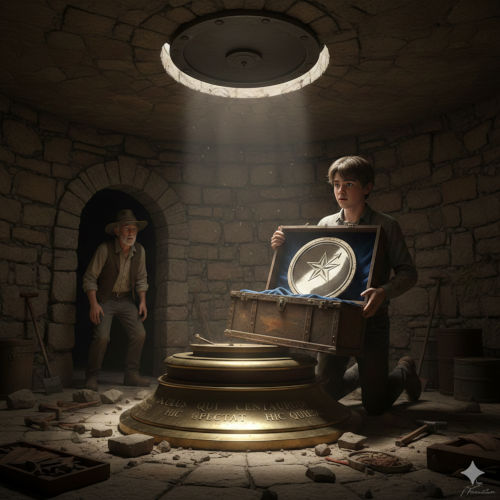
With a crowbar, he managed to pry the hatch open. A set of crumbling stone steps led down into a small, subterranean room. The air was cool and smelled of damp earth and old brass. This wasn’t a cellar; it was too deliberately circular.
In the centre of the room, positioned beneath a now-sealed hole in the ceiling, was a massive, brass-and-wood pedestal. The top section was missing, but etched deeply into the brass base plate was a series of calculations and an inscription:
The eye that watches the Centaur rests here.
Next to the pedestal, covered by a heavy tarpaulin, was a sturdy, military-style wooden trunk. It wasn’t locked, but sealed shut with heavy wax imprinted with a specific symbol: a large five-pointed star intersected by a long, curved arrow.
Ethan ripped the tarp off and lifted the lid. Inside, resting on velvet lining, was a single, beautiful artifact: a silvered, concave glass mirror, about 30 centimeters in diameter. It was clearly the primary lens for a powerful telescope, and it was perfectly preserved. This was the “eye” of the stargazer.
Suddenly, a voice boomed from the doorway. “What in the blazes have you found, boy?” Pop stood there, dusty and amazed. “That’s the foundation of your great-great-grandfather’s Observatory. We always wondered where he hid the telescope parts when he died.”
Comprehension Check: Chapter 1
- Setting and Environment: What is the primary environmental issue affecting Ethan’s family farm near Toowoomba, and what is the farm’s unique name?
- Discovery Location: Where, specifically, did Ethan find the hidden hatch?
- Physical Clues: What two items were inscribed on the brass base plate in the subterranean room?
- Key Artifact: What was the single, major object found inside the wooden trunk, and what was it clearly the lens for?
- Historical Figure: What did Ethan’s great-great-grandfather primarily use the circular room and the pedestal for?
Here is Chapter 2 of “The Sunken Observatory.”
🔭 Story 4: The Sunken Observatory
📜 Chapter 2: The Astronomer’s Code
Pop was thrilled by the discovery, but also puzzled. “Your great-great-grandfather, Arthur, was secretive. He sent his papers to the Sydney Observatory before he died, but he kept the key to his life’s work right here.”
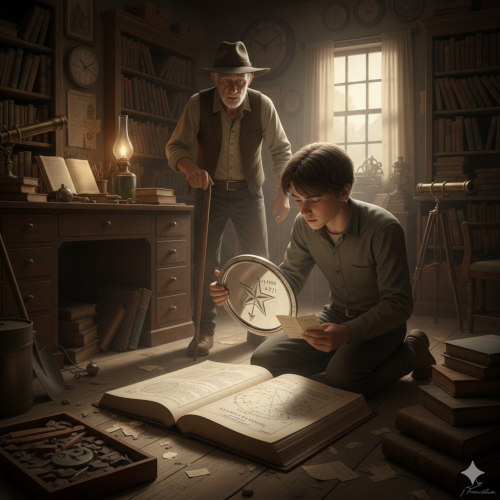
Ethan was more interested in the mirror. He noticed that the back of the concave glass was etched with the same five-pointed star and curved arrow symbol from the trunk’s wax seal. Beneath the symbol, a sequence of characters was written in a tight, looping script:
A-1400
C-47/1
M-20
This looked exactly like a form of astronomical coordinates, but they were incomplete. He remembered the inscription on the pedestal: The eye that watches the Centaur rests here. The Centaurus constellation, visible from the Southern Hemisphere, was famous for containing Alpha Centauri, the nearest star system to our own.
Ethan rushed to Pop’s small study, which was filled with dusty books. He needed an old star chart. After twenty minutes of searching, he found an 1890 edition of Celestial Navigation for Australian Settlers. Flipping to the section on Centaurus, he realized the letters likely represented star catalogue names:
- A could stand for Arthur, or possibly an Alpha star.
- C probably stood for the Centaurus constellation.
- M might indicate a Magnitude (brightness) or a Minute of time/arc.
He searched the Index for anything with the number 1400. He found a reference to a star catalogue known as the Australian Meridian Survey (AMS). The AMS used a system where 1400 was the catalogue number for Proxima Centauri, the closest known star in the Centaurus group. This meant the first line, A-1400, was a distraction, or just confirming the target star.
The key must be the second line: C-47/1. He knew that in old navigation, a slash often separated Degrees and Minutes.
- C = Centaurus.
- 47 = 47 degrees.
- 1 = 1 minute.
But what did the third line, M-20, mean? If M was magnitude, 20 was too dim to see. If it was Minute of Arc, it didn’t fit the pattern.
Ethan flipped the mirror over and saw that the wood frame holding the lens was chipped. Inside the chip was a tiny, folded piece of paper. It was a fragment of a journal page: …the three great domes look back. The alignment requires the M-20 to be set for the final hour.
Pop immediately understood. “The three great domes! That’s the Sydney Observatory! They have three iconic domes. Arthur must have aligned his telescope with a specific setting there to find his final secret.”
Comprehension Check: Chapter 2
- Prior Knowledge: According to Pop, where did Arthur send his papers before he died?
- Cipher Components: What are the three components of the coordinate sequence etched on the back of the mirror?
- Astronomical Identification: What star catalogue and specific star did Ethan connect the number 1400 to?
- New Clue/Artifact: What physical object did Ethan find hidden inside the mirror’s frame, and what critical instruction did it contain?
- Location Decoded: What specific landmark did Pop identify as the meaning of “the three great domes,” and where is it located?
Here is Chapter 3 of “The Sunken Observatory.”
🔭 Story 4: The Sunken Observatory
💻 Chapter 3: The Sydney Alignment
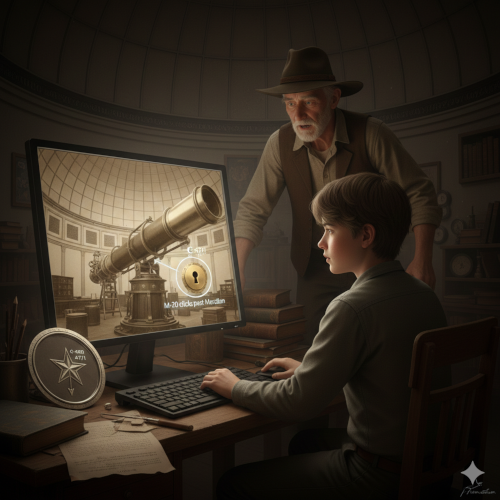
With the mirror clue in hand, Ethan knew he had to figure out the exact setting on one of the Sydney Observatory‘s telescopes. He realized he couldn’t just hop on a plane, so he did the next best thing: a deep dive into the Observatory’s digital archives.
He focused on the key coordinates: C-47/1 (Centaurus, 47 degrees, 1 minute) and the time factor, M-20.
Ethan found an old photograph of the Observatory’s interior, dating back to 1905, showing the main dome and the Telescope Turret. He noticed that each of the three major telescopes had a small, circular brass plate near its base, which was used to set its altitude. This was the target.
He needed to find out which telescope Arthur, the great-great-grandfather, would have used. Arthur’s note mentioned the Centaur constellation. Ethan cross-referenced Arthur’s working dates with the historical records and found that the Grubb Telescope was the primary instrument used for Southern Star mapping during that period.
Now for the final piece of the code: M-20. Ethan thought about the fragment of Arthur’s journal: The alignment requires the M-20 to be set for the final hour. The final hour of what? The day?
He discovered that in old observatories, when a celestial body was perfectly overhead (at its zenith), the telescope’s altitude reading would be set to $\mathbf{90^\circ}$. But when telescopes tracked stars across the sky, they often used a secondary reference for Meridian passages—the exact moment a star crosses the north-south line.
Ethan realized the ‘M’ likely stood for Meridian. The number 20 was not an angle, but a count. He found a set of archived instructions showing how astronomers would “count 20” clicks past the Meridian to offset for atmospheric refraction. The M-20 was an instruction: Move the altitude setting 20 clicks past the Meridian position.
Using the digitized photo, Ethan zeroed in on the Grubb Telescope’s altitude setting plate. He digitally superimposed the C-47/1 coordinates onto the plate. He saw a small, ornate screw head on the plate, clearly a decorative cover.
He zoomed in on the virtual image. The screw head, when rotated counter-clockwise by a tiny amount, revealed a miniature keyhole, perfectly sized for the small, star-shaped point on the back of his own silvered mirror. The lock was hidden inside the image itself, a digital representation of a physical lock.
This meant the final secret wasn’t at the Sydney Observatory; the Observatory itself was the key, and the code was the instruction for a hidden compartment back in Toowoomba.
Comprehension Check: Chapter 3
- Digital Research: What was the primary resource Ethan used to investigate the Sydney Observatory from his home in Toowoomba?
- Target Instrument: Which specific telescope at the Sydney Observatory did Ethan determine Arthur would have used for star mapping?
- Code Interpretation: What did Ethan determine the ‘M’ in M-20 stood for, and what did the number ’20’ represent in the context of telescope settings?
- Virtual Discovery: What small, hidden feature did Ethan find on the digitized image of the Grubb Telescope’s altitude plate?
- New Hypothesis: Why did Ethan conclude that the final secret must be back in Toowoomba, not at the Sydney Observatory?
Here is Chapter 4 of “The Sunken Observatory.”
🔭 Story 4: The Sunken Observatory
🔒 Chapter 4: The Final Lock
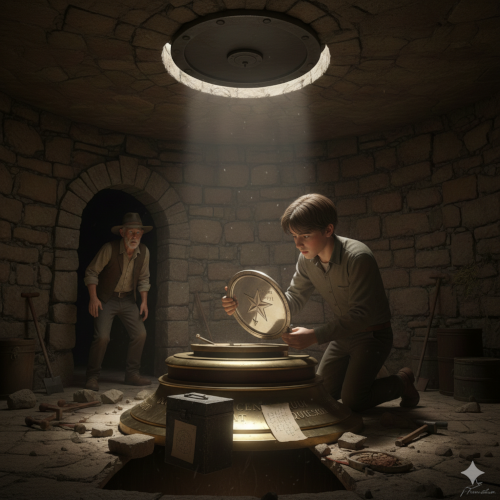
Armed with the knowledge that the Sydney Observatory was the key and the coordinates were the instruction, Ethan rushed back to the subterranean room beneath the dry water tank. Pop watched from the doorway, intrigued.
“We need to find a lock here that only accepts the telescope’s coordinates,” Ethan explained, pointing at the massive, empty pedestal. The eye that watches the Centaur rests here.
Ethan studied the pedestal’s brass base plate. It was covered in etched calculations, and the coordinate C-47/1 was clearly marked, but there was no keyhole. He suddenly remembered the other key: the time factor, M-20 (Meridian, 20 clicks).
He looked closely at the edge of the brass base plate. It was actually two plates fitted together, and the top one could rotate slightly. A series of tiny, unmarked click stops were etched around the circumference of the inner plate, like the markings on a compass.
“This is it, Pop,” Ethan whispered. “It’s not a keyhole; it’s a combination lock that uses rotation!”
He placed the silvered mirror onto the center of the pedestal. The concave glass fit perfectly into a shallow depression, settling exactly where the telescope’s eyepiece would have sat. The act of placing the mirror seemed to stabilize the pedestal, but nothing else happened.
Ethan realized the mirror wasn’t the lock; it was the handle and the alignment tool.
Following the sequence:
- Find the Starting Point: He rotated the mirror slowly until the etched symbol on its back (the five-pointed star and curved arrow) was perfectly aligned with the engraved coordinate C-47/1 on the brass plate. This was the “zero” point.
- Turn the Lock (M-20): He carefully turned the mirror counter-clockwise from the zero point. He listened carefully, counting the faint, rhythmic clicks: one, two, three… He stopped precisely on the twentieth click.
The moment the mirror reached the twentieth click, the massive brass pedestal didn’t move, but the foundation beneath it did. A loud, grinding sound echoed through the tiny room, and a section of the stone floor, directly beneath the pedestal, slid aside.
It revealed a deep, narrow shaft. Tucked into the side of the shaft, glowing faintly in the gloom, was a small, lead-lined metal box. Attached to the box was a note, written in the same looping script as the mirror’s code: The final alignment is ready for the rain.
Inside the lead-lined box, nestled amongst brittle tissue paper, was a bundle of what looked like tightly rolled, waterproofed parchments—Arthur’s missing papers. But the note was unnerving. “Ready for the rain.” The drought had kept this chamber dry, but if the rain ever returned, the shaft would flood. They had to retrieve the contents immediately.
Comprehension Check: Chapter 4
- Lock Mechanism: What did Ethan determine was the actual locking mechanism on the brass pedestal, rather than a traditional keyhole?
- Action/Climax: What action was required to set the “zero” point for the combination lock?
- Code Application: How did Ethan apply the M-20 code to the pedestal to unlock the secret?
- Discovery: What was revealed when the stone floor opened, and what key item was found inside the shaft?
- Final Warning: What crucial, unnerving message was attached to the lead-lined box, linking the discovery to the drought?
You’ve reached the final, critical chapter! The meaning of the story, and the secret of the drought-bound farm, will now be revealed.
Here is Chapter 5 of “The Sunken Observatory.”
🔭 Story 4: The Sunken Observatory
💧 Chapter 5: Celestial Fields

Ethan carefully extracted the lead-lined box containing the rolled parchments. Pop, his face etched with concern, read the attached note again: “The final alignment is ready for the rain.”
“The observatory foundation is built beneath the old tank,” Pop realized. “Arthur wasn’t just hiding his papers; he was protecting them from the water, or maybe waiting for the water to tell him something.”
They unrolled the parchments in the dry light of the kitchen. They weren’t star maps, but detailed geological surveys and architectural plans. Arthur wasn’t just a stargazer; he was an amateur hydrogeologist.
The final parchment was the key. It was a large, beautifully drawn cross-section of the ‘Celestial Fields’ property. It showed that the old Observatory foundation was not merely a subterranean room, but the capstone of a deep, ancient, natural underground fissure (a narrow opening). Arthur, using his astronomical calculations, had precisely located a hidden, massive subterranean aquifer—a vast, natural reservoir of fresh water, buried deep beneath the drought-stricken farm.
The inscription The eye that watches the Centaur rests here wasn’t just about the star; it was a clever double meaning. The “Centaur” was also a rare, deep-boring drill bit Arthur had ordered from Sydney a century ago, and the observatory’s telescope pedestal was built directly above the intended bore site.
The final message—The final alignment is ready for the rain—was Arthur’s instruction. The observatory and its telescope parts (the mirror and the pedestal) were the key to finding the water. The drought wasn’t an unavoidable fate; the solution was buried beneath their feet.
Ethan showed Pop the exact location on the map: a point marked with the five-pointed star symbol, just 30 meters from the old Observatory.
“He hid it all,” Pop said, tears welling up in his eyes as he looked at the century-old map. “He hid the plans so no one could profit or misuse the water, leaving a secret puzzle for his family to find when they needed it most.”
A week later, using the coordinates and the depth data on Arthur’s plan, a modern drilling rig arrived. After two days of drilling through layers of hard rock, the drill bit broke through. A massive geyser of clear, cool water erupted from the dry earth, soaking the dust-covered farm and finally justifying its name: Celestial Fields.
The story conveys that true knowledge and understanding (the “eye that watches”) can solve seemingly insurmountable problems (like the drought). The seemingly irrelevant pursuit of astronomy was actually a highly precise method for solving a vital local, geological problem. Ethan, by embracing the mystery of his history, saved his family’s future.
Comprehension Check: Chapter 5
- Nature of the Documents: What was the true content of the rolled parchments found in the lead-lined box?
- Double Meaning: Explain the dual meaning of the inscription “The eye that watches the Centaur rests here,” as revealed by the final chapter.
- The Great Secret: What major natural resource had Arthur’s final parchment and plans located beneath the farm?
- Moral/Message: What is the primary reason Arthur is implied to have created the puzzle and hidden the plans, rather than simply telling his family?
- Resolution: What physical event at the end of the chapter definitively proved the success of the quest, and what did this mean for the farm’s name?
*************************************************************************************
こんにちは!おかえりなさい。中学2年生の読書練習、**ストーリー4**を始めましょう。
この物語「沈んだ天文台」は、クイーンズランド州の地方を舞台に、ダーリング・ダウンズ周辺を中心とした科学と天文学の歴史的なつながりに焦点を当てています。
—
ストーリー4:沈んだ天文台
第1章:干ばつに見舞われた農場
イーサンは、トゥーンバ近郊にある家族の農場のひび割れた土を見つめて午後を過ごしていました。干ばつは容赦なく続き、敷地内で動いているのは砂嵐だけのように思えました。本来なら数学の宿題に取り組むはずでしたが、その代わりに、1800年代後半に高祖父が建てた古いクイーンズランド様式の家の歴史に夢中になっていました。
祖父のポップは、雨量と作物で人生を計る男で、この乾燥した気候では農場の名前「天空の畑」は冗談だとよく言っていた。「でも、昔は本当だったんだよ」とポップはよく言っていた。「お前の高祖父は大した農夫ではなかったが、熱心な**天体観測者**だったんだ。」
ある日の午後、メインの小屋の裏にある古くて乾いた貯水槽の土台を片付けていた時――貯水槽には2年間も水が入っていなかったからこそできる作業だった――イーサンは奇妙なものを見つけた。緩んだコンクリートの板の下に、レンガで塞がれた小さなハッチがあった。
バールでなんとかハッチをこじ開けた。崩れかけた石段が小さな地下室へと続いていた。空気は冷たく、湿った土と古い真鍮の匂いがした。ここは地下室ではなく、意図的に円形に作られていた。
部屋の中央、今は塞がれた天井の穴の下に、真鍮と木でできた巨大な台座があった。上部は失われていたが、真鍮の台座板には、一連の計算と銘文が深く刻まれていた。
*ケンタウロスを見張る目はここにある。*
台座の隣には、重い防水シートで覆われた、頑丈な軍用風の木製のトランクがあった。鍵はかかっていなかったが、重いワックスで封印され、そこには特定のシンボルが刻印されていた。大きな五芒せい(ペンタグラム)と、長く湾曲した矢印が交差していた。
イーサンは防水シートを剥がし、蓋を開けた。ベルベットの裏地の上に、美しい工芸品が一つあった。銀メッキの凹面ガラス製の鏡で、直径約30センチ。強力な望遠鏡の主レンズだったことは明らかで、完璧な状態で保存されていた。これは天文観測者の「目」だった。
突然、戸口から大きな声が響いた。「一体何を見つけたんだい、坊主?」父は埃まみれで驚きながらそこに立っていた。「あれは君の高祖父が作った**天文台**の基礎だ。亡くなった時に望遠鏡の部品をどこに隠したのか、いつも不思議に思っていたんだ。」
—
理解度チェック。第1章。
1. 設定と環境。 トゥーンバ近郊にあるイーサンの家族経営の農場を悩ませている主要な環境問題は何ですか?また、その農場のユニークな名前は何ですか?
2. 発見場所。 イーサンは具体的にどこで隠されたハッチを見つけましたか?
3.物理的手がかり。 地下室の真鍮製のベースプレートに刻まれていた2つのものは何ですか?
4. 重要な遺物。 木のトランクの中から見つかった唯一の重要な物体は何でしたか?そして、それは明らかに何のためのレンズでしたか?
5. 歴史上の人物。 イーサンの曽祖父は、円形の部屋と台座を主に何に使用していましたか?
—
ストーリー4:沈んだ天文台
第2章:天文学者の暗号
ポップはこの発見に興奮すると同時に、困惑もした。「きみの高祖父、アーサーは秘密主義だった。死ぬ前に書類をシドニー天文台に送ったが、生涯の仕事の鍵はここに保管していたんだ。」
イーサンは鏡にもっと興味を持っていた。凹面ガラスの裏側に、トランクの蝋封と同じ大きな五芒せい(ペンタグラム)と湾曲した矢印のシンボルが刻まれていることに気づいた。その記号の下には、ぎっしりと詰まった曲線状の文字が並んでいた。
A-1400
C-47/1
M-20
これはまるで天文座標のようだが、不完全だった。台座に刻まれた銘を思い出した。「ケンタウルス座を見守る目はここにある。」南半球から見えるケンタウルス座は、地球に最も近い恒星系であるアルファ・ケンタウリ(α星)があることで有名だった。
イーサンは埃っぽい本でいっぱいのポップの小さな書斎へ急いだ。古い星図が必要だった。20分ほど探した後、1890年版の「オーストラリア開拓者のための天体航法」を見つけた。ケンタウルス座の項をめくると、文字は星表名を表している可能性が高いことに気づいた。
* A は アーサー 、あるいは アルファ 星を表している可能性がある。
* C はおそらく ケンタウルス座 を表している。
* M は 等級(明るさ)か、分 の時間/弧を表している可能性がある。
彼は索引で 1400 という数字を含むものを探した。そして、オーストラリア子午線調査 (AMS) と呼ばれる星表への参照を見つけた。AMS は、ケンタウルス座グループで最も近い既知の恒星である プロキシマ・ケンタウリ のカタログ番号を 1400 とするシステムを採用していた。つまり、最初の行 A-1400 は、注意をそらすためか、あるいは単に対象の星を確認するためのものだった。
鍵となるのは2行目の「C-47/1」だろう。昔の航海術では、斜線で度と分を区切ることが多かったことを彼は知っていた。
C = ケンタウルス座。
47 = 47度。
1 = 1分。
しかし、3行目の「M-20」は何を意味するのだろうか?Mが等級だとしたら、20は暗すぎて見えない。分角だとしたら、パターンに合わない。
イーサンは鏡をひっくり返し、レンズを支える木枠が欠けているのに気づいた。欠けた部分の中には、小さな折り畳まれた紙切れが入っていた。それは日記のページの断片だった。「…3つの大きなドームがこちらを見ています。調整するには、M-20を最後の1時間に合わせる必要があります。」
ポップはすぐに理解した。 「3つの巨大なドーム!あれはシドニー天文台だ!象徴的なドームが3つあるんだ。アーサーは最後の秘密を見つけるために、望遠鏡をそこに特定の位置に合わせなければならなかったに違いない。」
—
理解度チェック。第2章
1. 前提知識。 ポップによると、アーサーは死ぬ前に書類をどこに送ったのですか?
2. 暗号の構成要素。 鏡の裏側に刻まれた座標列の3つの構成要素は何ですか?
3. 天文学的同定。 イーサンは1400という数字をどの星表と特定の星に結び付けましたか?
4. 新たな手がかり/遺物。 イーサンは鏡の枠の中に隠されていた物体を発見しましたか?そして、そこにはどのような重要な指示が書かれていましたか?
5. 場所の解読。 ポップは「3つの巨大なドーム」の意味として、どのランドマークを特定しましたか?そして、それはどこにありますか?
—
ストーリー4:沈んだ天文台
第3章:シドニー天文台の配置
鏡の手がかりを手にしたイーサンは、シドニー天文台の望遠鏡の正確な位置を突き止めなければならないと悟りました。飛行機に乗って移動するわけにはいかないと悟ったイーサンは、次善の策として天文台のデジタルアーカイブを徹底的に調べました。
彼は重要な座標である、C-47/1(ケンタウルス座、47度1分)と時間要素である、M-20に注目しました。
イーサンは天文台内部を写した1905年撮影の古い写真を見つけました。そこにはメインドームと望遠鏡タレットが写っていました。彼は、3つの主要な望遠鏡のそれぞれに、基部近くに小さな円形の真鍮板があり、それを使って高度を定めることに気づいた。これが目標だった。
彼は、高祖父アーサーがどの望遠鏡を使用していたかを調べる必要があった。アーサーのメモにはケンタウルス座について言及されていた。イーサンはアーサーの作業日と歴史的記録を照合し、その時代に南半球の星図作成に主に使用されていたのはグラブ望遠鏡であることを突き止めた。
さて、コードの最後のピース、M-20 だ。イーサンはアーサーの日記の断片について考えた。調整には、M-20 を最後の1時間に合わせる必要がある。 何の最後の1時間? その日の最後の1時間?
彼は、昔の天文台では、天体が真上(天頂)にあるとき、望遠鏡の高度表示は 90度 に設定されていたことを発見しました。しかし、望遠鏡が天空の星を追跡する際には、子午線通過、つまり星が南北線を横切る正確な瞬間を基準とすることが多かったのです。
イーサンは、「M」はおそらく子午線の略だと気づきました。20 という数字は角度ではなく、カウントです。彼は、天文学者が大気の屈折を補正するために子午線を「20」回数える方法を示す、アーカイブされた一連の指示書を見つけました。 M-20 は指示でした。高度設定を子午線位置から20クリック分進めてください。
デジタル化された写真を使って、イーサンはグラブ望遠鏡の高度設定板に焦点を合わせました。彼は $C-47/1$ 座標をその板にデジタル的に重ね合わせました。板の上に小さな装飾的なネジの頭が見えましたが、明らかに装飾用のカバーでした。
彼はその仮想像を拡大しました。ネジの頭を反時計回りに少し回すと、小さな鍵穴が現れました。これは、彼が所有する銀鏡の裏側にある小さな星型の点にぴったり合う大きさでした。鍵は画像自体の中に隠されており、物理的な鍵のデジタル表現でした。
つまり、最終的な秘密はシドニー天文台にあるのではなく、天文台自体 が鍵 であり、そのコードはトゥーンバにある隠し部屋への指示だったのです。
—
理解度チェック。第3章
1. デジタル調査。 イーサンがトゥーンバの自宅からシドニー天文台を調査するために使用した主な資料は何ですか?
2. 対象機器。 イーサンは、アーサーが星図作成に使用したであろうシドニー天文台の具体的な望遠鏡を特定しましたか?
3. コード解釈。 イーサンは、M-20 の「M」は何を表していると推測しましたか?また、望遠鏡の設定において「20」という数字は何を表していましたか?
4. 仮想発見。 イーサンは、グラブ望遠鏡の高度計のデジタル画像上で、どのような小さな隠された特徴を見つけましたか?
5. 新しい仮説。 イーサンはなぜ、最後の秘密はシドニー天文台ではなくトゥーンバにあるはずだと結論付けたのですか?
—
Q: 残念ながら、私は天文学の知識がないので、物語に出てくる専門用語のオタク的な魅力が理解できませんが、中学2年生くらいのお子さんなら興味をそそられるかもしれません。第4章に進んでください。
A: 率直なご意見、ありがとうございます!確かに、これらの用語は専門用語になることもありますが、科学やパズルに興味のある生徒にとっては非常に興味深い内容です。以降の章では、物語の焦点がアクションとミステリーにしっかりと合うように努めます。
—
ストーリー4:沈んだ天文台
第4章:最後の鍵
シドニー天文台が鍵で、座標が指示であるという知識を武器に、イーサンは乾いた水タンクの下の地下室へと急いで戻りました。ポップは戸口から興味津々にそれを見ていました。
「望遠鏡の座標だけを受け付ける鍵をここで見つける必要がある」とイーサンは、巨大な空っぽの台座を指差しながら説明しました。 ケンタウロスを見張る目はここにある。
イーサンは台座の真鍮製ベースプレートをじっくりと観察した。そこには計算式が刻まれ、座標 C-47/1 がはっきりと刻まれていたが、鍵穴はなかった。彼は突然、*もう一つの*鍵のことを思い出した。時間を表す要素、M-20(子午線、20クリック)だ。
彼は真鍮製ベースプレートの端をよく見てみた。それは実際には2枚のプレートが組み合わさったもので、上のプレートは少し回転する。内側のプレートの円周には、コンパスの目盛りのように、小さな、目盛りのないクリックストップが刻まれていた。
「これだ、ポップ」イーサンはささやいた。「鍵穴じゃない。回転を利用したコンビネーションロックだ!」
彼は銀色の鏡を台座の中央に置いた。凹面ガラスは浅い窪みにぴったりと収まり、望遠鏡の接眼レンズが取り付けられるはずの位置に正確に収まりました。鏡を置くことで台座が安定するように見えましたが、それ以外は何も起こりませんでした。
イーサンは鏡がロックではなく、ハンドルと調整ツールであることに気付きました。
手順は以下のとおりです。
1. 開始点を見つける。 鏡の裏面に刻まれたシンボル(五芒せいと湾曲した矢印)が真鍮板に刻まれた座標 C-47/1 と完全に一致するまで、鏡をゆっくりと回転させました。これが「ゼロ」点です。
2. ロックを回す (M-20)。 ゼロ点から鏡を反時計回りに慎重に回転させました。彼は注意深く耳を澄ませ、かすかなリズミカルなクリック音を数えました。1、2、3… 20回目のクリックで停止しました。
鏡が20回目のカチッという音を鳴らした瞬間、巨大な真鍮の台座は動かなかったが、その下の土台が動いた。大きな軋む音が小さな部屋に響き渡り、台座の真下の石の床の一部が滑り落ちた。
すると、深く細い竪穴が現れた。竪穴の側面に、薄暗い中でかすかに光る小さな鉛で覆われた金属製の箱が挟まっていた。箱には、鏡の暗号と同じ文字で書かれたメモが添えられていた。「雨に備えて、最終調整が完了した。」
鉛で覆われた箱の中には、脆い薄紙に挟まれ、きつく巻かれ、防水加工された羊皮紙らしきものが束になって入っていた。アーサーの行方不明の書類だ。しかし、そのメモは不安を掻き立てた。「雨に備えて。」干ばつのおかげでこの部屋は乾いていたが、もし再び雨が降れば、竪穴は浸水してしまうだろう。すぐに中身を回収しなければならなかった。
—
理解度チェック。4章
1. 錠の仕組み。 イーサンは、真鍮の台座に施錠機構が、従来の鍵穴ではなく、実際に何であると判断しましたか?
2. アクション/クライマックス。 コンビネーションロックの「ゼロ」ポイントを設定するには、どのような操作が必要でしたか?
3. コードの適用。 イーサンはどのようにして台座にM-20コードを適用し、秘密を解き明かしましたか?
4. 発見。 石の床が開いたとき、何が明らかになりましたか?そして、シャフトの中にはどんな鍵が見つかりましたか?
5. 最終警告。 鉛で覆われた箱に添えられていた、発見と干ばつを結びつける、重要かつ不安を掻き立てるメッセージは何ですか?
—
いよいよ最終章、そして重要な章に到達しました!物語の真髄、そして干ばつに見舞われた農場の秘密が、今、明かされます。
—
第4話:沈んだ天文台
第5章:天体
イーサンは巻かれた羊皮紙の入った鉛で覆われた箱を慎重に取り出した。ポップは不安げな表情で、添えられたメモをもう一度読んだ。「雨に備えて、最終的な調整が完了しました。」
「天文台の基礎は古いタンクの下に作られているんだ」とポップは気づいた。「アーサーはただ書類を隠していただけじゃない。水から守っていたのか、あるいは水が何かを教えてくれるのを待っていたのかもしれない。」
彼らはキッチンの乾いた光の中で羊皮紙を広げた。それは星図ではなく、詳細な地質調査と建築設計だった。アーサーは単なる天体観測者ではなく、アマチュア水文地質学者でもあった。
最後の羊皮紙が鍵だった。それは「天空の畑」の敷地の、大きく美しく描かれた断面図だった。そこには、かつての天文台の基礎が単なる地下室ではなく、深く古代にできた自然の地下亀裂(狭い開口部)の**頂石**であることが示されていた。アーサーは天文学的な計算を用いて、干ばつに見舞われた農場の地下深くに埋もれた、隠された巨大な地下**帯水層**、つまり広大な天然の淡水貯留層を正確に突き止めたのだ。
ケンタウロスを見守る目はここに、という碑文は、単に星のことだけを言っているのではない。巧妙な二重の意味を持っていたのだ。 「ケンタウロス」は、アーサーが1世紀前にシドニーから注文した希少な深部掘削用の**ドリルビット**でもあり、天文台の望遠鏡台座は掘削予定地の真上に建設されました。
最後のメッセージ――「雨のための最終調整が完了しました」――はアーサーの指示でした。天文台とその望遠鏡部品(鏡と台座)が水源を見つける鍵でした。干ばつは避けられない運命ではありませんでした。解決策は彼らの足元に埋もれていたのです。
イーサンはポップに地図上の正確な位置を示しました。大きな五芒せい(ペンタグラム)のシンボルでマークされた地点で、古い天文台からわずか30メートルのところでした。
「彼はすべてを隠したんだ」とポップは100年前の地図を見つめながら、目に涙を浮かべながら言いました。「誰も水から利益を得たり悪用したりできないように、設計図を隠したんだ。家族が最も困った時に見つけられる秘密のパズルを残してね。」
1週間後、アーサーの図面に記載された座標と深度データをもとに、最新式の掘削装置が到着しました。2日間にわたる硬い岩盤の掘削作業の後、ついにドリルビットが穴を突き破りました。乾いた大地から澄んだ冷水の巨大な間欠泉が噴き出し、埃まみれの農場を水浸しにし、ついにその名が「天空の野」にふさわしいものとなりました。
この物語は、真の知識と理解(「見守る目」)が、一見克服不可能に見える問題(干ばつなど)を解決できることを伝えています。一見無関係に思える天文学の探求は、実は地元の重要な地質学的問題を解決するための非常に精密な手段でした。イーサンは、自らの生い立ちの謎を受け入れることで、家族の未来を救ったのです。
[地下帯水層図の画像]
—
理解度チェック。第5章
1. 文書の性質。 鉛で覆われた箱の中にあった巻かれた羊皮紙の真の内容は何でしたか?
2. 二重の意味。 最終章で明らかにされた「ケンタウロスを見張る目はここにある」という碑文の二重の意味を説明してください。
3. 大いなる秘密。 アーサーの最後の羊皮紙と設計図は、農場の地下にどのような主要な天然資源として存在していましたか?
4. 教訓/メッセージ。 アーサーがパズルを作成し、設計図を家族に話すのではなく隠した主な理由は何ですか?
5. 解決。 章の終わりに起こった物理的な出来事の中で、探求の成功を決定的に証明するものは何ですか?そして、それは農場の名前にどのような意味をもたらしましたか?