We’ve reached the final story, and I will ensure it has a more measured pace and focuses on action and environmental mystery without getting overly technical.
This story, “The Tidal Echo,” will be set in the coastal wetlands near Mackay, focusing on local history and the impact of modernization.
🛶 Story 5: The Tidal Echo
🏝️ Chapter 1: The Old Jetty
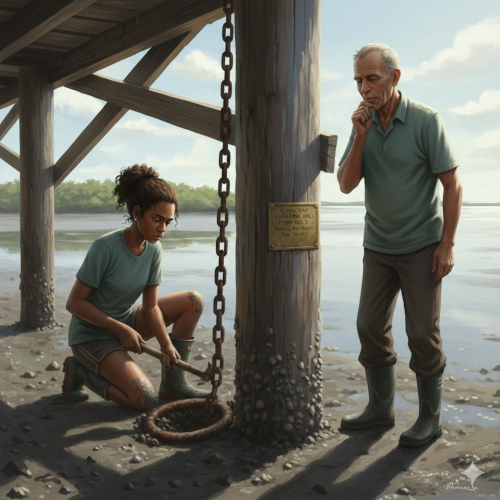
Maya loved the peace of the tidal flats near Mackay. The air always smelled of salt and sweet mud, a perfect contrast to the crowded school hallways. She was spending the term break with her aunt and uncle, who ran a small fishing charter.
Her favourite spot was the remains of an old, abandoned wooden jetty. It jutted out into the water like a broken finger, covered in tenacious barnacles and weathered grey timber. The jetty was deemed unsafe decades ago, but it had a quiet, forgotten charm.
One sunny afternoon, while sketching the mangrove silhouette, Maya noticed something odd clinging to one of the thickest, lowest pilings (support posts) of the jetty. It wasn’t a barnacle cluster or a shell; it was a piece of metal—a brass nameplate, almost completely encased in a layer of lime and algae.
Armed with a sturdy cleaning brush, Maya spent an hour carefully scrubbing the plate clean. The nameplate was rectangular and heavy. The inscription was faint but legible:
C. MACKAY SUGAR MILL PUMP NO. 3
Warning: Do Not Disable Code: 7A-1915
“A sugar mill pump?” Maya frowned. The closest operational sugar mill was kilometers away. And a “code”? Why would a pump have a warning code?
She used a stick to scrape around the base of the piling where the nameplate had been attached. The wood here was softer, almost crumbly, suggesting recent disturbance. As she pushed the stick deeper, it hit something hollow.
Maya returned with a small spade and started digging into the mud beneath the jetty. After ten minutes, she unearthed a large, corroded iron ring. The ring was attached to a thick, rusted chain that disappeared downward into the mud and the murky tidal water. Whatever it was attached to was big and heavy.
Uncle Ben, who came to check on her, whistled softly when he saw the ring. “That’s not fishing gear, Maya. The local rumour is that back around World War I, when the sugar industry was booming, one of the mills dumped a huge piece of machinery—some kind of experimental pump—out here to get rid of it. They said it was faulty, or maybe cursed.”
Maya looked back at the nameplate: 7A-1915. That date fit perfectly with the rumour. She was no longer just cleaning an old jetty; she had found a piece of industrial history that someone had deliberately concealed. The key to the sunken pump, and whatever it did, lay in the forgotten code.
Comprehension Check: Chapter 1
- Setting and Character: Where is Maya spending her term break, and what is the primary environment of the story?
- Key Artifact: What specific object did Maya find clinging to the old jetty piling?
- Historical Clues: What two pieces of information were clearly visible on the brass nameplate?
- Second Discovery: What large object did Maya find buried in the mud, and what was its purpose?
- Local Knowledge: What did Maya’s Uncle Ben reveal about the sunken object based on local rumours?
Here is Chapter 2 of “The Tidal Echo,” where Maya begins to research the mysterious sugar mill pump and its code.
🛶 Story 5: The Tidal Echo
🔍 Chapter 2: The Engineer’s Ledger

Maya brought the brass nameplate and the story of the sunken pump to Uncle Ben’s workshop. The pump’s code—7A-1915—stuck in her mind. It felt like a date, a model number, and a specific instruction all rolled into one.
“That mill was C. Mackay Sugar,” Uncle Ben said, polishing the nameplate with steel wool. “They consolidated with another company around the time that pump would have been retired. All their old records went to the Mackay Historical Archive.”
The next day, Maya cycled into town and spent the morning in the archive’s dusty reading room. She asked for any records related to the C. Mackay Sugar Mill from 1915. After an hour, the archivist brought her a massive, leather-bound book: the Mill Engineer’s Ledger for 1914–1916.
Flipping through the thick, brittle pages, she found a reference to “Experimental Tidal Pump No. 3,” installed to manage high salinity (saltiness) in the mill’s water intake during seasonal king tides. The pump was described as “overly complex” and was only operational for two weeks before being decommissioned.
On the final page dedicated to the pump, there was a handwritten entry dated Dec 12, 1915, signed by the chief engineer, Reginald Clarke. It read:
Pump No. 3 was dismantled and submerged at the secondary intake jetty. We must not permit the inversion cycle to be activated. If found, the safety measure requires the tide to be turned back at the lowest marker. Use the Seven Arches Rule to find the safety pin.
Beneath this warning, the code was repeated with a small footnote: 7A-1915: The 7 refers to the Arches, the A refers to the Anchor chain position.
This was a major breakthrough. The code was an instruction! The question was, what were the “Seven Arches”?
Maya knew of the large, modern traffic bridge near the town centre that had seven arches. But the engineer’s ledger was 1915. She pulled out a local history book and found a picture of the old, original Town Wharf near the river mouth. It had been demolished sixty years ago, but the picture clearly showed a massive, stone seawall with exactly seven distinct arches where the boats moored. The ruins of that old seawall were now mostly submerged, only visible during the lowest of tides.
Maya knew where she had to go next. She needed to return to the original Town Wharf location at the river mouth and wait for the tide to expose the ancient Seven Arches.
Comprehension Check: Chapter 2
- Information Source: Where did Maya go to find the historical records about the sugar mill pump?
- Pump Purpose: What was the experimental pump originally designed to help the sugar mill manage?
- The Threat: According to the engineer’s ledger, what process or cycle must not be activated if the pump is found?
- Deciphering the Code: What did the engineer’s footnote reveal that the ‘7’ and the ‘A’ in the code $7A-1915$ stood for?
- New Location: What specific historical structure did Maya identify as the ‘Seven Arches,’ and what natural condition was necessary to see it?
Here is Chapter 3 of “The Tidal Echo.”
🛶 Story 5: The Tidal Echo
🗿 Chapter 3: The Seven Arches Rule
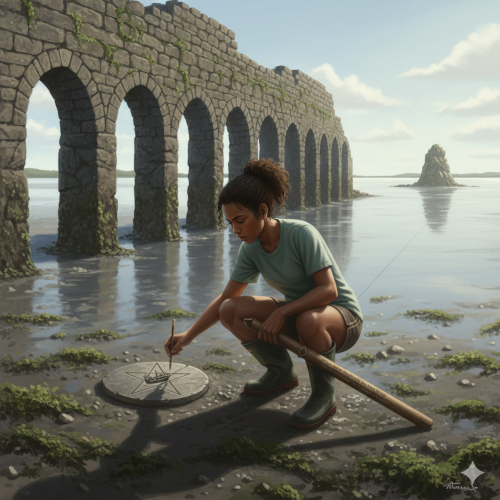
Maya arrived at the ruins of the old Town Wharf near the river mouth just as the tide was dropping to its lowest point. She navigated the slippery, algae-covered rocks until she reached the submerged seawall. Just as the old photograph had shown, the stone structure had seven distinct arches where small boats used to dock. The arches were now mostly exposed, dripping water.
The engineer’s ledger warned: Use the Seven Arches Rule to find the safety pin.
Maya realized this wasn’t about counting arches; it was about an instruction related to the number seven and the letter ‘A’ from the code 7A-1915. ‘A’ stood for the Anchor chain position.
She remembered the thick, rusted chain attached to the sunken pump back at the jetty. She reasoned that the chain was the only anchor connecting the pump to the surface, and its position must be crucial.
Maya started at the first arch and counted down the arches, looking for a marking or clue. Nothing. She checked the stonework of the seventh arch. Nothing there either.
She reread the journal entry in her mind: “Use the Seven Arches Rule…” Perhaps the ‘rule’ involved a relationship between the arches.
She ran her hand along the base of the arches, feeling the coarse, old stone. As she reached the fourth arch—the center point of the seven—her fingers brushed against something recessed. It was a smooth, polished stone plate, about the size of her palm, set perfectly flush into the stone base of the arch. It was almost invisible beneath the tidal scum.
She cleaned the plate. It was engraved with a perfect, elegant diagram: a seven-pointed star, and in the center, a miniature carving of a fishing trawler.
Suddenly, the whole sequence clicked. The number ‘7’ referred to the seven-pointed star. The ‘A’ in the code 7A referred to the Apex (or top point) of the star!
Maya took a pencil from her pocket and placed its tip on the center point of the star carving. She drew a faint line from the center, outward through the top point of the star. That line pointed directly—not back to the old jetty where the pump was found—but to a single, much smaller, isolated rock stack about fifty metres offshore.
She waded out towards the rock stack, her boots sinking in the soft mud. At the base of the stack, she found a narrow, deep crevice. Inside the crevice, protected from the tides for over a century, was the “safety pin”—a long, bronze lever, perfectly preserved, but with its main pin broken clean off. The engineer had truly left a broken pledge.
The inscription on the lever read: To be inserted into the Inversion Keyway and turned against the natural flow.
The pin was broken, but she had the bronze lever. She knew the keyway must be on the sunken pump itself. Now she just needed to figure out how to access the pump before the tide came back in.
Comprehension Check: Chapter 3
- Setting Detail: Describe the physical condition of the ‘Seven Arches’ seawall when Maya reached it.
- Cipher Breakthrough: What key artifact (a stone plate) did Maya find on the seawall, and what two objects were engraved on it?
- The Rule Decoded: What did Maya determine the ‘7’ and the ‘A’ in the code 7A referred to on the engraved stone?
- Directional Clue: Where did the line drawn through the apex of the seven-pointed star direct Maya?
- New Key Artifact: What object was found at the isolated rock stack, and what was its critical instruction?
Here is Chapter 4 of “The Tidal Echo.” The clock is ticking against the rising tide.
🛶 Story 5: The Tidal Echo
⏳ Chapter 4: Against the Flow
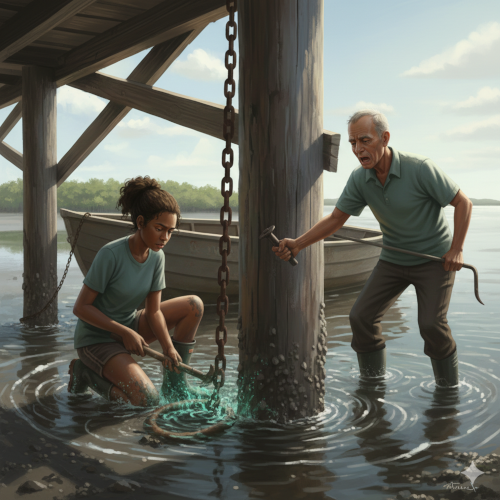
Maya and Uncle Ben motored their small boat back to the old, broken jetty. The tide was steadily creeping in, submerging the flats and making the water murky. They tied the boat to one of the intact pilings.
The rusted chain they had found in Chapter 1 was still anchored to the sunken pump. The problem was that the heavy pump—which they knew was now dangerously close to activating its “inversion cycle”—was far too deep and heavy to lift.
“We need to get to the Inversion Keyway,” Maya said, holding up the bronze lever they found at the rock stack. “It says we have to turn it against the natural flow.”
“Against the flow means counter-clockwise,” Uncle Ben noted. “But you can’t dive down to a massive pump in this mud and attach that lever.”
Maya studied the thick, rusted chain. It was anchored firmly to the pump below, but its upper loops were accessible just beneath the water surface. The chain itself was the only physical connection they had to the pump’s submerged body.
“What if the chain is the keyway?” Maya suggested, looking at the inscription on the lever. The lever was designed to turn against the flow.
She realized the engineer’s design must have been clever. The pump was experimental. The Inversion Keyway wasn’t on the pump’s body; it was designed to be operated from the surface using the chain.
Uncle Ben quickly fashioned a strong loop of rope and attached it to the bronze lever’s handle. He carefully threaded the rusted chain through the loop.
Maya took the lever, now threaded onto the chain, and lowered it, sliding it down until it reached the first solid, accessible anchor point on the main chain loop. She found a small, circular depression on that specific link—a lock point. The broken-off pin from the original lever was meant to slot into it.
Since the pin was broken, she had to improvise. Uncle Ben quickly handed her a large, sturdy steel bolt from the boat’s toolkit. Maya pushed the steel bolt through the link, securing the bronze lever in place, using the chain itself as the keyway.
She took a deep breath. She started to turn the lever, trying to force the heavy, rusted chain link to rotate. It grated and groaned, resisting her effort. The tide was already washing over her ankles.
“Turn it counter-clockwise! Against the flow!” Uncle Ben shouted, urging her on.
With a final, desperate heave, the lever moved one loud, scraping rotation against the current.
The water around the pump’s submerged location didn’t froth or bubble. Instead, a powerful, deep humming sound began to resonate up the chain. The noise was unnatural and worrying. The lever was still stuck in the ‘on’ position. They had activated the pump, but they hadn’t stopped it—and the tide was still coming in, creating the exact conditions the engineer had warned against!
Comprehension Check: Chapter 4
- Imminent Threat: Besides the weight of the pump, what natural event was creating urgency during this part of the quest?
- Improvisation: What specific material did Maya use to secure the bronze lever to the chain, replacing the original broken pin?
- Key Insight: What specific component did Maya and Uncle Ben realize was actually serving as the “Inversion Keyway”?
- Action and Result: What direction did Maya turn the lever, and what was the immediate, audible effect on the submerged pump?
- New Conflict: Why was the result of turning the lever alarming, despite successfully activating the pump?
We are at the final, crucial chapter! Let’s resolve the mystery of the tidal pump.
Here is Chapter 5 of “The Tidal Echo.”
🛑 Chapter 5: Inverting the Cycle
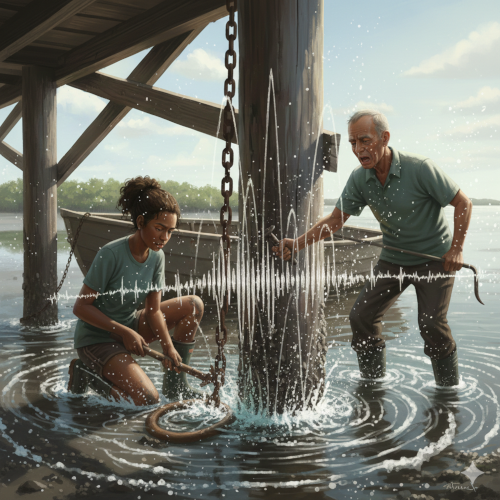
The deep, unsettling humming of the submerged pump grew louder, vibrating through the hull of the boat and the water around the old jetty. The tide was rushing in fast, and the combination of the king tide and the activated pump meant they had triggered the inversion cycle—the pump was rapidly drawing in huge volumes of water, likely increasing the speed of the rising tide in the local area.
“We didn’t just turn it on, Maya,” Uncle Ben yelled over the noise. “We turned it on against the flow! It’s running in reverse, making the tide surge! It’s the exact mistake the engineer warned against!”
Maya stared at the brass nameplate: Warning: Do Not Disable Code: $\text{7A-1915}$. The code wasn’t just to find the lever; it was the instruction on how to stop the pump safely.
She remembered the entire instruction from the Engineer’s Ledger: “The safety measure requires the tide to be turned back at the lowest marker.”
The lever was stuck in the “turned” position, held fast by the steel bolt and the pump’s own immense power. They couldn’t pull it out, and they couldn’t turn it back to the ‘off’ position.
“The keyway is the chain!” Maya suddenly shouted. “The pump’s power is running through the chain. The only way to turn the tide back is to reverse the direction of the power again!”
Maya looked at the lever. It had one rotation counter-clockwise—against the natural flow. To “turn the tide back” and stop the inversion, she had to rotate the lever clockwise—with the natural flow—to complete a full reversal cycle.
She grabbed the handle of the bronze lever, which was still firmly secured to the chain link. She put all her weight and strength into pushing it clockwise. The pump’s immense power fought her. Her hands slipped on the wet bronze.
Uncle Ben immediately leaped to help. Together, pushing with all their combined strength with the natural direction of the current, they managed to force the lever past the stuck point. The lever slowly, agonizingly, turned for a second, full rotation.
The moment the rotation was complete, the powerful, dangerous humming stopped instantly. The water, which had been rushing in with unnatural force, immediately slowed, returning to the normal, steady pace of the rising tide. The pump had been silenced.
They quickly pulled the lever and the steel bolt out of the chain link. The danger had passed.
Days later, a specialized salvage team recovered the pump. It wasn’t designed to drain water, but to powerfully mix it, rapidly accelerating the salt content in the water intake—a way to sabotage a rival mill during the war years, disguised as a faulty tidal regulator. The engineer, having fixed the sabotage pump but unable to destroy the evidence, had buried it with a cryptic, coded safeguard, hoping the next generation would understand the warning.
Maya looked out at the tranquil, beautiful tidal flats. She hadn’t just solved an industrial puzzle; she had prevented an ecological disaster and ensured that the history of the Mackay coast remained known, not forgotten.
Comprehension Check: Chapter 5
- Immediate Danger: What was the final, critical mistake Maya and Uncle Ben made that activated the ‘inversion cycle,’ and what was the effect on the water?
- Stopping the Pump: What specific action did Maya determine was necessary to complete the reversal cycle and stop the pump?
- Climactic Action: Who helped Maya perform the final, required action, and in what direction did they push the lever?
- Pump’s True Purpose: After recovery, what was the pump’s actual design function, and what was it likely used for in 1915?
- Conclusion/Significance: What was the dual importance of the coded safeguard left by the engineer, and what does this convey about the value of history?
That concludes Story 5: The Tidal Echo, and all five stories for your Grade 8 reading practice. I hope these stories are engaging and effective for the students!
********************************************************************************************************************************************************
今回は、技術的な話に偏りすぎず、アクションと環境ミステリーに焦点を当て、より落ち着いたペースで書けるようにしたいと思っています。
この物語「潮のこだま」は、マッカイ近郊の沿岸湿地帯を舞台に、地元の歴史と近代化の影響に焦点を当てます。
—
## 🛶 第5話:潮のこだま
### 🏝️ 第1章:古い桟橋
マヤは**マッカイ**近郊の干潟の静けさが大好きでした。空気はいつも潮の香りと甘い泥の香りが漂い、混雑した学校の廊下とは対照的でした。彼女は学期休暇中、小さな釣り船を経営する叔父と叔母と一緒に過ごしていました。
彼女のお気に入りの場所は、古くて廃墟となった木造の**桟橋**の跡でした。それは折れた指のように水面に突き出ており、頑固なフジツボと風化した灰色の木材で覆われていました。桟橋は数十年前は安全ではないとされていましたが、静かで忘れ去られた魅力を放っていました。
ある晴れた午後、マングローブのシルエットをスケッチしていたマヤは、桟橋の最も太く低い支柱の一つに奇妙なものがくっついていることに気づきました。それはフジツボの塊でも貝殻でもなく、金属片でした。真鍮の**銘板**で、石灰と藻の層にほぼ完全に覆われていました。
丈夫な掃除用ブラシを手に、マヤは1時間かけて丁寧にその銘板をこすり洗いしました。銘板は長方形で重厚なものでした。刻印はかすれていましたが、読み取ることができました。
**C. マッケイ製糖工場ポンプ No. 3**
**警告:無効化しないでくださいコード:7A-1915**
「製糖工場のポンプ?」マヤは眉をひそめました。一番近い稼働中の製糖工場は数キロも離れていました。それに「コード」だって?なぜポンプに警告コードがあるのでしょう?
彼女は棒切れで、銘板が取り付けられていた杭の根元の周りをこすった。この辺りの木は柔らかく、ほとんど崩れかけており、最近荒らされたことを示唆していた。棒を深く押し込むと、何か空洞のものに当たった。
マヤは小さなスコップを持って戻り、桟橋の下の泥を掘り始めた。10分後、彼女は大きな腐食した鉄の指輪を掘り出した。指輪は太くて錆びた鎖につながれていて、泥と濁った潮間帯の中へと消えていった。それが何に繋がれていたにせよ、大きくて重かった。
様子を見に来たベンおじさんは、指輪を見て小さく口笛を吹いた。「あれは漁具じゃないよ、マヤ。地元の噂では、第一次世界大戦の頃、砂糖産業が隆盛だった頃、製糖工場の一つが巨大な機械、いわゆる**実験用のポンプ**を処分するためにここに捨てたらしいんだ。故障したか、呪われていると言われていたんだ。」
マヤは銘板を振り返った。「7A-1915」。その日付は噂と完全に一致していた。彼女はもはや古い桟橋を掃除しているだけではない。誰かが故意に隠した産業史の一片を発見したのだ。沈没したポンプの鍵、そしてそれが何をするものであれ、その鍵は忘れられた暗号の中にあった。
—
### **理解度チェック:第1章**
1. **設定と登場人物:** マヤは学期休暇をどこで過ごしていますか?そして、物語の主な舞台は何ですか?
2. **重要な遺物:** マヤは古い桟橋の杭にしがみついているのを見つけましたか?
3. **歴史的手がかり:** 真鍮の銘板にはっきりと見えた2つの情報は何ですか?
4. **第二の発見:** マヤは泥の中に埋もれていた大きな物体を見つけましたか?そして、その目的は何でしたか?
5. **地元の知識:** マヤの叔父ベンは、地元の噂に基づいて沈没物体について何を明かしましたか?
—
**「潮のこだま」**の第2章では、マヤが謎の製糖工場のポンプとそのコードについて調べ始めます。
—
## 🛶 ストーリー5:潮のこだま
### 🔍 第2章:技師の台帳
マヤは真鍮の銘板と沈没したポンプの物語をベンおじさんの作業場に持ち込みました。ポンプのコード **7A-1915** が彼女の記憶に焼き付いて離れませんでした。日付、型番、そして具体的な指示がすべて一つにまとまったように感じました。
「あの製糖工場はC.マッケイ製糖でした」ベンおじさんは、銘板をスチールウールで磨きながら言いました。「あのポンプが廃止される頃に、別の会社と合併したんです。古い記録はすべて**マッケイ歴史文書館**に収蔵されています。」
翌日、マヤは自転車で町へ行き、午前中を文書館の埃っぽい閲覧室で過ごしました。彼女は1915年のC・マッケイ製糖工場に関する記録を尋ねました。1時間後、記録保管担当者は彼女に分厚い革装丁の冊子を持ってきました。それは1914年から1916年までの**製糖所技師台帳**でした。
厚くて脆いページをめくると、彼女は**「実験用潮汐ポンプNo.3」**への言及を見つけました。これは、季節的な大潮の際に工場の取水口の塩分濃度(塩分濃度)を管理するために設置されたものです。このポンプは「過度に複雑」とされ、わずか2週間で廃止されました。
このポンプに関する最後のページには、主任技師のレジナルド・クラークの署名入りで、1915年12月12日付の手書きの記述がありました。そこにはこう書かれていました。
*ポンプNo.3は解体され、二次取水桟橋に沈められました。**反転サイクル**の作動を許してはなりません。見つかった場合、安全対策として、最も低いマーカーで潮の流れを逆流させる必要があります。安全ピンを見つけるには、**セブンアーチルール** を使用してください。*
この警告の下に、小さな脚注付きでコードが繰り返されていました。**7A-1915:7はアーチ、Aはアンカーチェーンの位置を表します。**
これは大きな進歩でした。コードは指示でした!問題は、「セブンアーチ」とは何だったのかということです。
マヤは町の中心部近くにある、7つのアーチを持つ大きな近代的な交通橋を知っていました。しかし、技師の台帳は1915年のものでした。彼女は地元の歴史書を取り出し、河口近くの古くて元の**タウンワーフ**の写真を見つけました。60年前に取り壊されていましたが、写真には、船が係留された場所に、正確に**7つの明確なアーチ**を持つ巨大な石造りの防波堤がはっきりと写っていました。かつての防波堤の遺跡は、今では大部分が水没し、干潮時にしか姿を見せなくなっていました。
マヤは次にどこへ行けばよいか分かっていました。河口にある元の町の埠頭に戻り、潮が満ちて古代の**七つのアーチ**が姿を現すのを待つ必要がありました。
—
### **理解度チェック:第2章**
1. **情報源:** マヤは製糖工場のポンプに関する歴史的記録を探すためにどこへ行きましたか?
2. **ポンプの目的:** 製糖工場の管理を支援するために設計された実験用ポンプは何でしたか?
3. **脅威:** 技術者の台帳によると、ポンプが発見された場合、どのプロセスまたはサイクルを*実行してはならない*のでしょうか?
4. **コードの解読:** 技術者の脚注によると、コード **7A-1915** の「7」と「A」は何を意味していましたか?
5. **新たな場所:** マヤが「七つのアーチ」と名付けた具体的な歴史的建造物は何ですか?また、それを観察するにはどのような自然条件が必要でしたか?
—
物語の続き!**「潮のこだま」**の第3章です。
—
## 🛶 物語5:潮のこだま
### 🗿 第3章:七つのアーチの法則
マヤは、潮が最低潮に引くちょうどその時、河口近くの古い**町の埠頭**の廃墟に到着しました。彼女は藻で覆われた滑りやすい岩をかき分け、水没した防波堤に辿り着きました。古い写真に写っていた通り、その石造りの建造物には**7つのアーチ**があり、かつては小型船が停泊していた場所にありました。今ではアーチはほとんど露出し、水滴を滴らせていました。
技師の台帳にはこう記されていました。*安全ピンを見つけるには**七つのアーチの法則**を用いよ。*
マヤは、これはアーチの数を数えることではないことに気づきました。それは、コード **7A-1915** の数字「7」と文字「A」に関連した指示だった。「A」は **アンカーチェーンの位置** を表していた。
彼女は桟橋の沈没したポンプに付いていた、太くて錆びたチェーンを思い出した。そのチェーンこそがポンプを水面と繋ぐ唯一の**アンカー**であり、その位置が重要なはずだと彼女は考えた。
マヤは最初のアーチから始めて、アーチを数え、目印か手がかりを探した。何もなかった。7番目のアーチの石積みも確認したが、そこにも何もなかった。
彼女は心の中で日記を読み返した。「7つのアーチのルールを使う…」もしかしたら、その「ルール」はアーチ *同士* の関係性に関するものなのかもしれない。
彼女はアーチの土台に手を滑らせ、ざらざらとした古い石の感触を確かめた。7つのアーチの中心である**4番目のアーチ** に近づくと、彼女の指は何か窪んだものに触れた。それは彼女の手のひらほどの大きさの、滑らかで磨かれた石板で、アーチの石の土台にぴったりと収まっていた。潮の汚れに覆われて、ほとんど見えなかった。
彼女はその板をきれいに拭いた。そこには完璧で優美な図が刻まれていた。**七芒星**と、その中央に**漁船**のミニチュア彫刻。
突然、一連の流れが理解できた。数字の「7」は**七芒星**を指し、コード**7A**の「A」は星の**頂点**(頂点)を指しているのだ!
マヤはポケットから鉛筆を取り出し、星の彫刻の中心に鉛筆の先を当てた。中心から外側へ、星の頂点を通る細い線を引いた。その線は、ポンプが見つかった古い桟橋ではなく、沖合約50メートルのところにある、ずっと小さく孤立したひとつの**岩の柱**を指していた。
彼女は岩の柱に向かって歩いていくと、ブーツが柔らかい泥に沈んでいった。岩の根元に、狭く深い裂け目を見つけた。1世紀以上も潮の干満から守られていたその裂け目の奥には、「安全ピン」――長い青銅製の**レバー**――が完璧な状態で保存されていたが、メインのピンは完全に折れてしまっていた。技師はまさに破られた誓約を残したのだ。
レバーにはこう刻まれていた。「**反転キーウェイ**に挿入し、自然の流れに逆らって回転させる。」
ピンは折れていたが、彼女は青銅のレバーを持っていた。キーウェイは沈没したポンプ本体にあるはずだと彼女は確信していた。後は、潮が再び満ちる前にポンプにアクセスする方法を見つけるだけでした。
—
### **理解度チェック:第3章**
1. **設定の詳細:** マヤが「セブン・アーチ」防波堤に到達したとき、その物理的な状態を説明してください。
2. **暗号の突破:** マヤが防波堤で見つけた重要な遺物(石板)は何ですか?また、そこに刻まれていた2つの物は何ですか?
3. **解読された規則:** マヤは、刻まれた石に記されたコード **7A** の **’7’** と **’A’** を何と解釈しましたか?
4. **方向を示す手がかり:** 七芒星の頂点を通る線は、マヤをどこに導いたのですか?
5. **新たな重要な遺物:** 孤立した岩の山で見つかった物は何ですか?また、その重要な指示は何でしたか?
—
了解!任務の重要な局面へと向かうぞ。
**「潮のこだま」第4章です。** 満ち潮に逆らって時計の針が刻々と進む。
—
## 🛶 ストーリー5:潮のこだま
### ⏳ 第4章:流れに逆らって
マヤとベンおじさんは小さなボートで、古くて壊れた桟橋へと戻った。潮は着実に押し寄せ、浅瀬を水没させ、水は濁っていた。二人はボートを無傷の杭の一つに繋いだ。
第1章で見つけた錆びた鎖は、沈んだポンプにまだ繋がれていた。問題は、重いポンプがあまりにも深く、持ち上げられないことだった。彼らは、ポンプが「反転サイクル」を危険なほど起動させようとしていることを知っていた。
「**反転キーウェイ**に行かなきゃ」とマヤは岩の山で見つけた青銅の**レバー**を掲げながら言った。「自然の流れに逆らって回せって書いてあるのよ」
「流れに逆らってというのは、反時計回りってことだよ」とベンおじさんは言った。「でも、こんな泥の中に潜って巨大なポンプまでレバーを取り付けるわけにはいかないだろうね」
マヤは太くて錆びた鎖をじっと見つめた。鎖は下のポンプにしっかりと固定されていたが、上部のループは水面のすぐ下からアクセス可能だった。鎖だけが、水中に沈んだポンプ本体と物理的につながっている唯一のものだった。
「もし**鎖**がキーウェイだったらどうだろう?」とマヤはレバーの刻印を見ながら提案した。レバーは流れに逆らって回るように設計されていた。
彼女は、エンジニアの設計がきっと巧妙だったに違いないと思った。ポンプは実験的なものだ。**反転キーウェイ**はポンプ本体にはなく、地上から鎖を使って操作するように設計されていた。
ベンおじさんは素早く丈夫なロープの輪を作り、それを青銅のレバーのハンドルに取り付けた。そして、錆びた鎖を慎重に輪に通した。
マヤは鎖に通されたレバーを手に取り、下ろして、メインの鎖の輪の最初のしっかりとした、アクセスしやすいアンカーポイントまで滑らせた。彼女はその特定のリンクに小さな円形の窪み、つまりロックポイントを見つけた。元のレバーから折れたピンがそこに差し込まれるはずだった。
ピンが折れていたので、彼女は即興で解決しなければならなかった。ベンおじさんはすぐに船の工具箱から大きくて頑丈な**鋼鉄のボルト**を彼女に渡した。マヤは鋼鉄のボルトをリンクに差し込み、鎖自体を鍵穴にして青銅のレバーを固定した。
彼女は深呼吸をした。彼女はレバーを回し始め、重く錆びた鎖の輪を無理やり回そうとした。鎖は軋み、うめき声を上げて、彼女の力に抵抗した。潮はすでに彼女の足首まで押し寄せていた。
「**反時計回りに!** 流れに逆らって!」ベンおじさんは叫び、彼女を促した。
最後の、必死の力強い一振りで、レバーは流れに逆らって、大きな音を立てて一回転した。
ポンプが沈んでいる場所の周りの水は泡立ちもせず、代わりに、力強く深い**ハミング**音がチェーンに響き始めた。その音は不自然で、不安を掻き立てた。レバーはまだ「オン」の位置で動かなかった。ポンプは作動させたものの、止めていなかったのだ。そして潮はまだ満ちてきており、まさに技師が警告していた状況を作り出していた!
—
### **理解度チェック:第4章**
1. **差し迫った脅威:** ポンプの重さ以外に、このクエストのこの段階で緊急事態を引き起こしている自然現象は何だったか?
2. **即興:** マヤは壊れたピンの代わりに、青銅のレバーをチェーンに固定するためにどのような素材を使いましたか?
3. **重要な洞察:** マヤとベンおじさんは、実際にはどの部品が「反転キー溝」として機能していることに気付きましたか?
4. **行動と結果:** マヤはレバーをどの方向に回し、水中ポンプにどのような即時的な、そして聞こえる効果がありましたか?
5. **新たな対立:** ポンプは正常に起動したにもかかわらず、レバーを回した結果がなぜ危険なものだったのですか?
—
いよいよ最終章、そして正念場!潮汐ポンプの謎を解き明かしましょう。
**「潮の響き」**の第5章です。
—
## 🛑 第5章:サイクルの逆転
水中ポンプの深く不穏な**ハミング音**は次第に大きくなり、船体と古い桟橋周辺の水面を振動させた。潮は急速に押し寄せ、キングタイドと作動中のポンプの組み合わせは**逆転サイクル**を引き起こした。ポンプは大量の水を急速に吸い込み、おそらくその地域の満潮速度を速めていた。
「マヤ、ただスイッチを入れたんじゃないぞ」ベンおじさんは騒音にかき消されそうに叫んだ。「流れに逆らってスイッチを入れたんだ!逆回転して潮が上がってる!まさに技師が警告した通りのミスだ!」
マヤは真鍮の銘板を見つめた。「警告:無効にしないでくださいコード:7A-1915」。そのコードは単にレバーを見つけるためのものではなかった。ポンプを*安全に*停止させる方法を**指示**していたのだ。
彼女は技師台帳の指示を全て思い出した。*「安全対策として、**最低マーカーで潮流を逆流させる**必要があります。」*
レバーは「回した」位置で動かなくなっていた。鋼鉄のボルトとポンプ自身の強大な力によって、しっかりと固定されていたのだ。引き抜くことも、それを「オフ」の位置に戻すこともできなかった。
「鍵穴はチェーンよ!」マヤは突然叫んだ。「ポンプの力はチェーンを通して*流れている*の。潮流を**逆流させる**唯一の方法は、力の方向を*もう一度*逆にすることよ!」
マヤはレバーを見た。レバーは反時計回りに一回転――自然の流れに逆らって――した。「潮の流れを逆戻り」させて逆転を止めるには、レバーを自然の流れに合わせて**時計回り**に回し、**完全な逆転サイクル**を完了させなければならなかった。
彼女は、まだしっかりとチェーンリンクに固定されていた青銅のレバーのハンドルを掴んだ。彼女は全身の体重と力を込め、それを**時計回り**に押し込んだ。ポンプの強大な力が彼女を阻み、濡れた青銅の上で彼女の手は滑った。
ベンおじさんはすぐに助けに飛びついた。二人は力を合わせ、自然の流れに合わせて全力で押し、レバーを詰まった箇所から押し出すことに成功した。レバーはゆっくりと、苦痛に耐えながら、一回転、完全に回転した。
回転が完了した瞬間、強烈で危険な**ハミング音**は瞬時に止まった。不自然な勢いで押し寄せていた水は、たちまち勢いを緩め、満潮時の通常の一定の速度に戻った。ポンプは静かになった。
彼らは素早くレバーと鋼鉄のボルトをチェーンリンクから引き抜いた。危険は去った。
数日後、専門の救助隊がポンプを回収した。それは水を排水するためではなく、強力に水を**混ぜる**ことで取水口の塩分濃度を急速に高めるように設計されていた。戦時中、故障した潮汐調整装置に見せかけ、ライバルの製粉所を妨害する手段だった。技師は妨害ポンプを修理したものの、証拠を隠蔽することができず、謎めいた暗号を刻んだ安全装置をポンプに埋め込み、次世代の人々が警告を理解できるようにしたのだ。
マヤは静かで美しい干潟を見渡した。彼女は産業の謎を解いただけでなく、生態系の破滅を防ぎ、マッカイ海岸の歴史が忘れ去られることなく、人々に知られるようにしたのだ。
—
理解度チェック:第5章
1. 差し迫った危険:マヤとベンおじさんが犯した「逆転サイクル」を引き起こした最後の重大なミスは何でしたか?そして、水にどのような影響がありましたか?
2. ポンプの停止:マヤは逆転サイクルを完了させ、ポンプを停止させるために、具体的にどのような行動が必要だと判断しましたか?
3. クライマックスアクション:マヤが最後に必要な行動を行うのを手伝ったのは誰ですか?そして、彼らはレバーをどの方向に押しましたか?
4. ポンプの真の目的:復旧後、ポンプの本来の設計上の機能は何でしたか?そして、1915年にはどのような用途で使用されていたと考えられますか?
5. 結論/重要性:エンジニアが残した暗号化された安全装置の二重の重要性とは何でしたか?そして、これは歴史の価値について何を伝えていますか?
—
これで、ストーリー5「潮のこだま」と、中学2年生の読書練習用の全5つのストーリーが終わります。これらのストーリーが生徒たちにとって興味深く、効果的なものになることを願っています!