Hello! I’m happy to finish the series with the final story.
The fifth and final story will focus on Physics (Optics and Acoustics) and how those principles are used in engineering to solve a public safety issue involving a structure.
Here is the first chapter of the fifth story.
🌉 Story 5: The Resonance Riddle
Chapter 1: The Vibrating Bridge

Liam stood beneath the massive steel arch of the Cairns Harbour Bridge. The bridge was a vital piece of infrastructure, connecting the northern suburbs to the city centre. He wasn’t there on a tourist trip; he was interning with a team of structural engineers from the Department of Main Roads.
The air was heavy and humid, and the noise from the traffic above was a constant, loud drone. But there was a new sound that worried the engineers—a low, humming vibration that occasionally intensified into an unsettling wail.
“We call it the ‘singing bridge,’” said Mr. Hayes, the lead structural engineer, adjusting the safety helmet on his head. “It’s been happening for about six months now, mostly during peak traffic hours when the bridge is carrying maximum load, or during high winds.”
The structural integrity of the bridge was sound—it wasn’t about to collapse. However, the unexpected and excessive vibration indicated a phenomenon known as resonance.
Mr. Hayes explained the physics to Liam. “Every structure has a natural frequency—the specific rate at which it will vibrate if disturbed. Think of a guitar string; if you pluck it, it vibrates at its natural note. If an external force, like the wind or the rhythmic pounding of heavy traffic, matches that natural frequency, the vibrations build up rapidly. This is resonance, and it dramatically amplifies the oscillation.” .
The wailing sound was the acoustic manifestation of the bridge vibrating too strongly. Over time, these excessive oscillations could cause metal fatigue and weaken connections, turning a maintenance issue into a safety crisis.
Liam’s task was to help pinpoint the source of the acoustic feedback. He was given a briefcase containing an advanced piece of equipment: a Laser Vibrometer.
“This device uses a laser beam to measure the frequency and amplitude of vibrations on a surface without touching it,” Mr. Hayes explained. “We need to collect precise frequency data from different parts of the bridge—the main deck, the central arch, and the support cables—to figure out exactly which section is entering resonance and what frequency is triggering it.”
The initial readings were messy. The bridge was vibrating at multiple frequencies simultaneously, thanks to the constant stream of cars, trucks, and buses. Liam knew he had to separate the signal (the bridge’s natural frequency) from the noise (the random traffic vibrations). He needed to find the specific critical frequency that was causing the dangerous wail.
Comprehension Questions (Chapter 1)
- What is the main problem concerning the Cairns Harbour Bridge, and what physical event does the wailing sound indicate?
- What is a structure’s natural frequency, and how does it relate to the concept of resonance?
- What are the two specific external forces that Mr. Hayes suspects might be triggering the resonance in the bridge?
- What sophisticated piece of physics equipment was Liam given to help with his task, and what principle does it use to take measurements?
- What main challenge did Liam face when taking initial readings, and what was he trying to identify?
I will continue the story. Here is Chapter 2 of Story 5: The Resonance Riddle.
🌉 Story 5: The Resonance Riddle
Chapter 2: Isolating the Critical Frequency
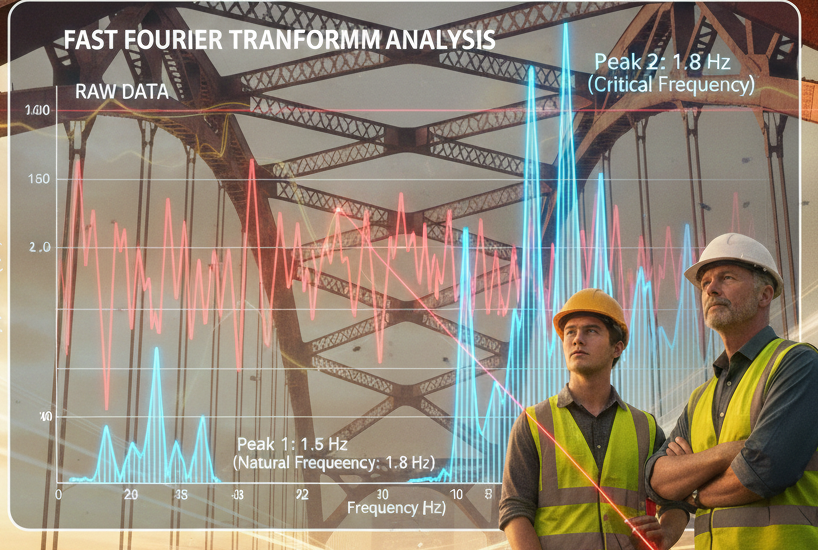
Liam and Mr. Hayes set up their equipment under the main span of the bridge. The traffic was heavy, creating a chaotic mix of sounds and vibrations. To successfully identify the bridge’s natural frequency and the external force triggering resonance, Liam needed to use signal processing principles.
“We can’t rely on the raw, instantaneous data,” Mr. Hayes explained. “The bridge is like a complex machine with many moving parts. We need to find the dominant frequency that persists across the whole structure when the ‘singing’ starts.”
Liam mounted the Laser Vibrometer at several points along the steel girders. The vibrometer measured the amplitude of vibration in micrometres (mu m) against frequency (in Hertz, Hz). He then input the data into specialised engineering software to perform a Fast Fourier Transform (FFT) analysis.
The FFT is a mathematical process that converts a complex signal (like the bridge’s combined vibration) into its individual component frequencies. .
After analysing several hours of data, a clear pattern emerged. While the traffic noise created a scatter of frequencies, two major spectral peaks consistently appeared when the bridge began to wail:
- Peak 1: A constant, low-amplitude peak at 1.5 Hz. This was identified as the bridge’s main, stable natural frequency when under load.
- Peak 2: A highly variable, intense peak that spiked between 1.5 Hz and 1.8Hz. This spike corresponded exactly with the onset of the loud, unsettling wail.
“Aha,” Mr. Hayes said, reviewing the FFT graph. “The external force is slightly higher than the natural frequency, but it’s close enough—specifically the 1.8 Hz frequency—to pull the bridge into destructive oscillation.”
Now they had to identify the source of that 1.8 Hz external frequency. Liam realised that the bridge design included an array of vertical support cables running from the arch down to the deck.
He took a new set of readings, aiming the laser vibrometer specifically at the central support cables. When he ran the FFT on the cable data alone, the 1.8 Hz peak was magnified exponentially.
“It’s the cables,” Liam concluded. “The rhythmic movement of the wind, or perhaps the ‘galloping’ effect of the heavy traffic, is causing these specific support cables to oscillate at their own natural frequency of 1.8 Hz.”
Because the cables are physically attached to the deck, their vibration acts as the external driving force. When the cables’ 1.8 Hz frequency aligns with the bridge’s 1.5 Hz natural frequency, it creates a forced, unstable vibration, leading to the dangerous resonance and the signature wailing sound.
The solution would not be to strengthen the whole bridge, but to focus on cancelling the 1.8 Hz vibration in the cables themselves.
Comprehension Questions (Chapter 2)
- What is Fast Fourier Transform (FFT), and what purpose did Liam use it for in his analysis?
- What were the two major spectral peaks that consistently appeared in the vibration data?
- Which of the two peaks represented the bridge’s stable natural frequency?
- What specific part of the bridge did Liam focus on in his second round of readings, and why did this area show an exponential magnification of the 1.8 Hz frequency?
- Based on the physics, what did Liam conclude was acting as the external driving force causing the resonance?
I will continue the story. Here is Chapter 3 of Story 5: The Resonance Riddle.
🌉 Story 5: The Resonance Riddle
Chapter 3: Damping the Driver
Having identified the source of the dangerous resonance as the vertical support cables oscillating at 1.8 Hz, the engineering team’s focus shifted from diagnosis to solution. The problem was an external force (1.8 Hz from the cables) matching the bridge’s natural frequency (1.5 Hz). To fix it, they needed to change the physics of the system.
“We have two options,” Mr. Hayes explained to Liam. “We can change the bridge’s natural frequency—which would mean major structural reinforcement and massive cost—or we can eliminate the external driving force from the cables.”
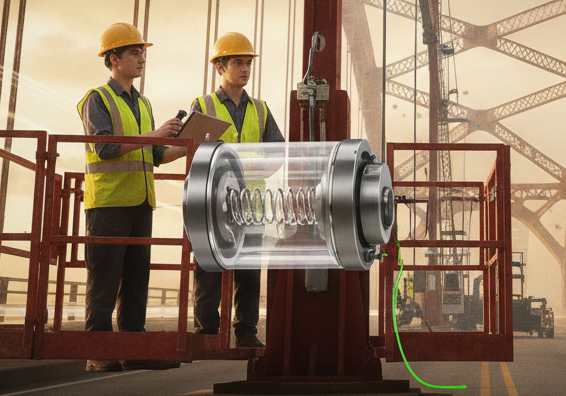
They chose the latter. The core principle of their solution was damping. Damping is the process of dissipating (converting) mechanical energy (vibration) into another form of energy, usually heat. .
The specific device they planned to use was a Tuned Mass Damper (TMD), or more simply, a dampener, which would be installed on each problematic support cable.
A TMD is essentially a weight attached to the structure by a spring and a viscous fluid (like oil or silicone). It is meticulously engineered to oscillate at the same frequency as the unwanted vibration—in this case, 1.8 Hz.
“The beauty of the TMD,” Mr. Hayes said, “is that when the cable starts vibrating at 1.8 Hz, the TMD vibrates out of phase with it. The TMD absorbs the cable’s energy, converting that vibrational energy into heat through the viscous fluid, effectively cancelling out the oscillation before it can be transferred to the main bridge deck.”
Liam’s new task was to assist the engineering team in precisely calculating the required mass (m) and spring constant (k) for each TMD. The calculation had to be exact, as the TMD’s frequency must precisely match the cable’s frequency (1.8 Hz. The fundamental frequency of a simple mass-spring system is given by:
They determined that a 50 kg mass, combined with a specific spring constant, was the optimal balance between effectiveness and weight.
The installation phase began over the next two nights, during periods of low traffic. Crews carefully attached the TMD units near the base of the most active support cables. Liam supervised the installation, ensuring the alignment and tension of the TMD springs were set according to the calculated specifications.
As the final dampener was secured, a large gust of wind swept under the bridge. The cables began to hum, but instead of the vibration building up into the familiar, dangerous wail, the sound was muffled, and the oscillation quickly decayed back to silence. The TMDs were doing their job, absorbing the kinetic energy and stopping the resonance before it could take hold.
Comprehension Questions (Chapter 3)
- What two options did the engineers consider for solving the resonance problem, and which one did they choose?
- What is the physics definition of damping?
- What specific device was chosen to eliminate the unwanted vibration, and what is its primary mechanism of action?
- Explain the key principle of how a Tuned Mass Damper (TMD) works to cancel out the vibration.
- What was the purpose of the equation in this chapter, and what two variables did Liam need to precisely calculate for the TMD?
I will continue the story. Here is Chapter 4 of Story 5: The Resonance Riddle.
🌉 Story 5: The Resonance Riddle
Chapter 4: The Sound of Silence
With the Tuned Mass Dampers (TMDs) installed on the most active support cables, the engineering team waited for the next major period of high traffic or strong wind to test their solution. This test would be the real-world validation of their theoretical physics calculations.
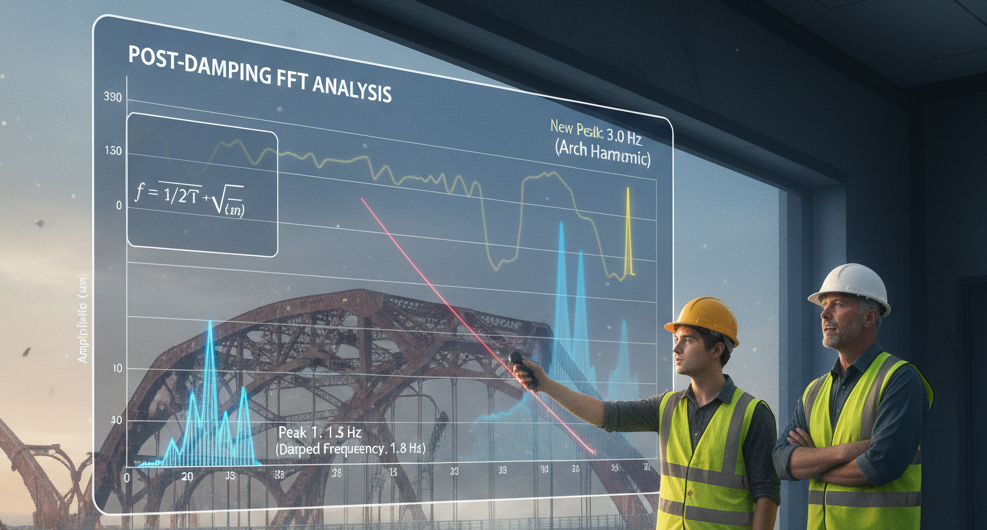
Liam and Mr. Hayes set up the Laser Vibrometer in the control room, pointing its sensor at a specific spot on the main deck that had previously shown the highest amplitude during resonance events. They were ready to use the Fast Fourier Transform (FFT) analysis one last time to compare the ‘before’ and ‘after’ data.
The wind picked up, gusting to 40 km/h—exactly the condition that had previously triggered the dangerous wail.
On the screen, the raw vibration data showed the bridge moving. However, when Liam ran the FFT analysis, the graph was dramatically different from the previous week’s results.
The massive, variable peak between 1.5 Hz and 1.8 Hz had almost vanished. It was replaced by a small, stable peak right at the bridge’s natural frequency of 1.5 Hz, but the oscillation amplitude was reduced by over 90%.
“The TMDs worked,” Mr. Hayes announced, relief evident in his voice. “The external driving force is gone.”
However, they noticed a new, unexpected, and subtle spectral peak in the analysis: a tiny, consistent spike at 3.0 Hz. It was far from the critical 1.5 Hz and posed no immediate threat, but it was a new vibration.
“What’s 3.0 Hz?” Liam wondered, running a quick check of the bridge’s structural harmonics.
Mr. Hayes pulled up the bridge blueprints. “That is exactly the first harmonic frequency of the central steel arch. It’s the frequency the arch would vibrate at if it were moving in a simpler, faster mode. It’s too high to resonate with the deck, but why is it showing up now?”
They left the control room and went out onto the deck. The familiar wail was absent, replaced only by the normal rumble of traffic. But as a heavy semi-trailer crossed the main span, Liam noticed a shimmer—a visual distortion—in the air just above the traffic barriers.
He aimed the Laser Vibrometer at the steel barrier itself. The FFT spiked directly at the 3.0 Hz mark. The barrier, which was a long, hollow tube running the length of the deck, was now resonating.
Liam suddenly recalled a concept from optics: acoustic refraction.
“The barrier isn’t vibrating from the wind or traffic,” Liam hypothesised. “It’s vibrating from sound! When the bridge was ‘singing’ at 1.8 Hz, that massive sound energy drowned out all other frequencies. Now that the main wail is gone, the 3.0 Hz sound waves created by the low-frequency rumble of heavy diesel engines are resonating with the thin, hollow steel of the barrier.”
This was a classic acoustics problem, not a structural one. The TMDs had fixed the major structural issue, only to reveal a minor acoustic one hidden beneath the roar. They had achieved structural silence, but the physics of sound was now creating a small, new disturbance.
Comprehension Questions (Chapter 4)
- How did the FFT analysis of the bridge vibration change after the TMDs were installed?
- What new, unexpected spectral peak appeared in the analysis, and what part of the bridge structure did it correspond to?
- Why did this new peak not pose an immediate threat to the bridge’s structural integrity?
- What physical phenomenon (related to light/sound) did Liam recall that might explain the new vibration in the traffic barrier?
- What was Liam’s final hypothesis about the source of the 3.0 Hz vibration, and why did it only appear after the main resonance problem was solved?
I will continue the story. Here is Chapter 5 of Story 5: The Resonance Riddle, concluding the final story.
🌉 Story 5: The Resonance Riddle
Chapter 5: Silence and Stability

The successful installation of the Tuned Mass Dampers (TMDs) had secured the Cairns Harbour Bridge from the dangerous 1.8 Hz structural resonance. The structural safety crisis was averted, thanks to the application of vibrational physics and precise engineering.
The only remaining issue was the subtle, newly revealed acoustic resonance in the long, hollow steel traffic barriers at 3.0 Hz. While not a structural threat, the sustained low hum could be irritating to drivers and eventually lead to cosmetic fatigue in the barriers themselves.
Liam and Mr. Hayes knew they couldn’t use another expensive TMD system for the barrier. The solution had to be simple and cheap, targeting the acoustics and material physics of the thin steel tube.
“We need to change the barrier’s natural acoustic frequency so it no longer matches the 3.0 Hz sound wave from the heavy diesel engines,” Mr. Hayes suggested.
The easiest way to alter a hollow object’s resonance frequency is to change its mass or its internal damping coefficient. They settled on increasing the damping, which would absorb the sound energy.
The final, elegant solution involved acoustic filling.
The maintenance crew pumped a cheap, inert material—a fine, compacted sand—into the hollow interior of the steel barriers.
- Result 1: Increased Mass: The sand slightly increased the barrier’s mass, which lowered its natural frequency below 3.0 Hz.
- Result 2: Internal Damping: More importantly, the loose sand granules provided immense internal damping. When the steel tube was struck by the 3.0 Hz sound wave, the energy was instantly transferred to the trillions of tiny grains of sand, which rub against each other, converting the sound vibration into negligible heat. This process instantly disrupted the barrier’s ability to sustain a resonant frequency.
Liam once again used the Laser Vibrometer to take the final readings. With the sand filling in place, the 3.0 Hz peak in the FFT graph vanished entirely. The bridge was finally silent, with the only noticeable sound being the normal rumble of traffic.
The project had been a perfect demonstration of applied science: they had used optics (Laser Vibrometer) and signal processing (FFT) to diagnose a vibrational physics problem (resonance), and solved it first with complex mechanical engineering (TMDs), and then with simple material science (sand damping).
Mr. Hayes shook Liam’s hand. “You didn’t just help install dampeners, Liam. You helped us understand the fundamental physics that governs massive structures. The ‘singing bridge’ is silent, and it’s safer, because you knew how to look beyond the noise and find the critical frequency.”
Liam felt a sense of immense achievement. He had learned that the equations and concepts taught in his Year 9 physics class—like natural frequency, resonance, and damping—were the literal tools that keep the world’s most vital structures stable and safe. The safety of thousands of commuters depended on the accuracy of his FFT analysis.
Comprehension Questions (Chapter 5)
- What two specific material properties did the engineers decide to change to solve the barrier resonance problem?
- What simple, low-cost material did the maintenance crew use for the acoustic filling?
- Explain the two ways the acoustic filling material helped solve the resonance problem based on the principles of physics and materials science.
- What two specific tools/techniques (from physics or data) were used to confirm that the 3.0 Hz vibration had been eliminated?
- What was the biggest takeaway lesson Liam learned about the connection between physics concepts and structural engineering?
That concludes the fifth and final five-chapter story, The Resonance Riddle, and completes the requested set of five reading practice stories.
Is there anything else I can help you with today, perhaps reviewing the comprehension questions or summarising the core science concepts from all five stories?
****************************************************************************
第5話、そして最後の話では、物理学(光学と音響)と、それらの原理が構造物に関わる公共安全問題の解決に工学的にどのように応用されているかに焦点を当てます。
第5話:共鳴の謎
第1章:振動する橋
リアムはケアンズ・ハーバー・ブリッジの巨大な鋼鉄アーチの下に立っていました。この橋は北部郊外と市内中心部を結ぶ重要なインフラです。彼は観光旅行でここに来たのではなく、主要道路局の構造エンジニアチームでインターンシップをしていました。
空気は重く湿っぽく、上空の交通騒音は絶え間なく大きな単調な音でした。しかし、エンジニアたちを悩ませる新たな音が聞こえてきました。それは、低くうなり声のような振動で、時折、不安な悲鳴へと強まるものでした。
「私たちはこれを『歌う橋』と呼んでいます」と、主任構造エンジニアのヘイズ氏は安全ヘルメットを調整しながら言った。「もう6ヶ月ほど前から、主に交通量が多く橋に最大荷重がかかる時間帯や強風時に発生しています」
橋の構造的完全性は良好で、崩落寸前ではなかった。しかし、予期せぬ過度の振動は、共振と呼ばれる現象を示唆していた。
ヘイズ氏はリアムにその物理的性質を説明した。「すべての構造物には固有振動数、つまり乱れた場合に振動する特定の速度があります。ギターの弦を想像してみてください。弦を弾くと、本来の音で振動します。風や交通量の多い道路のリズミカルな衝撃などの外力がこの固有振動数と一致すると、振動は急速に増大します。これが共振であり、振動が劇的に増幅されます」
あの悲鳴のような音は、橋が過度に振動していることを音響的に表していた。時間が経つにつれて、こうした過剰な振動は金属疲労を引き起こし、接合部を弱め、メンテナンスの問題を安全上の危機へと発展させる可能性があります。
リアムの任務は、音響フィードバックの発生源を特定することでした。彼には、レーザー振動計という高度な機器が入ったブリーフケースが渡されました。
「この装置はレーザー光線を用いて、表面に触れることなく振動の周波数と振幅を測定します」とヘイズ氏は説明しました。「橋の様々な部分、つまり主床版、中央アーチ、支持ケーブルから正確な周波数データを収集し、どの部分が共振状態にあり、どの周波数が共振を引き起こしているかを正確に把握する必要があります。」
最初の測定値は混乱を招きました。車、トラック、バスが絶え間なく通行するため、橋は複数の周波数で同時に振動していました。リアムは、信号(橋の固有振動数)とノイズ(交通によるランダムな振動)を区別する必要があることを知っていました。危険な音の原因となっている特定の臨界周波数を見つける必要がありました。
第2章:臨界周波数の特定
リアムとヘイズ氏は橋の主径間下に機器を設置した。交通量が多く、音と振動が混在する混沌とした状況だった。橋の固有振動数と共振を引き起こす外力を正確に特定するために、リアムは信号処理の原理を用いる必要があった。
「生の瞬間データに頼ることはできません」とヘイズ氏は説明した。「橋は多くの可動部品を持つ複雑な機械のようなものです。『歌い』始める際に、構造全体にわたって持続する卓越周波数を見つける必要があります。」
リアムは鋼桁の複数の地点にレーザー振動計を設置した。振動計は、周波数(ヘルツ、Hz)に対する振動の振幅をマイクロメートル(μm)単位で測定した。彼はそのデータを専用のエンジニアリングソフトウェアに入力し、高速フーリエ変換(FFT)解析を実行した。
FFTは、複雑な信号(橋の複合振動など)を個々の構成周波数に変換する数学的プロセスです。
数時間にわたるデータの分析の結果、明確なパターンが浮かび上がりました。交通騒音によって周波数にばらつきが生じている一方で、橋が揺れ始めると、2つの主要なスペクトルピークが一貫して現れました。
ピーク1:1.5Hzで一定かつ低振幅のピーク。これは、荷重がかかった際の橋の主要かつ安定した固有振動数であると特定されました。
ピーク2:1.5Hzと1.8Hzの間で急上昇する、変動の大きい強烈なピーク。この急上昇は、大きく不安を掻き立てる揺れの始まりと正確に一致していました。
「なるほど」とヘイズ氏はFFTグラフを確認しながら言いました。「外力は固有振動数よりわずかに高いのですが、1.8Hzという周波数は、橋を破壊的な振動に引き込むのに十分近いのです。」
次に、1.8Hzの外部周波数の発生源を特定する必要がありました。リアムは、橋の設計にアーチからデッキまで垂直の支持ケーブルが多数配線されていることに気付きました。
彼はレーザー振動計を中央の支持ケーブルに向け、新たな測定値を取得しました。ケーブルデータのみでFFTを実行したところ、1.8Hzのピークが指数関数的に増幅されました。
「ケーブルが原因だ」とリアムは結論づけた。「風のリズミカルな動き、あるいは交通量の多い道路の『ギャロッピング』効果によって、これらの支持ケーブルが1.8Hzという固有振動数で振動しているのだ。」
ケーブルは橋脚に物理的に固定されているため、その振動が外部駆動力として作用する。ケーブルの1.8Hzの振動数が橋の固有振動数1.5Hzと一致すると、強制的に不安定な振動が生じ、危険な共振と特徴的な「うなり音」につながる。
解決策は橋全体を補強することではなく、ケーブル自体の1.8Hzの振動を打ち消すことに焦点を当てることだ。
第3章:駆動源の減衰
危険な共振の原因が1.8Hzで振動する垂直支持ケーブルであると特定されたことで、エンジニアリングチームの焦点は診断から解決策へと移った。問題は、橋の固有振動数(1.5 Hz)と一致する外力(ケーブルからの1.8 Hz)でした。これを解決するには、システムの物理的な構造を変える必要がありました。
「選択肢は2つあります」とヘイズ氏はリアムに説明しました。「橋の固有振動数を変えるか(これは大規模な構造補強と莫大なコストがかかります)、ケーブルからの外力を排除するかです。」
彼らは後者を選択しました。彼らの解決策の中核となる原理は減衰でした。減衰とは、機械的エネルギー(振動)を別の形態のエネルギー(通常は熱)に消散(変換)するプロセスです。
彼らが使用を計画していた具体的な装置は、チューンドマスダンパー(TMD)、より簡単に言えばダンパーで、問題のある支持ケーブルごとに設置されます。
TMDは基本的に、バネと粘性流体(オイルやシリコンなど)によって構造物に取り付けられた重りです。この振動子は、不要な振動と同じ周波数(この場合は1.8Hz)で振動するように、細心の注意を払って設計されています。
ヘイズ氏は、「TMDの優れた点は、ケーブルが1.8Hzで振動し始めると、TMDがそれと位相がずれて振動することです。TMDはケーブルのエネルギーを吸収し、粘性流体を通してその振動エネルギーを熱に変換することで、振動が橋の主床版に伝わる前に効果的に打ち消します」と述べています。
リアムの新たな任務は、エンジニアリングチームが各TMDに必要な質量(m)とバネ定数(k)を正確に計算できるよう支援することでした。 TMDの周波数はケーブルの周波数(1.8Hz)と正確に一致する必要があるため、計算は正確でなければなりませんでした。単純な質量バネシステムの基本周波数は、次の式で与えられます。
f =
彼らは、50kgの質量と特定のバネ定数を組み合わせることで、効果と重量の最適なバランスが得られると判断しました。
設置作業は、交通量の少ない2晩にわたって開始されました。作業員は、最も活発な支持ケーブルの根元付近にTMDユニットを慎重に取り付けました。リアムは設置を監督し、TMDバネの配置と張力が計算された仕様通りに設定されていることを確認しました。
最後のダンパーが固定されると、強い突風が橋の下を吹き抜けました。ケーブルはうなり音を立て始めましたが、振動がおなじみの危険な音にまで増幅する代わりに、音は抑えられ、振動はすぐに静寂に戻りました。TMDは仕事は、運動エネルギーを吸収し、共鳴が定着する前にそれを止めます。
第4章:静寂の音
最も活発な支持ケーブルに同調質量ダンパー(TMD)を設置した後、エンジニアリングチームは、次に交通量が多くなる時期や強風になる時期を待ち、解決策をテストしました。このテストは、理論物理学の計算結果を現実世界で検証するものでした。
リアムとヘイズ氏は制御室にレーザー振動計を設置し、そのセンサーをメインデッキ上の特定の地点に向けました。この地点は、以前共振現象の際に最も高い振幅を示していました。彼らは、最後にもう一度高速フーリエ変換(FFT)解析を行い、「前」と「後」のデータを比較する準備を整えました。
風が強まり、突風が時速40キロメートルに達しました。まさに、以前危険な音を引き起こした状況です。
画面上の生の振動データでは、橋が動いていることが示されていました。しかし、リアムがFFT解析を実行すると、グラフは前週の結果とは劇的に異なっていました。
1.5Hzから1.8Hzの間の大きく変動するピークはほぼ消滅し、橋の固有振動数である1.5Hzに小さく安定したピークが現れた。しかし、振動振幅は90%以上減少していた。
「TMDは機能しました」とヘイズ氏は声に安堵の色がにじみ出ていた。「外部駆動力はなくなりました。」
しかし、分析の結果、新たな、予期せぬ、そして微妙なスペクトルピークが見つかった。3.0Hzに小さな、しかし一貫したスパイクが見られるのだ。これは危険な1.5Hzからは程遠く、直ちに脅威となるようなものではないが、新たな振動だった。
「3.0Hzって何?」リアムは橋の構造調和振動を素早く確認しながら、疑問に思った。
ヘイズ氏は橋の設計図を取り出し、こう言った。 「まさに中央の鋼鉄アーチの第一高調波周波数だ。アーチがより単純で高速なモードで動いていた場合、この周波数で振動するはずだ。デッキと共振するには高すぎるのに、なぜ今、それが現れるんだ?」
彼らは制御室を出てデッキに出た。聞き慣れた悲鳴は消え、代わりにいつもの交通騒音だけが響いていた。しかし、大型セミトレーラーがメインスパンを横切ったとき、リアムは交通遮断機のすぐ上の空気に揺らめき――視覚的な歪み――があることに気づいた。
彼はレーザー振動計を鋼鉄遮断機に向けると、FFTは3.0Hzのところで急上昇した。デッキの全長に渡る長い中空の管である遮断機が、今共振していたのだ。
リアムは突然、光学の概念を思い出した。音響屈折だ。
「遮断機は風や交通によって振動しているのではない」とリアムは仮説を立てた。 「音で振動しているんです!橋が1.8Hzで『歌って』いた頃は、あの巨大な音エネルギーが他のすべての周波数をかき消していました。今、主な悲鳴が消えた今、重ディーゼルエンジンの低周波の轟音によって生み出された3.0Hzの音波が、防波堤の薄く中空の鋼板と共鳴しているんです。」
これは構造上の問題ではなく、典型的な音響の問題でした。TMDは主要な構造上の問題を解決しましたが、轟音の裏に隠れていた小さな音響上の問題が露呈しました。構造上の静寂は達成されましたが、音響の物理的性質が今、小さな新たな乱れを生み出していたのです。
第5章:静粛性と安定性
TMD(チューンドマスダンパー)の設置に成功したことで、ケアンズ・ハーバーブリッジは危険な1.8Hzの構造共振から守られました。振動物理学と精密工学の応用により、構造上の安全危機は回避されました。
残る唯一の問題は、長く中空の鋼製交通遮断器において、新たに明らかになった3.0Hzの微妙な音響共振でした。構造上の脅威ではありませんが、持続的な低音は運転者を苛立たせ、最終的には遮断器自体の外観上の疲労につながる可能性があります。
リアムとヘイズ氏は、遮断器に高価なTMDシステムを使用することはできないと認識していました。解決策は、薄い鋼管の音響特性と材料物理学に焦点を当てた、シンプルで安価なものでなければなりませんでした。
「遮断器の固有音響周波数を変更し、大型ディーゼルエンジンから発生する3.0Hzの音波と一致しないようにする必要があります」とヘイズ氏は提案しました。
中空物体の共振周波数を変える最も簡単な方法は、質量または内部減衰係数を変えることです。彼らは減衰を増加させることで音エネルギーを吸収することにしました。
最終的な、そして洗練された解決策は、音響充填でした。
保守作業員は、安価で不活性な材料(細かく圧縮された砂)を鋼鉄製防音壁の中空内部に注入しました。
結果1:質量の増加:砂によって防音壁の質量がわずかに増加し、固有振動数が3.0Hz未満に低下しました。
結果2:内部減衰:さらに重要なのは、緩い砂粒が非常に大きな内部減衰効果を発揮したことです。鋼鉄製防音壁が3.0Hzの音波に当たると、そのエネルギーは瞬時に無数の微細な砂粒に伝達され、砂粒同士が擦れ合い、音の振動を無視できるほどの熱に変換します。このプロセスにより、防音壁の共振周波数を維持する能力は瞬時に破壊されました。
リアムは再びレーザー振動計を使って最終的な計測を行いました。砂が充填されると、FFTグラフの3.0Hzのピークは完全に消えました。橋はついに静まり返り、聞こえるのは交通の通常の騒音だけでした。
このプロジェクトは応用科学の完璧なデモンストレーションでした。彼らは光学(レーザー振動計)と信号処理(FFT)を用いて振動物理学上の問題(共振)を診断し、まず複雑な機械工学(TMD)で、次にシンプルな材料科学(砂の減衰)で解決しました。
ヘイズ氏はリアムと握手しました。「リアム、あなたは単に減衰装置の設置を手伝ってくれただけではありません。巨大な構造物を支配する基礎物理学を理解するのを助けてくれました。『歌う橋』は静かで、より安全です。それは、あなたがノイズの先を見据えて臨界周波数を見つける方法を知っていたからです。」
リアムは計り知れない達成感を感じました。彼は、9年生の物理の授業で習った方程式や概念――固有振動数、共振、減衰など――が、世界で最も重要な構造物を安定と安全に保つための文字通りのツールであることを学んでいた。何千人もの通勤者の安全は、彼のFFT分析の精度にかかっていたのだ。