Creating reading practice stories tailored to Year 10 students in Queensland requires stories with engaging themes, complex vocabulary, and sophisticated plot structures. These stories will aim for a reading level that challenges students and prepares them for senior English texts, focusing on skills like inference, analysis, and understanding figurative language.
I will begin by presenting Chapter 1 of the first story, “The Echo of Ember Island.”
📚 Story 1: The Echo of Ember Island
🌅 Chapter 1: The Weight of the Map
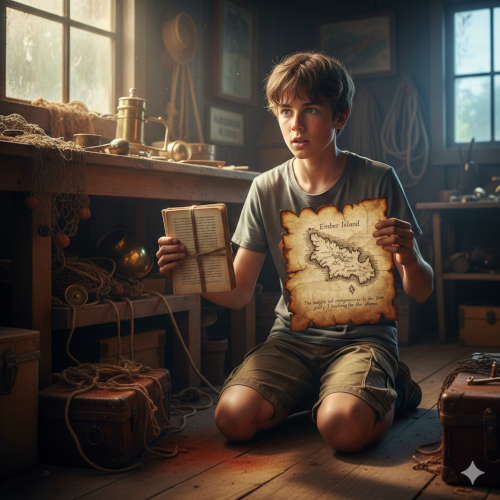
The air in the shed hung thick and heavy, smelling of brine, rust, and the faint, sweet decay of old paper. Elias wiped a layer of red dust from a steamer trunk, the grit catching under his fingernails. At fifteen, he was a study in contradictions: tall and gangly, yet possessing an unnerving stillness; drawn to the rugged coast of their family home, yet obsessed with the digital quiet of coding. He was supposed to be clearing out his late grandfather’s workshop on the Sunshine Coast, a task that felt less like maintenance and more like an archaeological dig into a life he barely knew.
His grandfather, known simply as ‘Old Man Finn’ by the few fishermen who still spoke of him, had been an enigma—a retired marine biologist who had, in his last decade, devolved into something of a recluse, fixated on local maritime myths. Elias had dismissed it all as the meandering of a lonely mind.
Until now.
Beneath a tangle of fishing nets and corroded brass instruments, Elias found a hidden compartment in the workbench. Inside, nestled on a bed of dry seaweed, was a journal wrapped in sun-bleached canvas and, crucially, a map. It wasn’t the kind of map you’d buy in a tackle shop; it was hand-drawn on brittle, parchment-like material, its edges singed as if rescued from a fire. The ink was a dark, almost sepia tone, tracing the familiar, jagged outline of the coastline, but with unsettling additions. Off the shore, where the old navigational charts showed nothing but deep blue, a small, heavily marked-up island was labelled simply: Ember Island.
A single, cryptic annotation scrawled near the island caught Elias’s attention: “The weight of the compass points to the truth in the dark water. The others are looking for the gold; I am looking for the silence.”
The journal provided no immediate answers, its pages filled with dense, meticulous notes on tidal patterns, bioluminescent algae, and the migratory habits of a near-extinct species of sea turtle. Elias felt a sudden, electric surge of curiosity—the kind that silenced the usual din of teenage apathy. The map felt ancient and significant in his hands, a genuine mystery that transcended the old man’s eccentric reputation. It was a tangible link to a secret, something hidden not just in the past, but potentially out there, beyond the familiar, tourist-laden beaches of Queensland.
❓ Chapter 1 Comprehension Questions
- Inference: What does the description of the workshop’s smell (“brine, rust, and the faint, sweet decay of old paper”) suggest about Old Man Finn’s life and work?
- Vocabulary/Figurative Language: Explain the meaning of the phrase “a study in contradictions” as it applies to Elias.
- Analysis: What key detail makes Elias transition from being apathetic toward his grandfather’s life to feeling a “sudden, electric surge of curiosity”?
- Prediction: The annotation on the map mentions that “The others are looking for the gold; I am looking for the silence.” Based on Chapter 1, what might “the silence” represent, given Old Man Finn’s background as a marine biologist?
📚 Story 1: The Echo of Ember Island
🌊 Chapter 2: The Coordinates of Loss
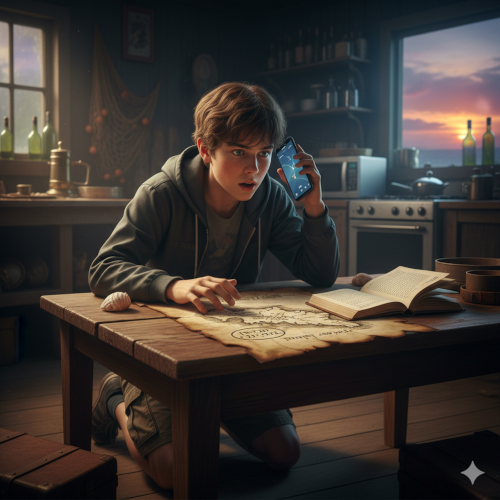
Elias carried the map and journal back to the house, the sun setting over the Coral Sea casting long, distorted shadows across the hallway floorboards. He spread the map out on the kitchen table, anchoring its brittle corners with two salt-encrusted shells. The map was clearly divided into two zones: the known, marked with faded labels for coastal towns and jetties, and the unknown, dominated by the swirling lines and detailed sketches of Ember Island.
He opened the journal, flipping past the marine biology notes until he found a section that was clearly a later addition, written in a more frantic, slanted hand. The entries abruptly shifted from detached scientific observation to personal, coded paranoia.
October 14th: The vessel is gone. Not sunk; vanished. The coast guard calls it a rogue wave, but the water doesn’t lie. They took more than the boat; they took the data. The only place the compass lies true is at the apex.
October 22nd: The patterns align. The tide is the clock. The bioluminescence isn’t just a bloom, it’s a beacon. If I plot the three sightings, the convergence point is unmistakable: 152° 58’ E, 26° 40’ S. It’s the closest they can get without being dragged under.
The coordinates jumped out at Elias. A quick check on his phone’s GPS revealed the location: a point in the open ocean, roughly five nautical miles east of the map’s depiction of Ember Island. This wasn’t a mythological spot; it was a real, precise coordinate. Elias shivered, the cold realisation sinking in that his grandfather hadn’t been chasing ghosts; he had been investigating something tangible and dangerous.
The journal entry about “the vessel” being “gone” coincided with the local legend Elias had heard whispered in the local fish markets—the disappearance of the Marlin’s Cry, a research boat owned by a competing marine institute. The official report had indeed blamed a freak storm. But Old Man Finn’s notes implied foul play and a stolen scientific secret.
Elias scrolled through his contacts. He needed someone who understood the sea and, crucially, understood discretion. He settled on Maya, his best friend, who spent every weekend working on her father’s charter fishing boat. Maya was grounded, sceptical, and possessed an encyclopaedic knowledge of everything that moved beneath the Queensland waves. The mystery, Elias knew, was too large to carry alone. He folded the map, the canvas rough against his palm, and dialled her number. The truth, he suspected, was waiting somewhere out in the turbulent dark water.
❓ Chapter 2 Comprehension Questions
- Recall: What specific piece of evidence from the journal leads Elias to believe his grandfather was investigating something “tangible and dangerous,” rather than just chasing myths?
- Vocabulary/Context: In the journal entry, Old Man Finn writes: “The tide is the clock.” What does this phrase suggest about how he was interpreting the environmental data?
- Analysis/Theme: The chapter mentions the disappearance of the Marlin’s Cry and the official explanation of a “freak storm.” How does the contrast between the official story and Finn’s notes establish the theme of hidden truth versus perceived reality?
- Characterisation: Why does Elias decide to call Maya, and what does this choice reveal about his strengths and weaknesses in approaching the mystery?
Chapter 2 is now complete. The plot is advancing with the introduction of real coordinates and the confirmation of a hidden secret.
I will now provide Chapter 3 of “The Echo of Ember Island.”
📚 Story 1: The Echo of Ember Island
💡 Chapter 3: The Bioluminescence Key
Maya arrived twenty minutes later, damp from her shift on the trawler and radiating a cool pragmatism that was exactly what Elias needed. She studied the map and the journal entries with the intensity of a cartographer examining a faulty reading. Her eyes narrowed at the coordinates.
“Five miles out, Elias? That’s past the shipping channel. And this island—Ember Island—it’s not on any official chart. It was either submerged a hundred years ago, or it’s a phantom rock. But Old Man Finn was meticulous. He didn’t invent geography.”
Elias pointed to the scientific notes on the bioluminescent algae and the reference to “the beacon.” He explained his theory: “My grandfather wasn’t just observing tides; he was tracking a pattern in the ocean’s light. Look at this equation.” He showed her a complex-looking formula scribbled in the margin:
“It looks like gibberish, but I cross-referenced the symbols. is the target wavelength at time . The rest is a calculation of spectral radiance and decay rate for a specific type of algae. He was calculating the exact timing and location where this algae, probably Noctiluca scintillans, would bloom strongest around Ember Island.”
Maya finally showed a flicker of excitement. “The bloom… he said it was ‘the clock.’ If the vessel was stolen for its research data, maybe the secret they stole was tied to this specific algal pattern. A new way to track migratory species? Or maybe something more valuable.”
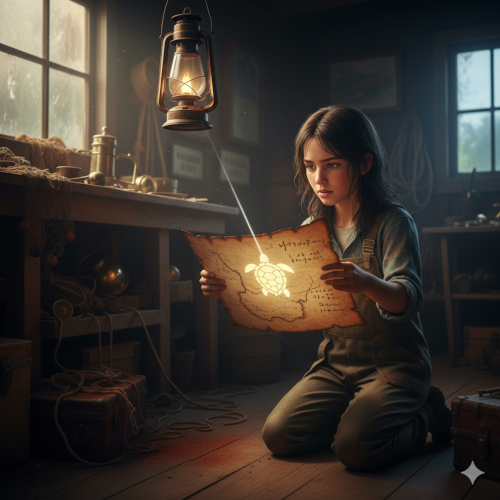
As she spoke, Maya noticed a small pinprick on the map, almost obscured by the legend ‘Ember Island.’ It wasn’t ink; it was a tiny hole in the parchment. She held the map up to the shed lamp. The light shone directly through the hole, landing precisely on the symbol of a stylised sea turtle in the journal’s opening pages. The turtle symbol was next to a name: The Aether Project.
“It’s a key,” Maya breathed. “The coordinates point to the location, and this hole points to the subject. The Aether Project must have been what the Marlin’s Cry was carrying. And it involves sea turtles.”
Elias felt a chill. The map wasn’t just a guide to a place; it was a complex cipher, requiring both scientific knowledge and a leap of faith to unlock. They had the ‘what’—a stolen project involving bioluminescence and turtles. Now they just needed the ‘why’ and the ‘how’ to get to Ember Island without being seen by whoever wanted the “silence” that Old Man Finn had sought.
❓ Chapter 3 Comprehension Questions
- Recall: What scientific phenomenon did Old Man Finn focus on that Elias believes is the key to timing and locating Ember Island?
- Analysis/Evaluation: Maya states that Old Man Finn “didn’t invent geography.” What does this comment reveal about her approach to the mystery compared to Elias’s initial dismissiveness?
- Scientific Literacy (Math): The chapter provides an equation for the target wavelength ($\lambda_t$). Without solving it, explain in simple terms what the formula is designed to calculate, based on the textual explanation given.
- Synthesis: How does the discovery of the tiny hole in the map link the coordinates and the journal’s scientific notes, moving the plot forward?
Chapter 3 has introduced a technical layer to the mystery and identified the core secret: The Aether Project.
I will now provide Chapter 4 of “The Echo of Ember Island.”
📚 Story 1: The Echo of Ember Island
🧭 Chapter 4: The Rogue Current
The plan they hatched was audacious, relying on Maya’s access to a boat and Elias’s newfound understanding of his grandfather’s cryptic research. They would take her father’s small, fast runabout, the Tide Runner, out under the guise of an early morning fishing trip.
The difficulty lay not just in reaching the coordinates, but in navigating the area. Old Man Finn’s notes had warned of a “rogue current,” a phenomenon where the normal, predictable flow of the Pacific coastal current was violently disrupted, creating a powerful, hidden whirlpool pattern.
Elias had been up all night cross-referencing meteorological data with the tidal charts in the journal. He discovered that the rogue current only stabilised—becoming traversable—during the precise window when the specific bioluminescent algae (the ‘beacon’) was at its peak glow. This confirmed his grandfather’s genius: the ‘clock’ wasn’t just for timing, it was a safety measure. The beacon marked the brief, still centre of the maelstrom.
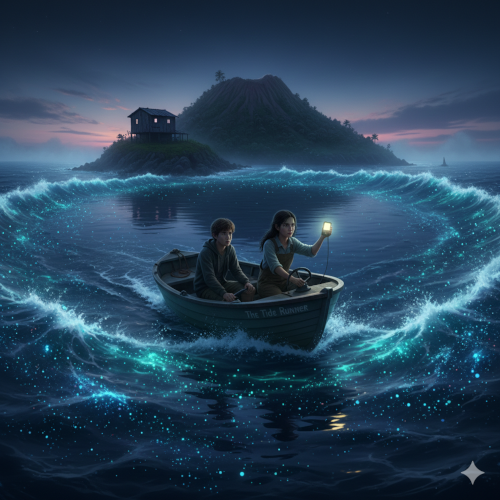
At 4:00 AM, before the first pink streaks touched the horizon, they slipped the Tide Runner from its moorings. The air was cool and smelled of impending adventure. Maya expertly handled the tiller, while Elias monitored the GPS, a makeshift hydrophone (made from a broken transducer his grandfather had salvaged), and a modified UV light sensor.
As they neared the charted location, the familiar chop of the waves turned into a strange, unsettling swell. The ocean seemed to be breathing, rising and falling with a deep, unnatural rhythm. Elias glanced at the UV sensor; the reading began to spike sharply.
“We’re hitting the bloom now,” he yelled over the engine’s drone. “It’s starting to glow. Look!”
Below the hull, the dark water was suddenly alive with intermittent flashes of sapphire and emerald light—the Noctiluca at full luminescence. It looked less like a natural phenomenon and more like scattered light from a submerged city. Following the map’s faded lines, Maya piloted the boat directly toward the strongest cluster of light.
They burst through a final, tumultuous patch of water, and the Tide Runner settled into an unnerving calm. The water was glass-smooth, perfectly dark, and silent. And there it was: Ember Island. It wasn’t large—a hump of volcanic rock, heavily vegetated, with a small, crescent-shaped cove. It was exactly as Finn had drawn it, a place that existed only by not being officially acknowledged. On the ridge above the cove, partially obscured by mist, a solitary structure stood: a small, weathered observation hut, built with no regard for local planning codes, its windows dark and uninviting. The silence was overwhelming, broken only by the gentle lapping of the water against the hull. They had found the ‘silence’ Old Man Finn was looking for.
❓ Chapter 4 Comprehension Questions
- Analysis/Cause and Effect: How did Old Man Finn’s notes regarding the “rogue current” prove his scientific ingenuity, beyond just identifying the timing of the algal bloom?
- Vocabulary/Sensory Detail: Describe the change in the sea conditions as the Tide Runner approaches the rogue current, using at least two descriptive words from the text.
- Inference: The observation hut on Ember Island is described as having been built “with no regard for local planning codes.” What does this detail suggest about the purpose of the hut and the people who built it?
- Synthesis/Theme: Elias and Maya enter the calm centre of the current, finding Ember Island. Explain how this physically represents the ‘truth in the dark water’—a central idea mentioned in Chapter 1.
Chapter 4 has successfully brought Elias and Maya to Ember Island.
I will now provide the final chapter, Chapter 5, of “The Echo of Ember Island.”
📚 Story 1: The Echo of Ember Island
🔒 Chapter 5: The Weight of Silence
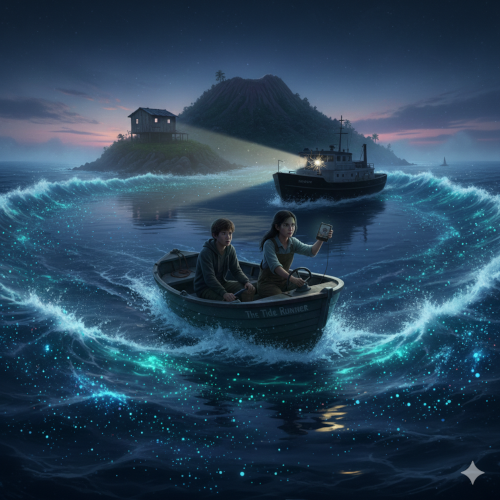
Elias and Maya secured the Tide Runner in the small cove, the island’s silence pressing down on them. They climbed the steep, slippery path toward the observation hut. The structure was even more derelict up close, built from marine-grade timber but left to rot.
Inside, the room was dominated by a large, complex console. The screen was dark, but a red indicator light pulsed next to a heavily shielded port. Scattered across the floor were empty ration packets, water bottles, and, most damningly, official-looking equipment packaging labelled with the logo of the competing marine institute—the same one that owned the Marlin’s Cry. The official story of the rogue wave was a lie; this was their covert base.
Elias knelt beside the console and found his grandfather’s missing piece: a portable hard drive, labelled with the sea turtle symbol and the words ‘Aether Core Data,’ was wedged behind a floor panel. He connected it to his phone. The files detailed an alarming discovery: The Aether Project was not about tracking migrating turtles; it was a method for using the turtles’ natural magnetic navigation system to precisely steer military-grade submersible drones through the deepest, undetectable ocean currents. The scientists had discovered how to temporarily hijack the turtles’ biological compass using ultra-low frequency sonic pulses.
Before Elias could download the core file, the sound of a distant engine reached them—a large, powerful vessel cutting through the ocean swell.
“They’re coming back,” Maya whispered, her voice tight. “They tracked the bioluminescence. They know someone found the beacon.”
Elias realised the chilling truth of his grandfather’s annotation: “The others are looking for the gold; I am looking for the silence.” The ‘gold’ was the weaponised data; the ‘silence’ was the elimination of that data and the stopping of the project. His grandfather hadn’t gone to the island to observe; he had gone to destroy.
With seconds to spare, Elias finished the download, extracting the critical file. But destroying the data on the console was impossible without explosives. Thinking fast, Elias grabbed the heavy brass compass Old Man Finn had used to anchor the map in the shed. He hurled it with all his strength against the console screen. The glass shattered, the display fizzled, and the red light died. He had crippled the base.
They scrambled back down the path as the large vessel, a sleek, black trawler unlike any fishing boat, rounded the headland. They jumped into the Tide Runner just as floodlights swept over the cove. Maya slammed the throttle forward, racing out of the calm zone and into the turbulent, glowing water. They were tossed violently, the boat shuddering, but the black trawler was too large to follow them safely into the chaos of the rogue current.
Looking back, Elias saw the trawler hesitate, its powerful engine idling at the edge of the maelstrom. He held the small, heavy hard drive. The mystery of Old Man Finn was solved, but a far greater responsibility had just begun. The weight of the compass, he realised, was the weight of the truth he now carried.
❓ Chapter 5 Comprehension Questions
- Recall: What was the true, dangerous purpose of The Aether Project, as revealed by the data Elias found on the hard drive?
- Analysis/Theme: Explain how the final action of Elias—destroying the console screen with the compass—symbolically and literally completes the final wish of his grandfather, based on the annotation “I am looking for the silence.”
- Inference: Why was the black trawler unable to follow the Tide Runner into the turbulent “rogue current,” and how did this feature of the sea ultimately protect Elias and Maya?
- Synthesis/Conclusion: Considering all five chapters, what is the central theme of “The Echo of Ember Island” (e.g., trust, truth, family), and how is this theme resolved or complicated in the final chapter?
This concludes Story 1: The Echo of Ember Island.
****************************************************************************
****************************************************************************
QLD – 10年生英語リーダー – ストーリー1
素晴らしいプロジェクトですね!クイーンズランド州の10年生向けに読解練習ストーリーを作るには、魅力的なテーマ、複雑な語彙、洗練されたプロット構成を持つストーリーが必要です。これらのストーリーは、推論、分析、比喩表現の理解といったスキルに焦点を当て、生徒の読解力を高め、上級レベルの英語テキストへの準備となるような読解レベルを目指します。
まずは、最初のストーリー「エンバー島のこだま」の第1章をご紹介します。
📚 ストーリー1:エンバー島のこだま
🌅 第1章:地図の重さ
小屋の中の空気は、塩水、錆、そしてかすかに古紙が腐っていくような甘い匂いが漂っていました。エリアスは汽船のトランクに積もった赤い埃を拭き取りました。砂埃が爪の間に引っかかりました。 15歳の彼は、矛盾の塊だった。背が高くひょろ長い体格でありながら、どこか不気味なほど静かだった。故郷の荒々しい海岸に惹かれながらも、コーディングというデジタルの静寂に取り憑かれていた。サンシャイン・コーストにある亡き祖父の工房を片付けるはずだったが、それはメンテナンスというより、ほとんど知らない人生を掘り起こす考古学的発掘のようだった。
祖父は、今も彼のことを話す数少ない漁師たちから「オールドマン・フィン」と呼ばれていたが、謎めいた人物だった。引退した海洋生物学者だったが、晩年の10年間は、地元の海洋伝説に執着する隠遁者のような姿になっていた。エリアスはそれを、孤独な心の迷走だと片付けていた。
今までは。
漁網と腐食した真鍮製の器具が絡み合った作業台の下に、エリアスは隠し部屋を見つけた。中には、乾いた海藻の層に寄り添うように、日に焼けた帆布に包まれた日記帳と、肝心の地図が入っていた。釣具店で売っているような地図ではなく、もろい羊皮紙のような素材に手書きで、端はまるで火事から救出されたかのように焦げていた。インクは暗く、ほとんどセピア色で、見慣れたギザギザの海岸線の輪郭を描いていたが、そこに不穏な追加が加えられていた。古い海図が深い青色しか描いていない沖合には、小さな島が、ぎっしりとマークで埋め尽くされており、その名前はただ「エンバー島」だった。
島の近くに走り書きされた、謎めいた一文がエリアスの注意を引いた。「コンパスの重みは、暗い海に浮かぶ真実を指し示す。他の者は黄金を探している。私は静寂を探している。」
日記帳は即座に答えを提供しなかった。潮汐のパターン、発光藻類、絶滅危惧種のウミガメの回遊性など、緻密で詳細な記録でページを埋め尽くしていた。エリアスは突然、電撃的な好奇心が湧き上がった。それは、十代の若者にありがちな無関心の喧騒を静めるようなものだった。地図は手に取ると、古くて大切なもののように感じられた。老人の風変わりな評判をはるかに超える、真の謎だった。それは秘密への確かな繋がりだった。過去に隠されているだけでなく、観光客で賑わう馴染み深いクイーンズランドのビーチの向こう側にも、隠されているかもしれない何か。
❓ 第1章 読解問題
- 推論: 工房の匂い(「塩水、錆、そしてかすかに甘い古紙の腐敗臭」)の描写は、フィン老人の人生と仕事について何を示唆していますか?
- 語彙/比喩表現: エリアスに当てはまる「矛盾の研究」という表現の意味を説明してください。
- 分析: エリアスが祖父の人生に無関心だった状態から「突然の、電撃的な好奇心の波」を感じる状態へと移行する上で、重要な点は何ですか?
- 予測: 地図の注釈には「他の人たちは金を探しているが、私は静寂を探している」と書かれています。第1章に基づいて、フィン老人が海洋生物学者であるという経歴を踏まえると、「静寂」は何を表しているのでしょうか?
私は最初の物語の第1章と読解問題を終えました。
「エンバー島のこだま」の第二章です。
📚 ストーリー1:エンバー島のこだま
🌊 第二章:喪失の座標
エリアスは地図と日記帳を家まで持ち帰った。珊瑚海に沈む夕日が廊下の床板に長く歪んだ影を落としていた。彼は地図を台所のテーブルに広げ、脆い角を塩で覆われた二つの貝殻で固定した。地図は明確に二つの領域に分かれていた。既知の領域には、沿岸の町や桟橋の色あせた標識が記されており、未知の領域には、エンバー島の渦巻く線と詳細なスケッチが描かれていた。
彼は日記帳を開き、海洋生物学のノートをめくっていくと、明らかに後から書き加えられたと思われる、より慌ただしく斜めに書かれた部分を見つけた。記録は、客観的な科学的観察から、個人的な、暗号化されたパラノイアへと突然変化した。
> 10月14日: 船は消えた。沈没ではなく、消えたのだ。沿岸警備隊はこれを突発的な波と呼んでいるが、水は嘘をつかない。彼らは船だけでなく、データも奪ったのだ。コンパスが正確に向くのは、頂点だけだ。
> 10月22日: パターンが揃った。潮の満ち引きが時計の針だ。生物発光は単なる開花ではなく、灯台だ。3つの目撃情報をプロットすると、合流点は紛れもなく、東経152度58分、南緯26度40分だ。彼らが海に引きずり込まれずに近づける最も近い地点だ。
座標がエリアスの目に飛び込んできた。携帯電話のGPSで素早く場所を確認すると、地図に描かれたエンバー島の東約5海里の外洋の一点が見つかった。これは神話上の場所ではなく、現実の正確な座標だった。エリアスは身震いした。祖父が幽霊を追いかけていたのではなく、何か実体のある危険なものを調査していたのだ、という冷徹な現実が身に染み込んできたのだ。
日記に記された「船」が「消えた」という記述は、エリアスが地元の魚市場で耳にしていた地元の伝説と一致していた。それは、競合する海洋研究所が所有する調査船「マーリンズ・クライ号」が失踪したというものだ。公式報告書では確かに異常な嵐が原因とされていたが、フィン老人のメモは、不正行為と科学的な秘密の盗難を示唆していた。
エリアスは連絡先をスクロールした。海に通じていて、そして何よりも慎重な人が必要だった。彼は親友のマヤに決めた。彼女は毎週末、父親のチャーター漁船で働いている。マヤは地に足が着いた、疑い深い女性で、クイーンズランドの波の下に潜むあらゆるものについて百科事典のような知識を持っていた。エリアスは、その謎は一人で抱えきれないほど大きいことを知っていた。彼は地図を折りたたみ、キャンバスのざらざらした感触を手のひらに感じながら、彼女の番号に電話をかけた。真実は、荒れ狂う暗い海のどこかに待ち受けていると彼は疑っていた。
❓ 第2章 読解問題
- 回想: 日誌のどの具体的な証拠から、エリアスは祖父が単なる神話を追うのではなく、「具体的で危険な」何かを調査していたと信じるに至ったのか?
- 語彙/文脈: 日誌の中で、フィン老人は「潮は時計だ」と書いている。この言葉は、彼が環境データをどのように解釈していたかについて何を示唆しているだろうか?
- 分析/テーマ: この章では、マーリンズ・クライ号の消失と「異常な嵐」に関する公式の説明について触れられている。公式のストーリーとフィンのメモの対比は、隠された真実と認識された現実というテーマをどのように確立しているのでしょうか?
- キャラクター設定: エリアスはなぜマヤに電話することにしたのでしょうか?そして、この選択は、謎に迫る彼の強みと弱みについて何を明らかにしているのでしょうか?
第2章が完結しました。実際の座標の提示と隠された秘密の確定により、プロットは前進しています。
では、「エンバー島のこだま」の第3章をお届けします。
📚 ストーリー1:エンバー島のこだま
💡 第3章:生物発光の鍵
20分後、マヤが到着した。トロール船の勤務でびしょ濡れだったが、冷静な現実主義を漂わせていた。まさにエリアスが必要としていたものだった。彼女は地図と日誌の記述を、まるで地図製作者が誤った読み取り値を調べるかのように熱心に調べた。そして座標に目を細めた。
「5マイル沖合だよ、エリアス?航路の向こうだ。そしてこの島、エンバー島は、公式の海図には載っていない。100年前に水没したか、幻の岩かのどちらかだ。だが、フィン老人は几帳面だった。地理学を発明したのは彼ではない。」
エリアスは、生物発光藻類に関する科学的記録と「ビーコン」への言及を指差した。彼は自分の理論を説明した。「祖父は潮汐を観察していただけではありません。海の光のパターンを追っていたのです。この式を見てください。」彼は余白に走り書きされた複雑そうな数式を彼女に見せた。
「意味不明なようですが、記号を相互参照しました。は時刻における目標波長です。残りは特定の種類の藻類の分光放射輝度と減衰率の計算です。彼は、おそらくNoctiluca scintillansであろうこの藻類が、エンバー島周辺で最も強く繁殖する正確な時期と場所を計算していたのです。」
マヤはようやく興奮の兆しを見せた。「繁殖…彼は『時計』だと言っていました。」もしこの船が研究データのために盗まれたのだとしたら、盗まれた秘密はこの特定の藻類のパターンに関係しているかもしれない。回遊性生物を追跡する新しい方法?それとも、もっと価値のある何か?
そう言いながら、マヤは地図に小さな穴が開いていることに気づいた。「エンバー島」という凡例にほとんど隠れていた。それはインクではなく、羊皮紙に開いた小さな穴だった。彼女は小屋のランプに地図をかざした。光がその穴から直接差し込み、日誌の冒頭にあるウミガメの図柄のシンボルに正確に当たった。ウミガメのシンボルは、エーテル計画という名前の隣にあった。
「これは鍵よ」マヤは息を切らして言った。「座標が場所を指し示していて、この穴が主題を指し示している。エーテル計画こそが、マーリンズ・クライ号が運んでいたものに違いない。そして、ウミガメが関係している。」
エリアスは身震いした。地図は単なる場所への案内ではない。それは複雑な暗号であり、解読には科学的知識と大胆な信念の両方が必要でした。彼らは「何」か、つまり生物発光とカメに関する盗まれたプロジェクトを知っていました。あとは、フィン老人が求めていた「静寂」を求める何者かに見られずにエンバー島へたどり着くための「なぜ」と「方法」を知るだけでした。
❓ 第3章 理解度チェック問題
- 回想: フィン老人が注目した科学現象の中で、エリアスはエンバー島の場所とタイミングの鍵となると考えているものは何ですか?
- 分析/評価: マヤはフィン老人が「地理を発明したのではない」と述べています。この発言は、エリアスが当初軽視していたことと比較して、彼女の謎へのアプローチについて何を明らかにしていますか?
- 科学的リテラシー(数学): 本章では、標的波長($\lambda_t$)の式を示します。解答はせず、与えられた説明文に基づいて、式が何を計算するために設計されているかを簡潔に説明してください。
- 統合: 地図上の小さな穴の発見は、座標と日誌の科学的記録をどのように結びつけ、物語を前進させるのでしょうか?
第3章では、謎に技術的な側面が加わり、核となる秘密であるエーテル計画が明らかになりました。
これから「エンバー島のこだま」の第4章をお届けします。
📚 ストーリー1:エンバー島のこだま
🧭 第4章:異常な潮流
彼らが立てた計画は大胆なものだった。マヤがボートを利用できること、そしてエリアスが祖父の謎めいた研究について新たに得た知識を頼りにしていたのだ。彼らは、マヤの父親が所有する小型で高速な小型小型ボート「タイドランナー」に乗り込み、早朝の釣りに出かけるという偽装旅行に見せかけるつもりだった。
難題は座標に辿り着くことだけでなく、その地域を航行することだった。フィン老人のメモには、「異常な潮流」について警告されていた。これは、太平洋沿岸の通常の流れが激しく乱され、強力な渦潮が発生する現象だ。
エリアスは徹夜で、日誌の潮汐表と気象データを照合していた。彼は、特定の発光藻類(「ビーコン」)が最も強く輝くまさにその瞬間にのみ、この異常な海流が安定し、通過可能になることを発見した。これは祖父の天才を証明した。「時計」は単なる時間計測ではなく、安全策でもあったのだ。ビーコンは、渦潮のほんの一瞬の、静止した中心点を示した。
午前4時、最初のピンク色の筋が水平線に触れる前に、彼らはタイドランナー号を係留地から引き揚げた。空気は冷たく、迫り来る冒険の匂いが漂っていた。マヤは巧みに舵を操り、エリアスはGPS、間に合わせの水中聴音器(祖父が回収した壊れた変換器で作ったもの)、そして改造した紫外線センサーを監視していた。
彼らが海図に記された地点に近づくにつれ、見慣れた波のざわめきは奇妙で不安を掻き立てるうねりへと変わった。海は呼吸をしているかのように、深く不自然なリズムで上下していた。エリアスは紫外線センサーに目をやった。数値が急上昇し始めた。
「今、ブルームだ」エンジンの音にかき消されて叫んだ。「光り始めたぞ。見て!」
船体の下の暗い水面が、突然、サファイアとエメラルド色の閃光で活気づいた。夜光虫が最大限に発光しているのだ。それは自然現象というより、水没した都市から発せられる散乱光のようだった。地図に描かれた薄暗い線を辿りながら、マヤは最も強い光の集団へとボートをまっすぐに操った。
最後の荒れ狂う水面を突き抜けると、タイドランナー号は不気味なほど静まり返った。水面はガラスのように滑らかで、真っ暗で、静まり返っていた。そして、そこにエンバー島があった。それほど大きくはない。火山岩の隆起で、植物が生い茂り、小さな三日月形の入り江があった。それはフィンが描いた通り、公式に認められていないからこそ存在する場所だった。入り江の上の尾根に、霧に部分的に覆われた、ぽつんと建っていた。風化した小さな観測小屋で、地域の都市計画法を無視して建てられており、窓は暗く、居心地の悪いものだった。静寂は圧倒的で、船体に優しく打ち寄せる波の音だけがそれを破っていた。彼らは、フィン老人が探し求めていた「静寂」を見つけたのだ。
❓ 第4章 読解問題
- 分析/因果関係: フィン老人の「異常流」に関するメモは、藻類ブルームの発生時期を特定するだけでなく、彼の科学的創意工夫をどのように証明したか。
- 語彙/感覚的詳細: タイドランナー号が異常流に近づくにつれて、海況がどのように変化したかを、本文中の少なくとも2つの描写語を用いて説明しなさい。
- 推論: エンバー島の観測小屋は「地域の都市計画基準を無視して」建てられたと描写されています。この記述は、小屋の目的とそれを建てた人々について何を示唆していますか?
- 統合/テーマ: エリアスとマヤは静かな流れの中心に入り、エンバー島を発見します。これが、第1章で言及された中心的な概念である「暗い水の中の真実」を物理的にどのように表しているかを説明してください。
第4章では、エリアスとマヤは無事にエンバー島に到着しました。
では、「エンバー島のこだま」の最終章、第5章をお届けします。
📚 ストーリー1:エンバー島のこだま
🔒 第5章:沈黙の重み
エリアスとマヤは小さな入り江でタイドランナーを確保した。島の静寂が二人を圧迫していた。彼らは観測小屋へと向かう、急勾配で滑りやすい道を登っていった。間近で見ると、その建物はさらに荒廃していた。海洋用の木材で造られたものの、朽ち果てていたのだ。
部屋の中は、大きく複雑なコンソールが目立っていた。画面は暗かったが、厳重にシールドされたポートの横で赤いインジケーターライトが点滅していた。床には空の食料袋、水筒、そして何よりも忌々しいのは、競合する海洋研究所のロゴが入った、公式に見える機器のパッケージが散乱していたことだ。その研究所はマーリンズ・クライの所有者でもあった。巨大波に関する公式発表は嘘だった。ここは彼らの秘密基地だったのだ。
エリアスはコンソールの横にひざまずき、祖父の失くした部品を見つけた。ウミガメのシンボルと「エーテル・コア・データ」と書かれたポータブルハードドライブが、床パネルの裏に押し込まれていた。彼はそれを携帯電話に接続した。ファイルには驚くべき発見が記されていた。「エーテル・プロジェクト」は、回遊するウミガメを追跡するものではなく、ウミガメの自然な磁気航法システムを利用して、軍用潜水ドローンを最深部、検知不可能な海流の中で正確に操縦する方法だった。科学者たちは、超低周波音波パルスを用いてウミガメの生物学的コンパスを一時的に乗っ取る方法を発見していたのだ。
エリアスがコアファイルをダウンロードする前に、遠くからエンジンの音が聞こえてきた。巨大で強力な船が海のうねりを切り裂いて進んでいく音だった。
「彼らが戻ってくるわ」マヤは声を張り上げて囁いた。 「彼らは生物発光を追跡した。誰かがビーコンを見つけたことを知っている。」
エリアスは祖父の注釈に記された、ぞっとするような真実に気づいた。「他の奴らは金を探している。俺は沈黙を探している。」 「金」とは兵器化されたデータであり、「沈黙」とはそのデータの消去とプロジェクトの停止を意味する。祖父は島に観察に行ったのではなく、破壊するために行ったのだ。
数秒の猶予を得て、エリアスはダウンロードを終え、重要なファイルを抽出した。しかし、コンソール上のデータを破壊するには爆発物が必要だった。エリアスは素早く考え、フィン老人が小屋で地図を固定するために使っていた重い真鍮製のコンパスを掴み、渾身の力でコンソールのスクリーンに投げつけた。ガラスは割れ、ディスプレイは消え、赤色のライトも消えた。彼は基地を機能停止させたのだ。
漁船とは思えない、流線型の黒いトロール船が岬を回り込むと、彼らは急いで道を下っていった。入江に照明が灯るまさにその時、彼らは「タイド・ランナー」号に飛び込んだ。マヤはスロットルを勢いよく前に押し出し、静穏な海域から荒れ狂う輝く海へと突き進んだ。彼らは激しく揺さぶられ、船は震えたが、黒いトロール船は大きすぎて、彼らを安全に追って荒れ狂う海流の中へ入っていくことはできなかった。
振り返ると、エリアスはトロール船がためらっているのが見えた。強力なエンジンが渦巻の端でアイドリングしている。彼は小さく重いハードドライブを握っていた。オールドマン・フィンの謎は解けたが、はるかに大きな責任が始まったばかりだった。コンパスの重さは、今彼が背負っている真実の重さだと、彼は悟った。
❓ 第5章 理解度チェック問題
- 回想: エリアスがハードドライブで発見したデータから明らかになった、エーテル計画 の真の危険な目的とは何だったのでしょうか?
- 分析/テーマ: 注釈「私は静寂を探している」に基づき、エリアスの最後の行動(コンパスでコンソール画面を破壊すること)が、祖父の最後の願いを象徴的にも文字通りにも実現していることを説明してください。
- 推論: なぜ黒いトロール船はタイド・ランナーを追って荒れ狂う「暴走流」に入ることができなかったのでしょうか?そして、この海流は最終的にどのようにしてエリアスとマヤを守ったのでしょうか?
- 統合/結論: 全5章を踏まえて、「エンバー島のこだま」の中心テーマ(例:信頼、真実、家族)は何ですか?そして、最終章でこのテーマはどのように解決、あるいは複雑化していますか?
これでストーリー1:エンバー島の響きは終了です。