Applied Trigonometry in Year 11 Maths extends basic right-angled triangle ratios (sin cos tan) to more complex areas like radians, unit circle, trigonometric graphs, identities, and the Sine/Cosine Rules, allowing you to solve problems in non-right-angled triangles, find areas, arc lengths, and model periodic behaviour, moving beyond just finding sides and angles in simple triangles to real-world applications.
Here’s a breakdown of key concepts:
- Beyond Right-Angled Triangles: You learn to use the Sine Rule (for any triangle) and the Cosine Rule (for any triangle) to find unknown sides and angles.
- Radians: Understand angles in radians, not just degrees, and how to convert between them, crucial for calculus and advanced functions.
- Unit Circle & General Angles: Extend sin, cos, tan to any angle (positive, negative, over 360°) using the unit circle, understanding ASTC (All Students Take Calculus).
- Trigonometric Graphs: Graph y = sin(x), y = cos(x), y = tan(x), exploring transformations (amplitude, period, phase shift) to model waves, sound, and oscillations.
- Trigonometric Identities: Prove and use identities like to simplify complex expressions.
- Applications: Solve problems involving sectors, arc lengths, bearings, navigation, and more complex geometric scenarios.
Essentially, Year 11 Applied Trigonometry builds a powerful toolkit to describe periodic phenomena and solve complex measurement problems in geometry and physics.
*****************
The Sine Rule
The Sine Rule (or Law of Sines) is used in any triangle to find unknown sides when you have corresponding angles, or to find unknown angles when you have corresponding sides and another angle. It establishes a relationship between the sides of a non-right-angled triangle and the sines of their opposite angles.
The formula is expressed as:
Where and are the lengths of the sides opposite to angles and , respectively.
The Cosine Rule
The Cosine Rule (or Law of Cosines) generalizes the Pythagorean theorem to any triangle. It is primarily used to find the third side of a triangle when two sides and the included angle are known (SAS), or to find the angles of a triangle when all three sides are known (SSS).
The formula can be expressed in three forms, depending on which side you want to find:
It can also be rearranged to solve for an angle, for example, angle :
********************
radians
In QLD Year 11 Maths (Mathematical Methods), radians are a standard way to measure angles, defined as the angle where the arc length equals the radius; a full circle is radians (360°), making π radians equal to 180°. Radians are crucial for calculus (differentiation of trig functions) and use π (approx. 3.14) instead of degrees, with conversions like multiplying degrees by to get radians, and are used in the unit circle for circular functions.
Key Concepts
- Definition: One radian is the angle subtended at the center of a circle when the arc length is exactly the same as the radius.
- Relationship to π:
- 2π radians = 360° (a full circle)
- π radians = 180° (a straight line/semicircle)
- radians = 90° (a right angle)
- Why Radians?: They simplify formulas and are essential for higher-level mathematics, especially when dealing with calculus and circular functions (trigonometry).
- Unit: Radians don’t usually have a symbol, but sometimes a small ‘c’ (for circular) or ‘rad’ is used, though often no symbol implies radians in mathematical contexts.
Conversion Formulas
- Degrees to Radians: Multiply the angle (in degrees) by .
- Radians to Degrees: Multiply the angle (in radians) by .
In Practice
- Calculator Mode: Ensure your calculator is in ‘RAD’ mode when working with radians.
- Unit Circle: Angles on the unit circle (radius 1) are easily expressed in radians (x-axis values become π, 2π , etc.).
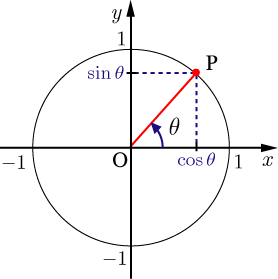
A circle with a radius of 1 is called a unit circle.
Usually, a unit circle is drawn with its center at the origin on a coordinate plane (see the diagram on the right). If the angle between the axis and the line segment is as shown in the diagram, the coordinates of a point on the unit circle are as follows, according to the definition of trigonometric functions:
****************************
Trigonomrtric Graphs
In Queensland Year 11 Mathematics, trigonometric graphs are Mathematical Methods applied to functions and relations. They are used to model periodic or cyclic real-world phenomena like ocean tides or pendulum swings. In General Mathematics, the focus is more on applications of trigonometry in right-angled and non-right-angled triangles rather than sketching and transforming the graphs themselves.
>> For Mathematical Methods Students
The Year 11 Mathematical Methods syllabus covers a detailed study of trigonometric functions and their corresponding graphs, including:
- Understanding the Unit Circle: Defining the sine (sin ), cosine (cos ), and tangent (tan ) functions using the unit circle and understanding their periodic nature.
- Angle Measurement: Using both degrees and radians, and converting between them (e.g., 360° = 2π radians).
- Sketching Basic Graphs: Recognising and sketching the graphs of , , and over extended domains.
- Key Features: Identifying the properties of these graphs:
- Period: The length of one complete cycle (e.g., 2π for sine and cosine, π for tangent).
- Amplitude: Half the distance between the maximum and minimum values (e.g., 1 for basic sine and cosine).
- Maximum/Minimum Values: The peak and trough values of the functions.
- Asymptotes: Vertical lines where the function is undefined (for the tangent function).
- Transformations: Investigating how parameters (A, B, C, D) affect the basic graphs to sketch functions of the form .
- Applications: Using trigonometric functions to model and solve practical problems involving periodic behaviour.
>> For General Mathematics Students
In General Mathematics, the focus is less on sketching and transforming the graphs and more on the application of trigonometric ratios to solve practical problems:
- Reviewing sine, cosine, and tangent as ratios of side lengths in right-angled triangles (SOH-CAH-TOA).
- Applying the Sine Rule and Cosine Rule to solve problems involving non-right-angled triangles.
- Calculating the area of a triangle using the formula Area = .
- Solving problems involving angles of elevation and depression and bearings.
************************
Trigonometric identities are
equalities involving trigonometric functions that are true for every value of the variable. In the Queensland (QLD) Year 11 Mathematical Methods syllabus, students focus on foundational identities, primarily the Pythagorean identity and ratio/reciprocal identities, which are used to simplify expressions and solve trigonometric equations.
Key Identities Covered in QLD Year 11.
The QLD syllabus assumes familiarity with basic trigonometry and introduces the following fundamental identities, often in the context of the unit circle and general angles:
- Pythagorean Identity: This is a fundamental identity derived from the Pythagorean theorem applied to the unit circle:
- Ratio Identity: This identity defines the tangent function in terms of sine and cosine:
- Reciprocal Identities: These define the other three trigonometric functions (cosecant, secant, and cotangent) as reciprocals of the primary functions: (also written as ), ,
Application in the QLD Syllabus
In Year 11, these identities are not just for memorisation; they are crucial tools for:
- Simplifying trigonometric expressions.
- Proving other, more complex identities (which usually involves manipulating one side of an equation to match the other, simpler side).
- Solving trigonometric equations within a specified domain (e.g., or ). This often involves converting all functions in an equation to a single function using identities.
- Understanding symmetry properties of trigonometric functions (e.g., ) which are also considered identities in the syllabus.
More advanced identities, such as the sum and difference of angles or double-angle formulas, are typically introduced in Year 12 Mathematical Methods or Specialist Mathematics, rather than Year 11.
****************************************************************************
11年生数学の応用三角法では、基本的な直角三角形の比(sin cos tan)を、ラジアン、単位円、三角関数のグラフ、恒等式、正弦・余弦定理といったより複雑な分野にまで拡張します。これにより、直角三角形以外の三角形の問題を解いたり、面積や弧の長さを求めたり、周期的な挙動をモデル化したりできるようになります。単純な三角形の辺や角度を求めるだけでなく、実社会への応用も視野に入れます。
主な概念を以下にまとめます。
• 直角三角形の枠を超えて:正弦定理(あらゆる三角形に適用)と余弦定理(あらゆる三角形に適用)を用いて、未知の辺や角度を求める方法を学びます。
• ラジアン:角度を度だけでなくラジアンで表し、それらの変換方法を理解します。これは微積分や高度な関数に不可欠です。
• 単位円と一般角:単位円を用いて、sin、cos、tanを任意の角度(正、負、360°以上)に拡張し、ASTC(All Students Take Calculus)を理解します。
• 三角関数のグラフ:y = sin(x)、y = cos(x)、y = tan(x)のグラフを描き、変換(振幅、周期、位相シフト)を検討して、波、音、振動をモデル化します。
• 三角関数の恒等式: のような恒等式を証明し、用いて複雑な式を簡略化します。
• 応用:扇形、弧の長さ、方位、航行、そしてより複雑な幾何学的シナリオを含む問題を解きます。
基本的に、11年生の応用三角法は、周期現象を記述し、幾何学と物理学における複雑な測定問題を解決するための強力なツールキットを構築します。
*************
正弦定理
正弦定理(または正弦定理)は、あらゆる三角形において、対応する角度がある場合に未知の辺を求めるため、または対応する辺と別の角度がある場合に未知の角度を求めるために使用されます。これは、直角でない三角形の辺とそれらの対角の正弦との関係を確立します。
式は次のように表されます。
ここで、a、b、c はそれぞれ角度 A、B、C の反対側の辺の長さです。
余弦定理
余弦定理(または余弦定理)は、ピタゴラスの定理をあらゆる三角形に一般化したものです。この式は主に、2辺と内角がわかっている三角形の3辺目を求める(SAS)、または3辺すべてがわかっている三角形の角度を求める(SSS)ために使用されます。
この式は、求めたい辺に応じて、以下の3つの形式で表すことができます。
また、角度を求めるように変形することもできます。例えば、角度 :
*****************************
ラジアン(弧度法)
QLD 11年生の数学(数学的方法)では、ラジアンは角度を測る標準的な方法であり、弧の長さが半径と等しい角度と定義されます。。円は2πラジアン(360°)なので、πラジアンは180°に等しくなります。ラジアンは微積分(三角関数の微分)において非常に重要であり、度ではなくπ(約3.14)を使用します。ラジアンを求めるには度に を掛けるなどの変換が必要です。また、円関数の単位円においてもラジアンが使用されます。
主要概念
• 定義:1ラジアンとは、円弧の長さが半径と正確に一致するときの円の中心における角度です。
• π との関係:
◦ 2π ラジアン = 360°(円)
◦ π ラジアン = 180°(直線/半円)
◦ ラジアン = 90°(直角)
• なぜラジアン?:ラジアンは数式を簡略化し、高等数学、特に微積分や円関数(三角法)を扱う際に不可欠です。
• 単位:ラジアンには通常記号はありませんが、小文字の「c」(円)または「rad」が使われることもあります。ただし、数学的な文脈では、記号がなくてもラジアンが意味を持つことはよくあります。
変換式
• 度からラジアンへ:角度(度)に を掛けます。
• ラジアンから度へ:角度(ラジアン)に を掛けます。
実践編
• 計算機モード:ラジアンを扱う際は、計算機が「RAD」モードになっていることを確認してください。
• 単位円: 単位円:半径が1の円 ( 1 ラジアス) 上の角度はラジアンで簡単に表すことができます (x 軸の値は π、2π などになります)。
半径の長さが1の円を単位円という.
通常 座標平面上の原点に円の中心をとり単位円を描く(右図参照).単位円上の点の座標 は,軸と線分のなす角を図のように とすると,三角関数の定義より
となる.
*************************************************************************
三角グラフ
クイーンズランド州の11年生数学では、三角グラフは関数と関係に適用される数学的手法です。海の潮汐や振り子の揺れといった、周期的または周期的な現実世界の現象をモデル化するために用いられます。一般数学では、グラフ自体の描画や変形よりも、直角三角形と非直角三角形における三角法の応用に重点が置かれます。
>> 数学的手法を学ぶ生徒の方へ
11年生数学的手法のシラバスでは、三角関数とそれに対応するグラフについて、以下の内容を含めて詳細に学習します。
• 単位円の理解:単位円を用いて正弦(sin )、余弦(cos )、正接(tan )関数を定義し、それらの周期性を理解する。
• 角度の測定:度とラジアンの両方を使用し、それらの変換を行います(例:360° = 2π ラジアン)。
• 基本グラフの描画:拡張された定義域における 、 and のグラフを認識し、描画します。
• 主な特徴:これらのグラフの特性を特定します。
◦ 周期:1周期の長さ(例:正弦関数と余弦関数の場合は2π、正接関数の場合はπ)。
◦ 振幅:最大値と最小値の間の距離の半分(例:基本的な正弦関数と余弦関数の場合は1)。
◦ 最大値/最小値:関数のピーク値と谷値。
◦ 漸近線:関数が定義されていない垂直線(正接関数の場合)。
• 変換:パラメータ(A、B、C、D)が基本グラフにどのように影響するかを調べ、 の形の関数を描画します。
• 応用:三角関数を用いて、周期的な挙動を伴う実用的な問題をモデル化し、解く。
>> 一般数学を学ぶ学生向け
一般数学では、グラフの描画や変換よりも、三角比を応用して実用的な問題を解くことに重点が置かれます。
• 直角三角形の辺の長さの比としての正弦、余弦、正接(SOH-CAH-TOA)を復習する。
• 正弦定理と余弦定理を用いて、直角でない三角形の問題を解く。
• 三角形の面積を、Area = という公式を用いて計算する。
• 仰角、俯角、方位角を含む問題を解く。
**********************************************************************
三角関数の恒等式
三角関数の恒等式は、変数のあらゆる値に対して成り立つ三角関数の等式です。クイーンズランド州(QLD)の11年生数学指導法のシラバスでは、生徒は基礎的な恒等式、特にピタゴラスの恒等式と比/逆数の恒等式に重点的に取り組みます。これらの恒等式は、式の簡略化や三角方程式の解法に用いられます。
QLD 11年生で扱う主要な恒等式
QLDのシラバスでは、基本的な三角法の知識を前提とし、単位円や一般的な角度の文脈で、以下の基本的な恒等式を導入します。
ピタゴラスの定理:これは、ピタゴラスの定理を単位円に適用することで得られる基本的な恒等式です。
比の恒等式:この恒等式は、正弦関数と余弦関数を用いて正接関数を定義します。
逆数の恒等式:これらは、他の3つの三角関数(コセカント、セカント、コタンジェント)を、基本関数の逆数として定義します。
( とも表記されます)
QLDシラバスにおける応用
11年生では、これらの恒等式は単なる暗記ではなく、以下のための重要なツールとなります。
三角関数の式を簡略化する。
より複雑な恒等式の証明(通常は、方程式の片辺をもう一方のより単純な辺と一致するように操作する)。
指定された領域(例: または ラジアン)内で三角関数の方程式を解く。これには、多くの場合、方程式内のすべての関数を恒等式を用いて単一の関数に変換することが含まれます。
シラバスでは恒等式とみなされる三角関数(例:)の対称性を理解すること。
角度の和と差、倍角の公式といったより高度な恒等式は、通常、11年生ではなく、12年生の数学メソッドまたは専門数学で導入されます。